



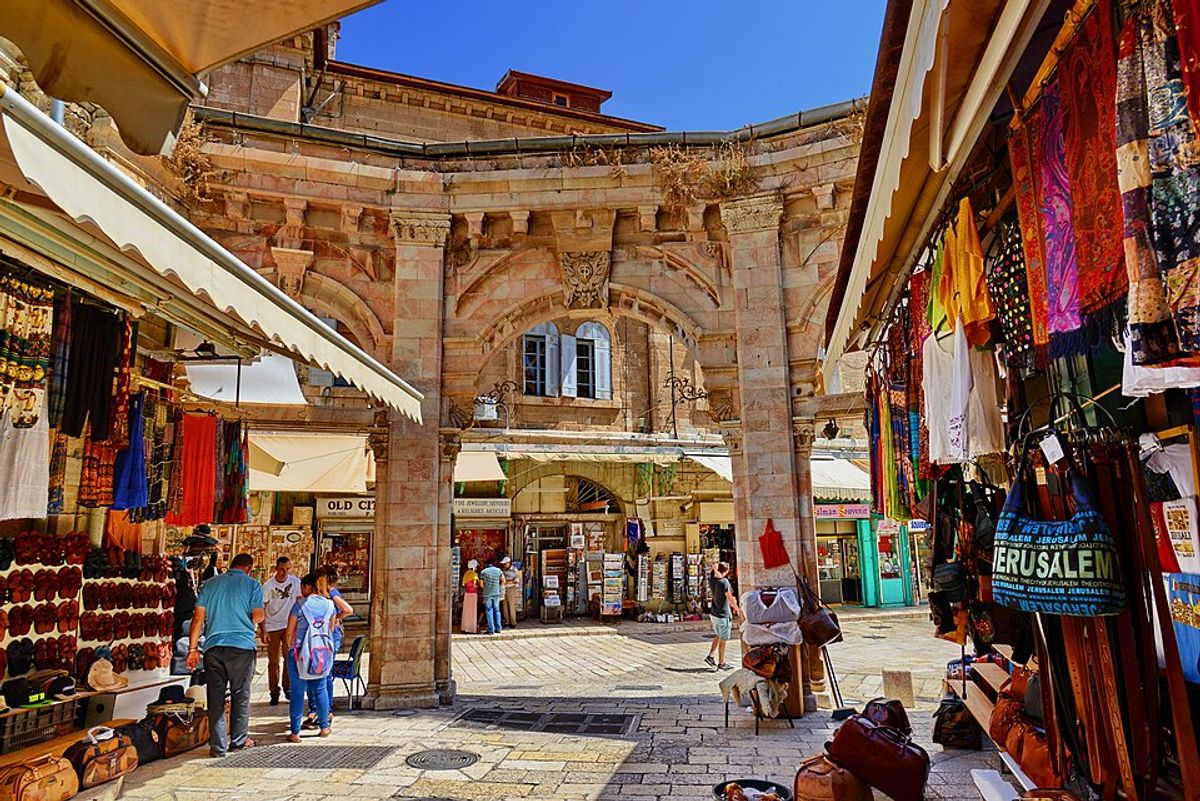
The Christian Quarter Jerusalem occupies the northwestern section of the Old City, centered on the Church of the Holy Sepulchre, the holiest site in Christianity. The quarter is home to approximately 40 Christian religious institutions, including churches, monasteries, pilgrim hospices, and patriarchates representing denominations from around the world: Greek Orthodox, Roman Catholic (Franciscan), Armenian, Coptic, Ethiopian, Syrian Orthodox, Lutheran, Anglican, and more. It is the most international quarter of the Old City, and every building tells a story of faith, politics, and the centuries-long competition among Christians for a foothold near the tomb of Christ.
Everything in the Christian Quarter revolves around the Church of the Holy Sepulchre, the site where tradition holds that Jesus was crucified, buried, and resurrected. The church, shared (and fought over) by six denominations, is the spiritual center of Christianity, and the streets that lead to it are the arteries of the quarter.
Patriarchs and Their Processions Jerusalem
The Greek Orthodox Patriarchate occupies a massive compound adjacent to the Holy Sepulchre, its entrance marked by a blue-trimmed doorway on the street leading from the Jaffa Gate. The Latin (Catholic) Patriarchate is located near the Jaffa Gate on Latin Patriarchate Road. The Armenian Patriarchate is within the Armenian Quarter. Each patriarch lives within walking distance of the Holy Sepulchre, and their ceremonial processions to the church are one of the great spectacles of Old City life.
When the Greek Orthodox Patriarch processes to the Holy Sepulchre for a major feast, he walks in full vestments through the narrow streets, preceded by kavasses (ceremonial guards) in Ottoman-era uniforms striking the pavement with silver-topped staffs. The procession parts the crowd, and the patriarch enters the church through the main door with a solemnity that has not changed in centuries. The Latin Patriarch arrives with Franciscan friars in brown habits, often accompanied by the sound of an organ from within the church. The Armenian Patriarch processes with clergy in pointed hoods carrying elaborate crosses. Witnessing these processions, with their robes, incense, chanting, and ancient protocol, is one of the most vivid experiences in Jerusalem. The processions are most frequent and most dramatic during Holy Week and Easter, when all three patriarchates celebrate in close succession.
Custodia di Terra Santa
The Franciscan Custody of the Holy Land (Custodia di Terra Santa) is the Catholic institution responsible for guarding and maintaining the holy sites in the name of the Roman Catholic Church. The Custody was established in 1342 by Pope Clement VI, who entrusted the Franciscan Order with the care of the Christian holy places in the Holy Land. For nearly 700 years, the Franciscans have maintained a continuous presence in Jerusalem, Bethlehem, Nazareth, and dozens of other sites across the region.
The Custody’s headquarters, the Monastery of St. Saviour (San Salvatore), is located in the Christian Quarter near the New Gate. The complex includes a church, a library, a printing press (one of the oldest in the Middle East, founded in 1847), a school, and the offices from which the Custody coordinates its work across the Holy Land. The Franciscan presence in the quarter is visible daily: the brown-robed friars are a constant sight on the streets, and the Franciscan-led procession along the Via Dolorosa every Friday afternoon at 3:00 PM is one of the most beloved traditions in Jerusalem.
Streets, Markets, and Denominations
The main arteries of the Christian Quarter run from the Jaffa Gate along David Street and Christian Quarter Road toward the Holy Sepulchre. The streets are lined with shops selling religious items: olive wood carvings, mother-of-pearl crosses, rosaries, icons, Armenian ceramics, candles, and embroidered vestments. The shops are run by Arab Christian families, many of whom have been in the quarter for generations. The quality varies enormously, from mass-produced souvenirs to genuine handcrafted pieces from Bethlehem and the Armenian workshops.
Walking through the Christian Quarter is walking through the full diversity of global Christianity. Greek Orthodox priests in black cassocks, Franciscan friars in brown habits, Armenian clergy in pointed hoods, Coptic monks in embroidered caps, and Ethiopian monks in white robes share the same narrow streets. Each denomination maintains its own compound, its own traditions, and its own liturgical calendar, and the overlap of feast days, processions, and services creates a constant hum of religious activity that never stops.
Hidden Churches
Beyond the major sites, the Christian Quarter is full of hidden churches and chapels that most visitors never find. The Church of Alexander Nevsky contains archaeological remains of the ancient city gate through which Jesus may have passed. The Church of St. John the Baptist in the Muristan is one of the oldest churches in Jerusalem, dating to the 11th century. The Ethiopian Chapel, accessed through a doorway on the roof of the Holy Sepulchre, is one of the most atmospheric spaces in the Old City. The Coptic Chapel of St. Michael, also on the roof, is barely larger than a closet but has been a place of worship for centuries. And behind unmarked doors throughout the quarter, small chapels, libraries, and monastic communities carry on traditions that have been unbroken for centuries.
The Christian Communities and Their Rooftop Disputes
The Christian Quarter has the most complex rooftop geography in the Old City. The roof of the Holy Sepulchre is itself a contested space, divided between the Ethiopians and the Copts. The dispute over Deir es-Sultan, the rooftop compound claimed by both communities, has involved legal battles, diplomatic interventions, and on at least one occasion, monks coming to blows. The Church of the Redeemer tower offers the best aerial view. And the Austrian Hospice rooftop, on the border with the Muslim Quarter, provides one of the finest panoramas in the city along with Viennese coffee and strudel.
The Arab Christian community of the quarter has been declining for decades due to emigration, economic pressure, and the political situation. The community is predominantly Greek Orthodox and Catholic, with smaller groups of Armenians, Copts, and Protestants. Despite the challenges, the community maintains its schools, cultural organizations, and social life. The Easter celebrations, when the quarter fills with processions from every denomination, candles, incense, and the sound of bells from a dozen churches ringing simultaneously, remain among the most vivid expressions of Christianity in the world.
Visit with Hoshen Tours
The Christian Quarter is home to the Church of the Holy Sepulchre, the holiest site in Christianity, and a wealth of historic churches and institutions. Your Hoshen Tours guide will take you through the Muristan with its Crusader-era history, to the Alexander Nevsky Church with its ancient archaeological finds, and up to Deir es-Sultan on the rooftop of the Holy Sepulchre. The quarter is easily reached through Jaffa Gate, making it an ideal starting point for a day of exploration. Hoshen Tours often combines this site with Sephardic Synagogues, Deir es-Sultan, and Sisters of Zion for a memorable day exploring the region.
Explore Our Tour Collection
Ready to experience Israel in true colors?
Plan Your TourPrivate tours designed around your interests, schedule, and pace.