



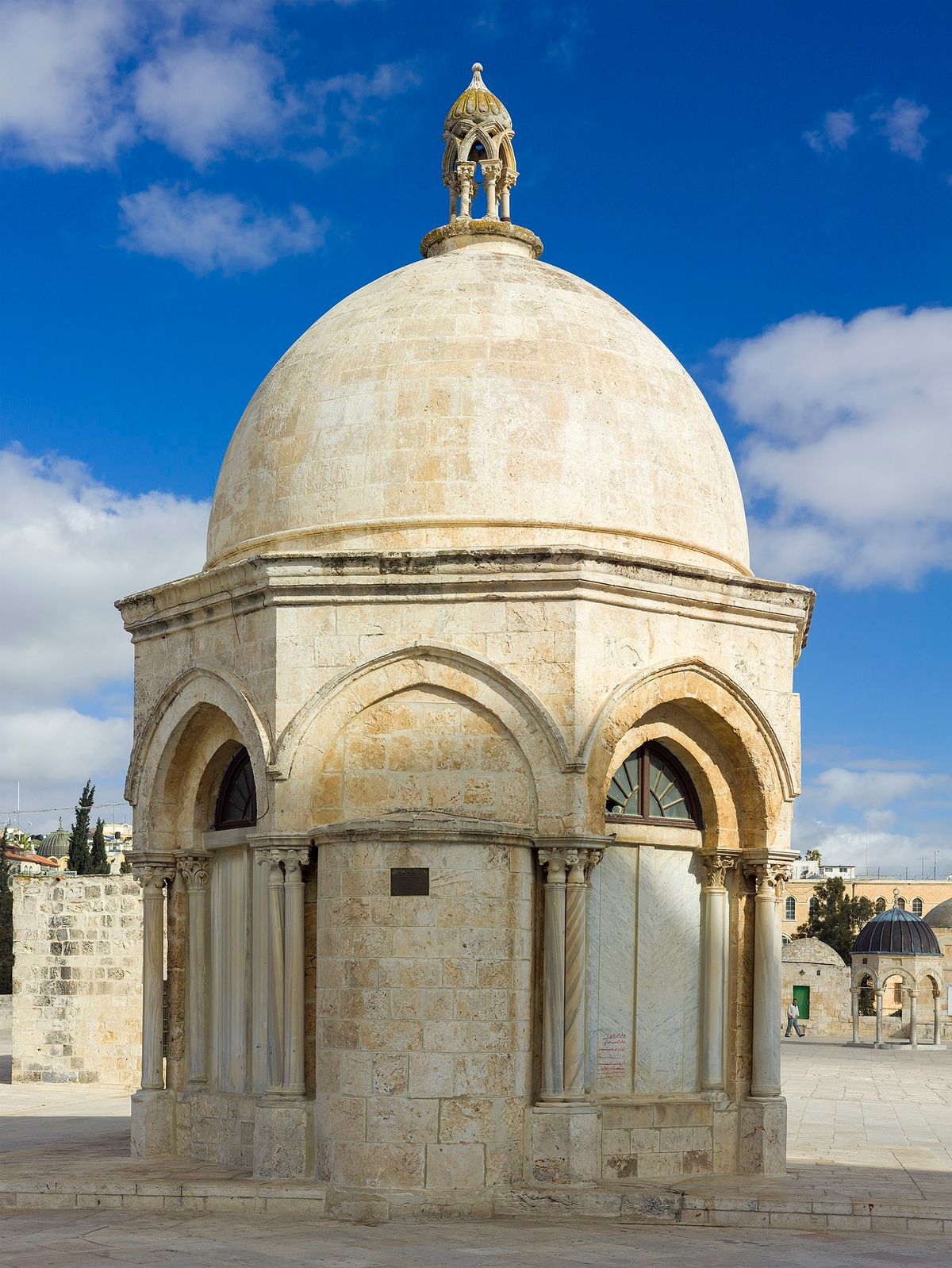
At the summit of the Mount of Olives stands the Chapel of the Ascension, a small octagonal structure marking the place where, according to tradition, Jesus ascended to heaven 40 days after the resurrection: “He was taken up before their very eyes, and a cloud hid him from their sight. They were looking intently up into the sky as he was going, when suddenly two men dressed in white stood beside them. ‘Men of Galilee,’ they said, ‘why do you stand here looking into the sky?’” (Acts 1:9-11).
The Last Footprint
The stone in the center of the chapel floor bears a depression that pilgrims have venerated as the footprint of Jesus at the moment of ascension since at least the 4th century. The impression in the rock, roughly the shape of a right foot, is worn smooth by centuries of touching. Whether it is a natural formation or was carved to conform to the tradition, it has served as a physical anchor for the ascension story for over 1,600 years.
From Church to Mosque
The original Byzantine church built here in the 4th century was open to the sky, a deliberately roofless structure symbolizing the open heaven through which Jesus ascended. The design was unique and architecturally ambitious: a circular church with no dome, leaving the worshippers exposed to the sky above the spot where tradition holds Jesus was last seen on earth.
When Saladin captured Jerusalem in 1187, the church was converted to a mosque, the walls were partially rebuilt, and a dome was added, closing the sky that the Byzantine architects had deliberately left open. The minaret was added later. Today, the site is administered by the Islamic Waqf but is open to Christian pilgrims. On Ascension Day (40 days after Easter), the different Christian denominations hold services in and around the chapel, each in their own liturgical tradition.
Theological Meaning
The Ascension is one of the pivotal events in Christian theology. It marks the moment when Jesus’s earthly ministry ended and his heavenly reign began. In the Gospel of Luke, the ascension is described as both an ending and a promise: the two men in white (angels) told the stunned disciples, “This same Jesus, who has been taken from you into heaven, will come back in the same way you have seen him go into heaven” (Acts 1:11). For Christians, the Mount of Olives is believed to be not only where Jesus left the earth but also where he will return.
Jewish tradition shares this expectation in a different form. The prophet Zechariah wrote: “On that day his feet will stand on the Mount of Olives, east of Jerusalem, and the Mount of Olives will be split in two from east to west” (Zechariah 14:4). Both traditions, Jewish and Christian, look to this mountain for the great event that will transform the world. The Mount of Olives is, quite literally, the mountain of the future.
Russian Tower
Near the Chapel of the Ascension, the Russian Orthodox Church built the Tower of the Ascension (also called the Russian Candle) in the 1870s, a tall, slender bell tower that is one of the highest points on the Mount of Olives. The tower offers views that rival the main viewpoint and is less crowded. The Russian compound also includes a church and a convent, adding another layer to the multi-denominational character of the mountain’s summit.
The small chapel sits within a larger compound that includes the minaret, a courtyard, and the remains of the Crusader-era church. The compound is modest and often uncrowded, which gives visitors time to absorb the story without the pressure of crowds.
Visit with Hoshen Tours
The Church of the Ascension stands at the summit of the Mount of Olives, marking the place where tradition holds that Jesus ascended to heaven. With Hoshen Tours, the visit begins here and continues downhill through the Church of Pater Noster and the Palm Sunday Road, descending past the Tomb of the Virgin Mary into the Kidron Valley at the base.
Explore Our Tour Collection
Ready to experience Israel in true colors?
Plan Your TourPrivate tours designed around your interests, schedule, and pace.