



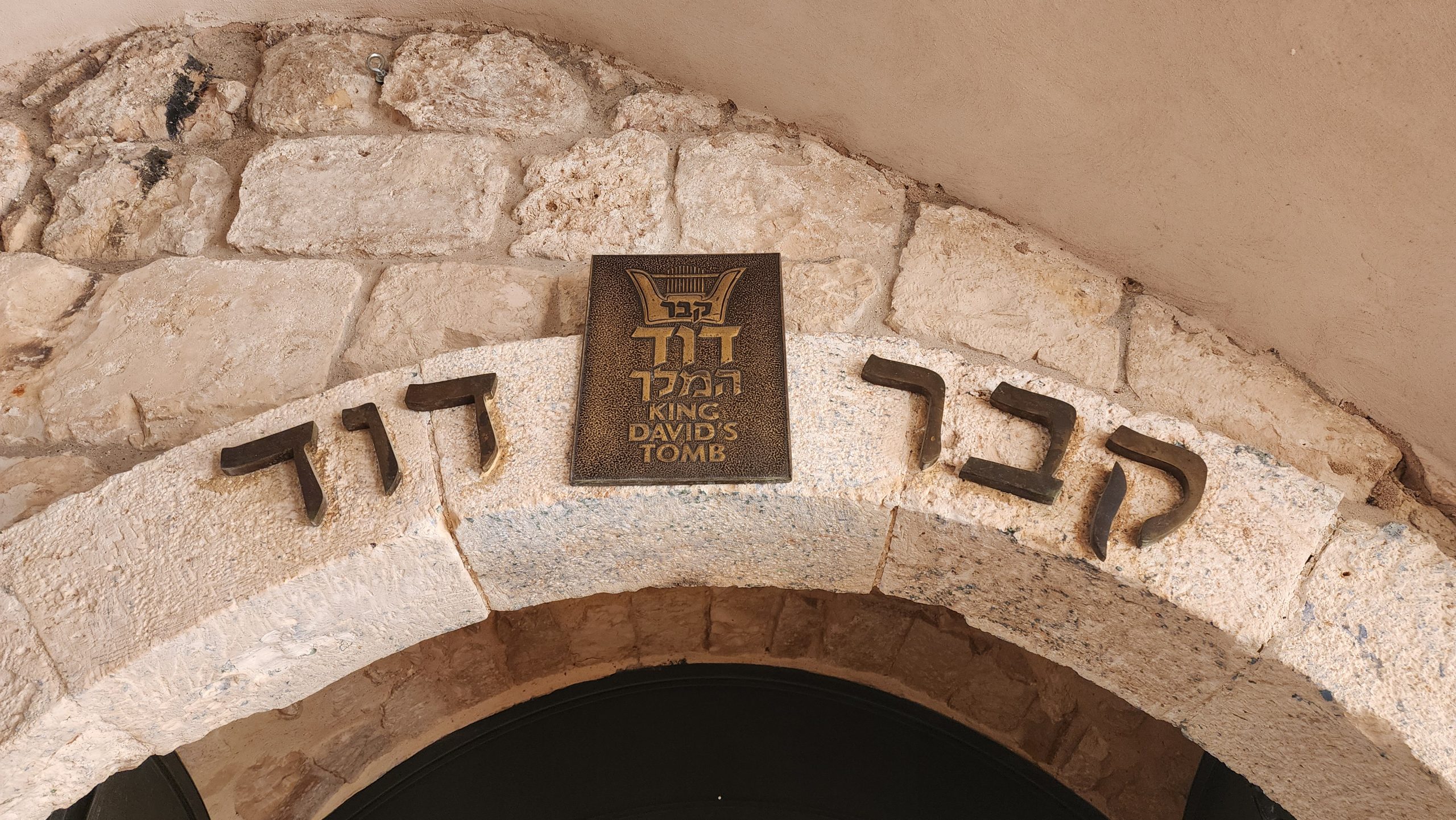
The Tomb of King David in Israel is one of the most historically layered buildings in Jerusalem. Located on Mount Zion, just outside the walls of the Old City, the two-story structure houses a Jewish cenotaph on the ground floor and the Cenacle (the room of the Last Supper) on the floor above. The building has been a church, a mosque, a synagogue, and a national pilgrimage site, and its story touches Judaism, Christianity, and Islam in ways that are impossible to untangle.
David and Jerusalem
David conquered the Jebusite city and made it his capital, unifying the twelve tribes under one crown (2 Samuel 5:6-10). He brought the Ark of the Covenant to Jerusalem from Kiryat Ye’arim, dancing before it in the streets (2 Samuel 6), and established Jerusalem as the spiritual center of Israel. When a plague struck the nation after David’s census, the angel of the Lord stopped at the threshing floor of Araunah the Jebusite on Mount Moriah. David purchased the threshing floor and built an altar there (2 Samuel 24:18-25). That spot became the site of Solomon’s Temple. David himself did not build the Temple, but he prepared everything for it: the plans, the materials, the treasury. When he died, “David slept with his fathers and was buried in the City of David” (1 Kings 2:10).
The Tradition and the Problem
The Bible is clear that David was buried in the City of David, the narrow ridge south of the Temple Mount now known as the City of David archaeological site. Mount Zion, where the traditional tomb stands today, was not inhabited during David’s time. Modern archaeologists are unanimous on this point. So how did the tradition move here? After the Roman destruction of Jerusalem in 70 CE, and especially after the Bar Kokhba Revolt of 132-135 CE, when Hadrian rebuilt the city as Aelia Capitolina, knowledge of the original burial site was gradually lost. By the early Muslim period, a new tradition had taken root associating David’s tomb with this hilltop. The 12th-century Jewish traveler Benjamin of Tudela recorded a story of two workers who tunneled into a marble palace beneath the site and found a golden scepter and crown before being driven away by mysterious voices. The story helped cement the Mount Zion identification in Jewish consciousness, and by the Crusader period it was firmly established.
The Building Through the Ages
The Crusaders built the two-story structure that largely survives today and created the Gothic cenotaph, an ornamental stone sarcophagus, that visitors see in the tomb chamber. In 1342, the Franciscans acquired the upper floor (the Cenacle) and established their headquarters there. Less than a century later, in 1429, the Mamluks took the lower floor and converted the tomb chamber into a mosque, adding a mihrab (prayer niche). Under Suleiman the Magnificent in 1551, the Ottomans permanently expelled the Franciscans from the entire building from the entire building and added a minaret. The Dajani family was appointed as custodians of the shrine, which became known as Maqam al-Nabi Daoud (Sanctuary of the Prophet David), since David is honored as a prophet in Islam. The building remained a Muslim shrine until 1948.
1948-1967: The Holiest Accessible Site
When the Old City fell under Jordanian control in 1948, Jews lost access to the Western Wall and every holy site within the walls. Mount Zion, however, remained on the Israeli side of the armistice line. Overnight, the Tomb of David became the holiest Jewish site accessible in Israel. For nineteen years, from 1948 to 1967, Jewish pilgrims who could not reach the Western Wall came here instead. They prayed at the cenotaph and climbed to the rooftop to gaze toward the Temple Mount and the Old City, visible but unreachable. The cenotaph was draped with a blue cloth embroidered with crowns, Torah finials, and Hebrew inscriptions. Hundreds visited daily. After the Six-Day War reunified Jerusalem, the Western Wall was accessible again, but the Tomb of David retained its sanctity. Today the Diaspora Yeshiva, a seminary known for attracting returnees to Judaism, operates in the building.
Visit with Hoshen Tours
The Tomb of David stands at the center of the Mount Zion complex, steps from the Cenacle above and the Dormition Abbey nearby. Hoshen Tours tells the story of how a biblical king’s memory migrated from one hill to another, and how a building that has been a church, a mosque, and a substitute Western Wall became one of the most contested and meaningful sites in Jerusalem. Hoshen Tours often combines this site with Herzl Museum, Haas Promenade, and Zion Gate for a memorable day exploring the region.
Explore Our Tour Collection
Ready to experience Israel in true colors?
Plan Your TourPrivate tours designed around your interests, schedule, and pace.