



The Palm Sunday Road traces the path that, according to the Gospels, Jesus took when he rode a donkey from the village of Bethphage, on the eastern slope of the Mount of Olives, down the mountain and into Jerusalem. The crowds lined the road, spreading their cloaks and palm branches on the ground, and shouted: “Hosanna to the Son of David! Blessed is he who comes in the name of the Lord! Hosanna in the highest heaven!” (Matthew 21:9). The event, celebrated on Palm Sunday, marks the beginning of Holy Week, the final week of Jesus’ life.
Jesus Enters Jerusalem: The Gospel Account
Jesus had sent two disciples ahead to the village of Bethphage with specific instructions: “Go to the village ahead of you, and at once you will find a donkey tied there, with her colt by her. Untie them and bring them to me” (Matthew 21:2). The choice of a donkey was deliberate and prophetic. The prophet Zechariah had written: “Rejoice greatly, Daughter Zion! See, your king comes to you, righteous and victorious, lowly and riding on a donkey, on a colt, the foal of a donkey” (Zechariah 9:9). By riding a donkey rather than a horse, Jesus was declaring himself a king of peace, not a military conqueror, and fulfilling a prophecy that his audience would have recognized immediately.
The crowd’s reaction was electric. They spread their cloaks on the road, cut branches from the trees, and shouted “Hosanna,” a Hebrew word meaning “save us” that had become a cry of praise. The Pharisees, alarmed by the messianic overtones, told Jesus to silence his followers. His response was characteristic: “I tell you, if they keep quiet, the stones will cry out” (Luke 19:40).
From Bethphage to Gethsemane
The Palm Sunday Road descends the western slope of the Mount of Olives, passing the Dominus Flevit church (where tradition holds Jesus wept over the city during this same descent), the Church of Mary Magdalene, and Gethsemane at the foot. The road then crosses the Kidron Valley and enters the Old City.
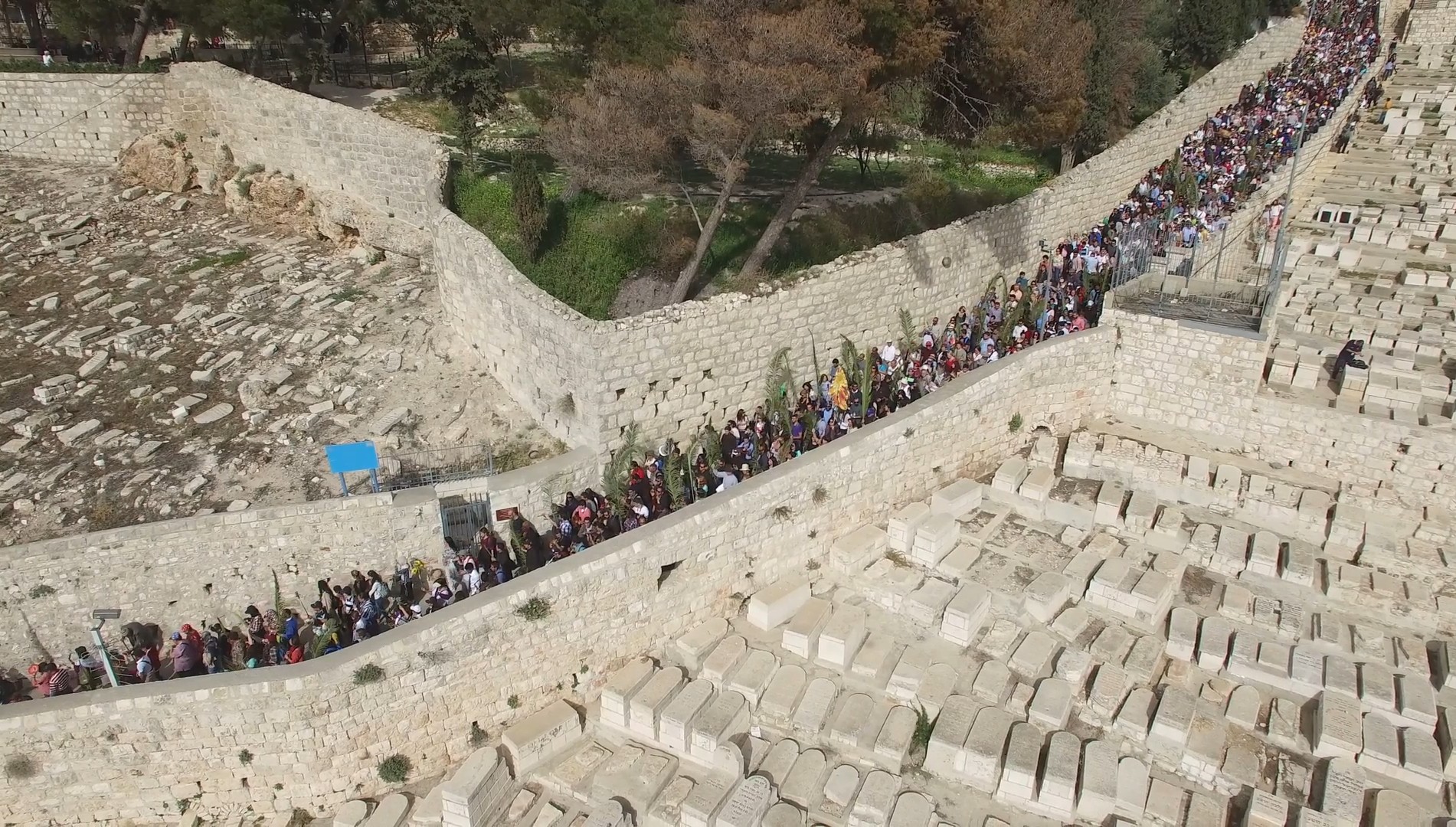
The route is still walked today. On Palm Sunday, thousands of Christian pilgrims gather at Bethphage, carry palm branches, and process down the mountain singing hymns, retracing the path that Jesus rode 2,000 years ago. The procession, organized by the Franciscan Custody of the Holy Land, is one of the most moving public ceremonies in Jerusalem, and the sight of thousands of people carrying palms down the Mount of Olives toward the Old City walls is unforgettable.
The starting point of the procession is the Franciscan chapel at Bethphage, on the eastern slope of the Mount of Olives near the village of et-Tur. The chapel contains a stone block (the “Bethphage Stone”) painted with medieval frescoes depicting the triumphal entry, the raising of Lazarus, and other scenes. The stone is believed to be the mounting block from which Jesus climbed onto the donkey. The chapel is small and rarely crowded outside of Palm Sunday, and the frescoes, though faded, are among the most charming medieval paintings in Jerusalem.
The triumphal entry is inseparable from what followed. Five days after the crowds shouted “Hosanna,” many of the same people would shout “Crucify him.” The Palm Sunday Road that descends in joy is the same mountain where, days later, Jesus would weep over the city (Dominus Flevit), teach the Lord’s Prayer (Pater Noster), pray in agony (Gethsemane), and be arrested. Walking the Palm Sunday Road with this knowledge transforms a pleasant downhill walk into a meditation on the distance between triumph and suffering.
Walking the Palm Sunday Road Jerusalem Today
The Palm Sunday route remains one of the most meaningful walks in Jerusalem for Christian visitors. The path descends from the summit of the Mount of Olives through the village of et-Tur, past the Dominus Flevit chapel, through the Garden of Gethsemane, and across the Kidron Valley to the Lions’ Gate. On Palm Sunday itself, thousands of pilgrims from churches around the world walk the route carrying palm branches and singing hymns, recreating the procession that the Gospels describe. The experience of walking downhill toward the Old City walls, with the golden Dome of the Rock growing larger with every step, gives the Gospel narrative a physical reality that no amount of reading can provide.
Visit with Hoshen Tours
Walking the Palm Sunday Road with Hoshen Tours means retracing the path of the Triumphal Entry from the summit of the Mount of Olives down toward the Old City. The route passes the Church of the Ascension and the Church of Pater Noster near the top, then descends past Dominus Flevit to the Tomb of the Virgin Mary and the Garden of Gethsemane at the base of the Kidron Valley.
Ready to experience Israel in true colors?
Plan Your TourPrivate tours designed around your interests, schedule, and pace.