



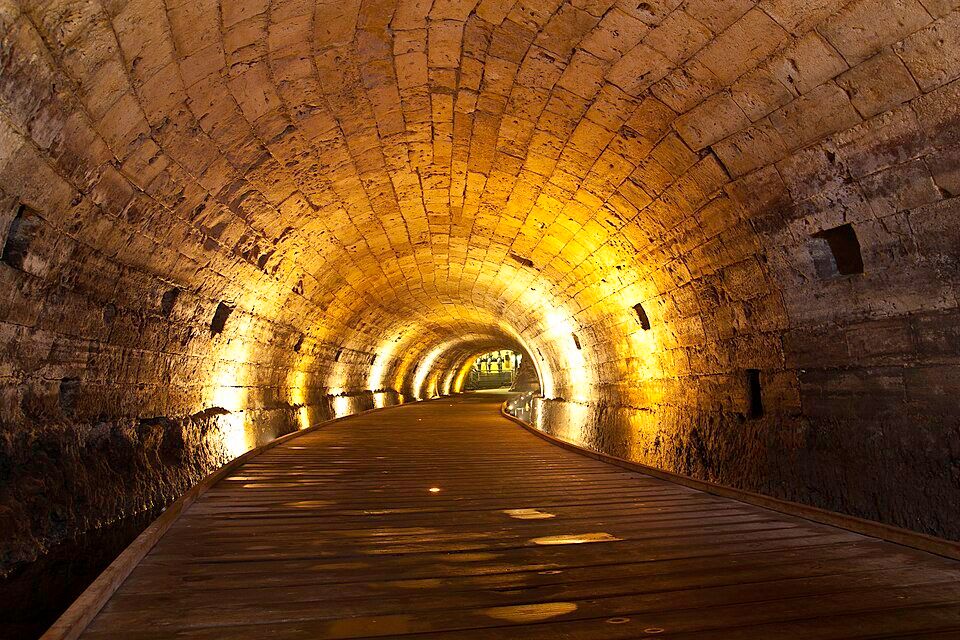
In 1994, a woman in Akko’s old city noticed flooding in her home and called in workers to investigate. They did not find a burst pipe. Beneath her floor lay a 150-meter-long medieval tunnel, built by the Knights Templar some 800 years earlier, running from the Templar fortress in the southwestern corner of the old city to the port. Sealed and forgotten for seven centuries, the tunnel is now one of the most dramatic archaeological experiences in Israel.
The Knights Templar
The Knights Templar were a military-religious order founded in 1119 by a small group of French knights who pledged to protect Christian pilgrims on the dangerous roads of the Holy Land. They established their first headquarters on the Temple Mount in Jerusalem, in the building the Crusaders identified as the Temple of Solomon, and it is from that location that they took their name. Over the following decades the order grew into one of the most powerful and wealthy institutions in the medieval world, with a network of commanderies across Europe, a sophisticated banking operation that allowed pilgrims to deposit funds at home and withdraw them in the Holy Land, and a formidable military presence throughout the Crusader states.
After Saladin’s victory at the Battle of Hattin in 1187 and the subsequent fall of Jerusalem, the Templars relocated their headquarters to Akko following the city’s recapture by the Third Crusade in 1191. They built their fortress at the southwestern corner of the city, a fortified compound that rivaled the Hospitallers’ complex in scale and sophistication. For a century, Akko was the capital of the Crusader Kingdom, and the Templar fortress was one of its most imposing structures.
The Templar Tunnel to the Port
The tunnel runs approximately 150 meters in a straight line beneath the old city, connecting the Templar fortress to the port. It was built in the 12th or 13th century as a strategic underground passage: a secure route for moving supplies, treasure, and personnel between the two most vital points in the Templar quarter without exposure to the streets above. In a city as crowded and politically fractious as Crusader Akko, where rival merchant republics and military orders competed fiercely,the ability to move unobserved was a genuine military asset. The tunnel also served as an escape route to the harbor, a last resort if the fortress walls were breached.
The passage is cut through bedrock and lined with dressed stone, its barrel-vaulted ceiling high enough to walk through upright. The construction is solid and deliberate, this was not a hasty excavation but a planned piece of military engineering, built to last and built to function under pressure.
Discovery
The tunnel’s rediscovery in 1994 was entirely accidental. A woman living in the old city reported flooding beneath her house. When workers came to investigate, they broke through into the medieval passage below her floor. Archaeologists followed, and excavations revealed the full length of the tunnel, intact and remarkably well-preserved after more than 700 years of burial. The find transformed the understanding of the Templar presence in Akko and added one of the most visited sites in the old city to the archaeological map. It was the kind of discovery that reminds visitors that in a city like Akko, the medieval world is not a remote abstraction, it is directly underfoot. Walking the tunnel today, it is easy to imagine armored knights hauling crates of supplies through this same corridor, torchlight flickering on the vaulted stone, their footsteps the only sound beneath a city that never knew they were passing below.
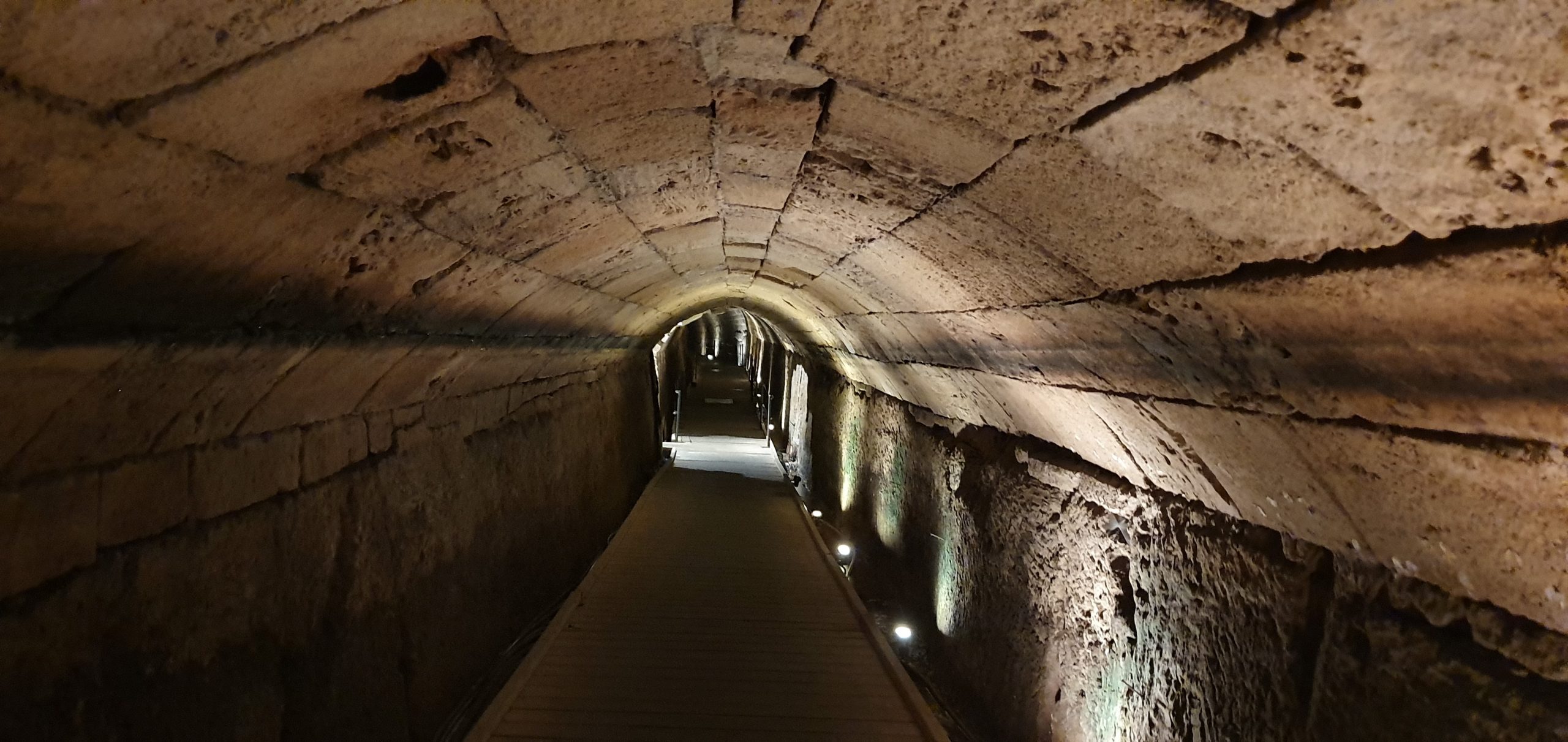 Entering the tunnel today, visitors pass from the sunlit stone streets of the old city into a narrow, dim corridor of dressed Crusader masonry. Atmospheric lighting illuminates the vaulted ceiling and the worn stone underfoot. The echo of footsteps carries in the enclosed space, and the air is cool and still. Walking 150 meters through an 800-year-old underground passage, knowing it was built by one of the most famous orders in medieval history, is an experience that no museum description quite prepares you for. At the far end, the tunnel emerges near the port, and visitors step back into daylight on the edge of the ancient harbor where Templar ships once anchored.
The End of the Templars
The Knights Templar were expelled from the Holy Land when Akko fell to the Mamluks in 1291, the last Crusader stronghold in the Levant. They retreated first to Cyprus and then to Western Europe, where their enormous wealth and secretive reputation made them a target. In 1307, King Philip IV of France, deeply in debt to the order,ordered the mass arrest of the Templars in France. Under torture, many confessed to heresy and other charges. Pope Clement V, under pressure from the French crown, dissolved the order at the Council of Vienne in 1312. Jacques de Molay, the last Grand Master of the Knights Templar, was burned at the stake in Paris in 1314, maintaining his innocence to the end. The order that had built the tunnel beneath Akko was gone within a generation of losing the city.
Visit with Hoshen Tours
A visit to Templar Tunnel in Akko pairs beautifully with nearby destinations along your route. Consider combining it with a stop at Knights Halls in Akko or Tunisian Synagogue in Akko, both just a short drive away. Many travelers also enjoy exploring Akko Prison and Akko on the same day, while Rosh HaNikra offers another worthwhile addition to your itinerary. Your Hoshen Tours guide will craft a seamless route that brings each destination to life with expert commentary and insider knowledge.
Explore Our Tour Collection
Ready to experience Israel in true colors?
Plan Your TourPrivate tours designed around your interests, schedule, and pace.