



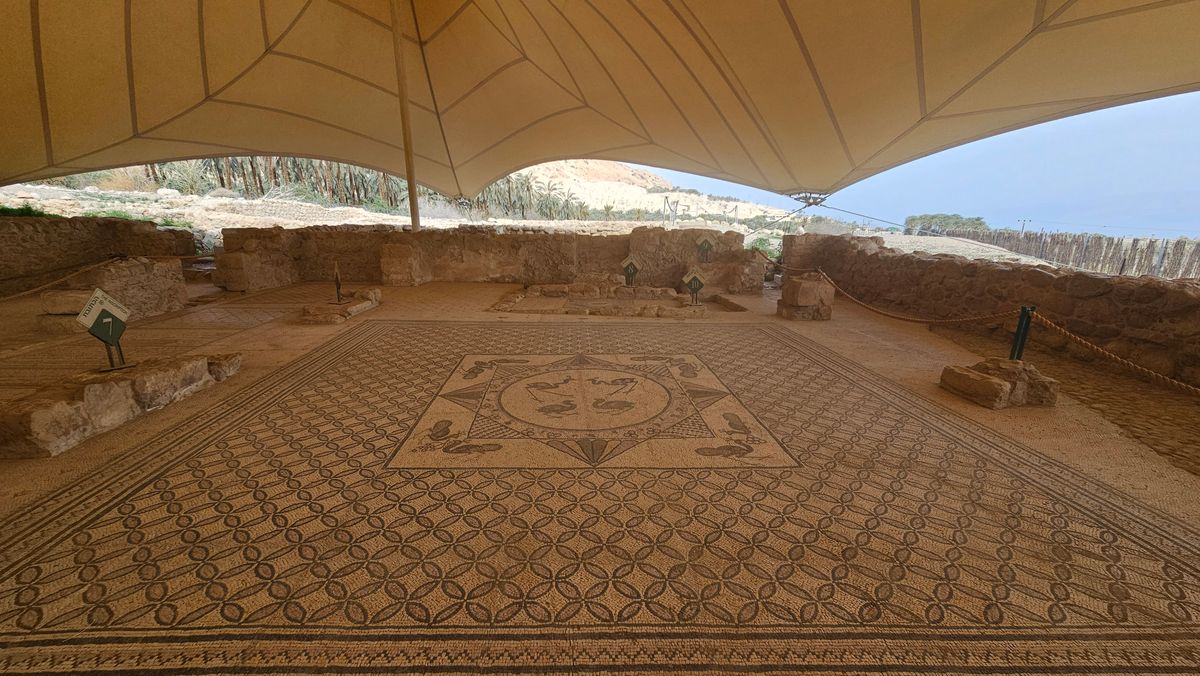
On the slope above Ein Gedi, the remains of an ancient synagogue from the Byzantine period (5th-6th century CE) contain one of the most intriguing inscriptions ever found in Israel: a curse against anyone who reveals “the secret of the town.” The secret, scholars believe, was the formula for producing balsam (afarsemon), the precious perfume and medicinal oil that made Ein Gedi one of the wealthiest communities in the ancient world.
Balsam Industry
Ein Gedi was famous in antiquity for its balsam plantations. The balsam tree (Commiphora gileadensis) produced a resin that was one of the most expensive substances in the ancient world, worth more than its weight in gold. The Roman historian Pliny the Elder described the balsam of Ein Gedi as the finest available, and Josephus records that the balsam groves were so valuable that during the Great Revolt (66-70 CE), the Jewish defenders tried to destroy the plantations to prevent them from falling into Roman hands, while the Romans fought to save the trees.
The balsam was used in Temple incense, in medicine, in perfumery, and as a luxury trade good exported across the Roman Empire. The production process was a closely guarded secret, known only to the families of Ein Gedi, and the synagogue inscription was the community’s way of protecting its most valuable asset: “Anyone who reveals the secret of the town to the gentiles, the One whose eyes roam the entire earth and who sees what is hidden will uproot that person and his seed from under the sun.”
Facing Jerusalem
The synagogue faces north, toward Jerusalem. This orientation is significant: most ancient synagogues in Israel were oriented toward Jerusalem as the direction of prayer, and for a synagogue south of Jerusalem, this means facing north rather than the more common southward orientation found in Galilee synagogues. Ein Gedi is one of the few examples of an ancient synagogue south of Jerusalem where this northward orientation is clearly preserved, providing evidence for the practice described in the Talmud of praying in the direction of the Temple.
The Mosaic Floor and Its Curse Inscription
The synagogue floor features two mosaic carpets with geometric patterns of squares and triangles, decorated with images of plants and birds. In the four corners of the central mosaic, pairs of male peacocks are depicted, each pair holding a round cluster of grapes. In the central circle, two cranes and two purple swamphens (porphyrio) are portrayed, birds that were likely very common in the Land of Israel in antiquity. Small menorah motifs surround the central carpet.
A separate find was a small cast bronze menorah with seven branches, measuring just 22 cm by 14 cm, which was apparently part of the decoration of the Torah ark.
The inscription panel, in Hebrew and Aramaic, lists the generations from Adam to Japheth, the twelve months of the Hebrew calendar, the three patriarchs (Abraham, Isaac, Jacob), and then delivers the curse.
The Jewish Community of Ein Gedi
The synagogue confirms that a prosperous Jewish community lived at Ein Gedi during the Byzantine period, sustained by the balsam trade and the agricultural potential of the oasis. The community was wealthy enough to build a synagogue with fine mosaics and to maintain its secret industry for centuries. The balsam trees of Ein Gedi eventually disappeared, probably destroyed during the Muslim conquest in the 7th century, and the secret of their cultivation was lost. Modern attempts to identify and re-cultivate the biblical balsam tree are ongoing, with several candidates being tested in the Ein Gedi area and at Neot Kedumim.
The synagogue is located on the slope between the Kibbutz Ein Gedi and the Dead Sea shore. The remains include the mosaic floor (covered by a protective shelter), the walls of the synagogue building, and a ritual bath (mikveh). The views from the synagogue toward the Dead Sea and the mountains of Jordan are spectacular.
Visit with Hoshen Tours
The ancient synagogue makes a perfect short stop on any Ein Gedi visit. Hoshen Tours pairs it with the nature reserve at Ein Gedi, a float at the Dead Sea, the hidden the Bar Kokhba Caves, and the scroll site at Qumran. We bring the mosaic floor and its mysterious inscription to life.
Explore Our Tour Collection
Ready to experience Israel in true colors?
Plan Your TourPrivate tours designed around your interests, schedule, and pace.