



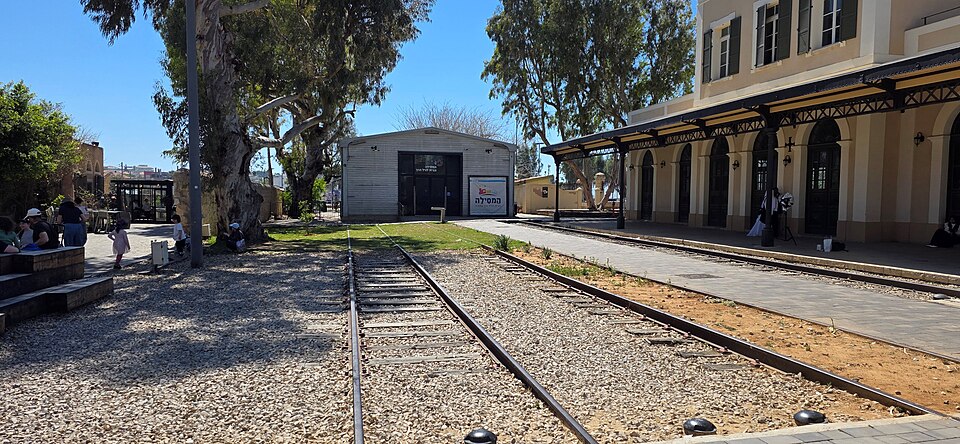
HaTachana (“The Station”) is the restored Ottoman-era railway station at the southern edge of Tel Aviv, where the first train in the Holy Land pulled in from Jerusalem on September 26, 1892. Today the stone buildings and original platforms house restaurants, cafes, boutiques, and galleries, a beautifully preserved compound where the iron tracks still run between the tables.
Decline and Revival
Rail service from the station ceased during the 1948 War of Independence, when fighting between Jewish and Arab forces severed the line. The compound was used for various purposes over the following decades but gradually fell into disrepair. In 2010, the station was restored and reopened as an open-air commercial and cultural compound. The original railway tracks have been preserved as part of the design, running through the center of the complex. The stone buildings now house restaurants, designer shops, a chocolate boutique, and event spaces.
The First Railway in the Holy Land
The Jaffa, Jerusalem railway was not just the first railway in Palestine. It was the first in the entire Ottoman Levant. The concession was obtained by Joseph Navon, a Jewish entrepreneur from Jerusalem, in 1888. A French company built the line: 87 kilometers of narrow-gauge track climbing from sea level at Jaffa through the coastal plain, up the narrow Sorek Valley, and through the Judean hills to Jerusalem at 800 meters. The inaugural journey on September 26, 1892, took approximately three and a half hours, a fraction of the two-day journey by horse and carriage. The railway transformed travel to the Holy City, bringing pilgrims, tourists, and immigrants to Jerusalem in comfort for the first time. For decades, the Jaffa terminus, this station, was the gateway to the Holy Land.
The Station Today
The restored compound preserves the original Ottoman-era station building, the passenger platforms, and the railway tracks that run between the restaurants and shops. Weekend markets, cultural events, and exhibitions take place in the old buildings. The complex connects Neve Tzedek to the south and Jaffa to the west, making it a natural crossroads for walking between the oldest neighborhoods and the ancient port.
Visit with Hoshen Tours
A visit to HaTachana pairs beautifully with nearby destinations along your route. Consider combining it with a stop at Tel Aviv or Neve Tzedek, both just a short drive away. Many travelers also enjoy exploring Jaffa and Carmel Market on the same day, while Rothschild Boulevard offers another worthwhile addition to your itinerary. Your Hoshen Tours guide will craft a seamless route that brings each destination to life with expert commentary and insider knowledge.
Explore Our Tour Collection
Ready to experience Israel in true colors?
Plan Your TourPrivate tours designed around your interests, schedule, and pace.