



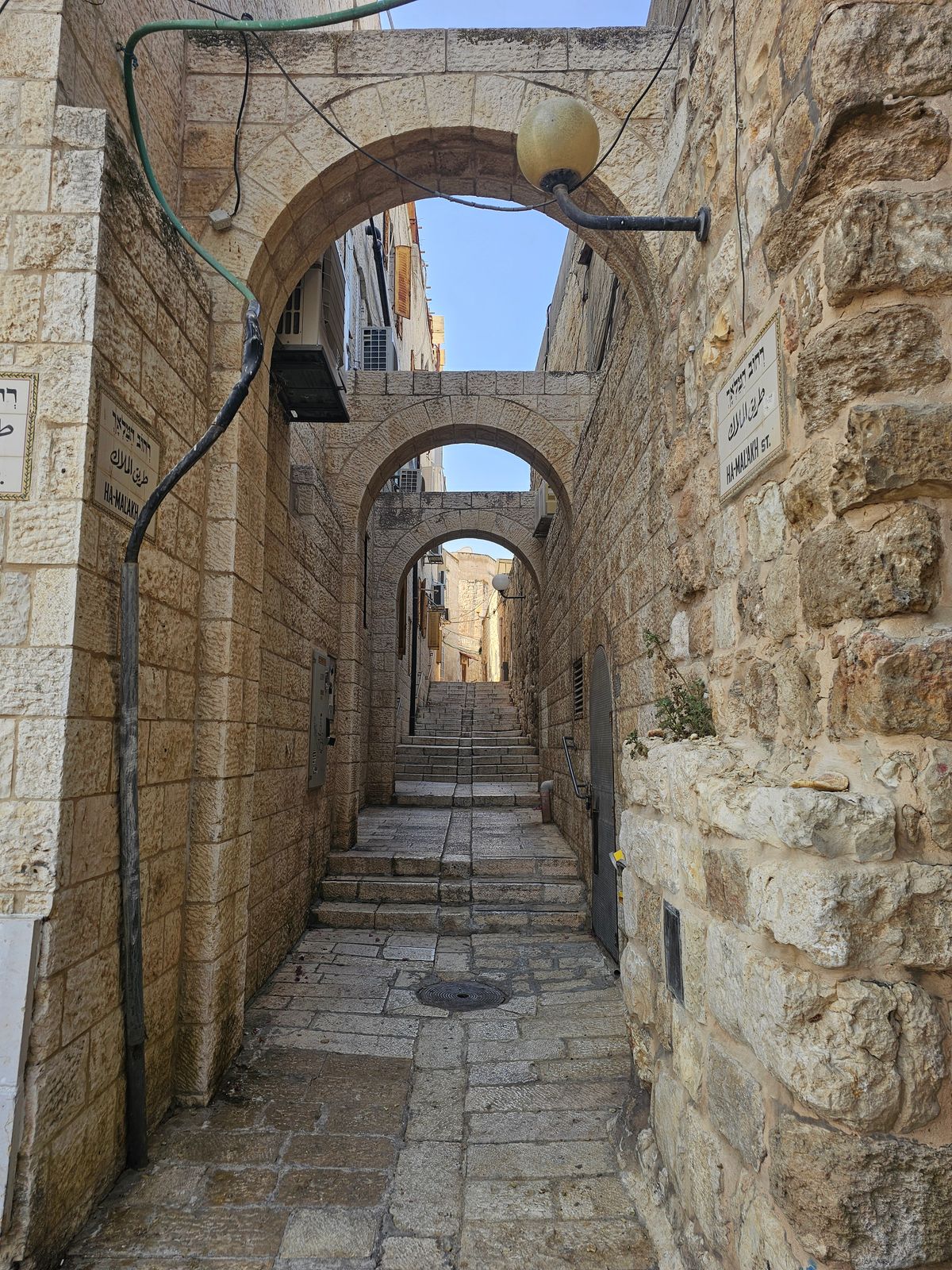
The Jewish Quarter Jerusalem occupies the southeastern section of the Old City, a neighborhood of honey-colored stone, clean streets, and archaeological discoveries at every turn. The quarter has been destroyed and rebuilt more times than any other part of the Old City, most recently after the 1948 war when Jordan captured the Old City and demolished most of the quarter’s synagogues. After Israel recaptured the Old City in 1967, the quarter was rebuilt, and the reconstruction uncovered some of the most important archaeological finds in Jerusalem.
Archaeological Discoveries Jerusalem
The rebuilding of the Jewish Quarter in the 1970s and 1980s was accompanied by extensive archaeological excavations. The discoveries were extraordinary: the Broad Wall from the 8th century BCE, the Burnt House from the Roman destruction of 70 CE, the Herodian Quarter with its palatial mansions, the Byzantine Cardo, and the ruins of the Nea Church. The quarter is as much an open-air museum as a residential neighborhood.
Synagogues Old and New
The Hurva Synagogue, with its white dome visible from across the city, is the quarter’s most prominent landmark. But the quarter also contains the Four Sephardic Synagogues, a cluster of 16th-17th century synagogues that served the Sephardic community for over 300 years. The Ramban Synagogue, established in 1267 by the great rabbi and scholar Nachmanides (Ramban), is one of the oldest synagogues in the Old City still in use.
1948: Siege, Surrender, and Destruction
When the British Mandate ended on May 14, 1948, the Jordanian Arab Legion crossed the Jordan River and entered the West Bank. By May 19, Jordanian forces had encircled the Old City and begun shelling the Jewish Quarter. The defenders fought from house to house, using the narrow streets and stone buildings as cover, but they were outnumbered, outgunned, and cut off from reinforcement. Several attempts by Jewish forces outside the walls to break through and relieve the quarter failed.
On May 28, 1948, after two weeks of fighting, with ammunition exhausted and casualties mounting, the rabbinical and civilian leaders of the quarter negotiated a surrender with the Arab Legion. The terms allowed civilians to be evacuated and fighters to be taken as prisoners of war. The photograph of the elderly residents walking out of the quarter, carrying bundles of belongings, is one of the most poignant images of the war. approximately 1,200 civilians were evacuated. approximately 340 people were taken prisoner to camps in Jordan.
After the surrender, the Jordanian forces and local residents systematically destroyed the Jewish Quarter. 58 synagogues were demolished or desecrated. The Hurva Synagogue was blown up. The ancient cemetery on the Mount of Olives was vandalized, with tombstones used as paving stones and latrines. For 19 years, from 1948 to 1967, no Jew was permitted to visit the Western Wall or the Jewish Quarter, in violation of the armistice agreement.
Return and Rebirth
On June 7, 1967, Israeli paratroopers entered the Old City through the Lions’ Gate and reached the Western Wall. The Jewish Quarter was in ruins. The rebuilding, which began in the 1970s, transformed the quarter into the neighborhood that stands today, and the archaeological discoveries made during reconstruction were among the most important ever found in Jerusalem.
The rebuilt Jewish Quarter is home to about 2,000 residents, numerous yeshivot (religious academies), and a thriving community of artists and scholars. The streets are clean and well-maintained, the architecture blends modern construction with ancient stone, and the atmosphere is noticeably quieter and more orderly than the other quarters. The concentration of archaeological sites, synagogues, and museums makes it one of the richest areas in the Old City for visitors.
A Living Neighborhood
Despite the archaeology and the tour groups, the Jewish Quarter is first and foremost a place where people live. Its approximately 2,000 residents are a mix of religious and secular families, and the rhythm of daily life is visible everywhere. Children play in the open plaza near the Hurva Synagogue while their parents shop in the small grocery stores and clothing boutiques along the lanes. Students walk between the quarter’s many yeshivot, and the sound of Torah study drifts from open windows. Small restaurants and cafes serve both residents and visitors. One of the quarter’s quiet pleasures is the rooftop views: from several points along the walkways you can look out over the Temple Mount, the Mount of Olives, and the domes and minarets of the other quarters. The Jewish Quarter is not a museum. It is a living, breathing neighborhood that happens to sit on top of 3,000 years of history.
Visit with Hoshen Tours
The Jewish Quarter is rich with archaeological treasures and living history. With your Hoshen Tours guide, explore the restored Hurva Synagogue rising above the rooftops, walk along the ancient Cardo with its Roman-era columns, and see the Broad Wall dating to the First Temple period. The Burnt House museum brings the destruction of 70 CE to life with its dramatic presentation. The quarter connects directly to the Western Wall plaza, making it easy to combine these highlights into one unforgettable walk.
Explore Our Tour Collection
Explore this site and 65 more in Sacred Steps in the Holy Land
225 pages · The Life, World, and Footsteps of Jesus · Maps, photos, and Scripture references
Ready to experience Israel in true colors?
Plan Your TourPrivate tours designed around your interests, schedule, and pace.