



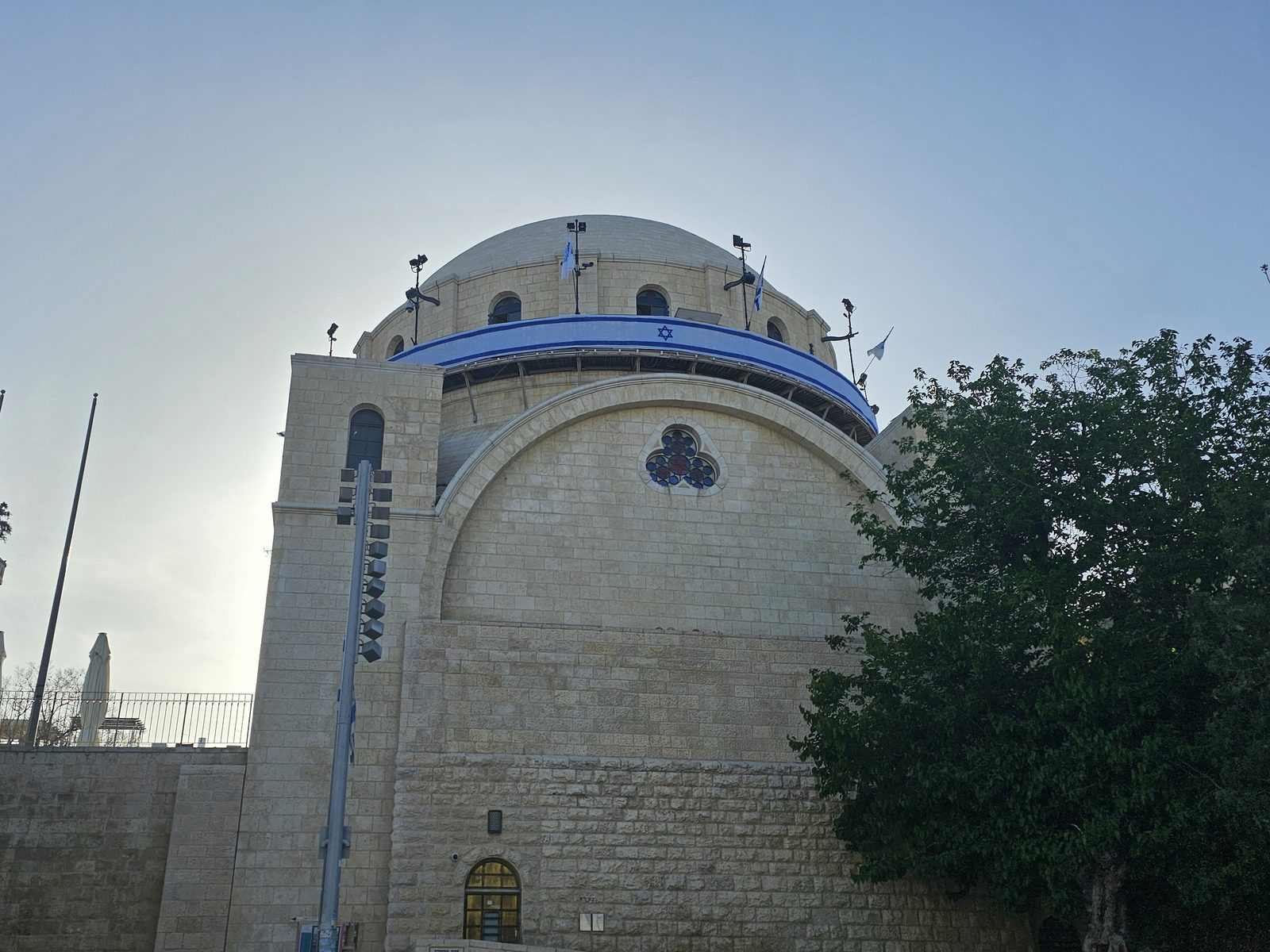
The Hurva Synagogue dominates the skyline of the Jewish Quarter with its white stone dome, a landmark visible from across the city. The name “Hurva” means “ruin,” a name that tells the story of a building destroyed and rebuilt not once but twice, each time rising from the rubble to reclaim its place as the most important Ashkenazi synagogue in Jerusalem.
First Destruction
The original synagogue was built in 1701 by a group of Ashkenazi Jews led by Rabbi Yehuda HeHasid, who immigrated to Jerusalem from Poland with some 500 followers. Rabbi Yehuda himself died just days after arriving in the Holy Land, leaving his community without their leader. The group struggled financially, fell into heavy debt, and in 1721, Arab creditors set the synagogue ablaze. The Ashkenazi community was expelled from the Jewish Quarter, and the ruins stood for over a century. The desolate site became known as the Ruin of Rabbi Yehuda HeHasid, giving the Hurva its lasting name.
Rebuilding and Second Destruction
In 1864, the synagogue was rebuilt in a grand neo-Byzantine style, with a large dome that became the most prominent feature of the Jewish Quarter skyline. The Hurva became the spiritual center of Ashkenazi Jewry in Jerusalem, the site of chief rabbinical installations, community celebrations, and the place where, in 1948, the defenders of the Jewish Quarter made their last stand.
During the 1948 Arab-Israeli War, the Jordanian Arab Legion captured the Jewish Quarter after fierce fighting. The Hurva was systematically destroyed by the Jordanian forces. For 19 years, from 1948 to 1967, the Jewish Quarter lay in Jordanian hands, and its synagogues, including the Hurva, were demolished or desecrated.
Third Hurva
After Israel recaptured the Old City in 1967, the Jewish Quarter was rebuilt, but the Hurva remained a ruin for decades while architects debated how to reconstruct it. In 1977, one of the four great stone arches that had originally supported the synagogue’s dome was recreated on the site, a 16-meter-high arch facing the Temple Mount, intended as a memorial to what had been destroyed and a symbol of continuity. For nearly thirty years, the solitary arch became the emblem of the Jewish Quarter, one of the most recognizable silhouettes in Jerusalem, painted and photographed by countless artists. In 2006, the arch was finally removed as work began to fully reconstruct the 19th-century building.
The rebuilt synagogue was rededicated in 2010, its signature dome restored to the skyline for the first time since 1948. The rededication was an emotional moment for the Jewish community, closing a circle of destruction and renewal that had lasted 62 years.
The rebuilt synagogue features a soaring interior with four massive pillars supporting the dome, stained glass windows, and a balcony offering panoramic views of the Old City, including the Temple Mount and the Mount of Olives. The synagogue is an active house of worship, and services are held daily.
Beneath the Synagogue
During excavations carried out at the site in 2003 by the Hebrew University and the Israel Exploration Society, the layers beneath the Hurva revealed evidence from four settlement periods: First Temple (800–600 BCE), Second Temple (1st century CE), Byzantine, and Ottoman. Three rock-hewn mikvaot (ritual baths) dating to the Second Temple period were uncovered, along with an intact Byzantine arch, 3.7 meters wide and 5 meters high, standing beside a stone-paved street that once branched off the Cardo. These remains are now displayed in the synagogue’s basement, allowing visitors to descend below the prayer hall and walk through 2,000 years of Jerusalem’s history.
The excavations also yielded an unexpected discovery: a forgotten weapons cache hidden beneath the synagogue by the Irgun (Etzel) underground in 1938, during the pre-state struggle against British rule. Grenades, mortar bombs, and ammunition were found in a concealed space beneath the steps of the aron kodesh (Torah ark), a cave known as the “kasefet” (safe), originally used to store the synagogue’s silver ritual objects. Both the Irgun and Lehi maintained separate weapons caches in the Hurva, turning the holiest Ashkenazi synagogue in Jerusalem into a secret armory. The synagogue that served as a house of prayer by day had hidden beneath its floors the tools of a national uprising.
Visit with Hoshen Tours
The Hurva Synagogue, with its soaring dome visible across the Jewish Quarter, tells the story of Jewish resilience through centuries of destruction and rebuilding. Your Hoshen Tours guide can pair this visit with the nearby Sephardic Synagogues complex, a walk along the Cardo, a look at the ancient Broad Wall, and a visit to the Western Wall plaza below. Together, these sites offer a moving journey through Jewish life in Jerusalem from antiquity to the present.
Ready to experience Israel in true colors?
Plan Your TourPrivate tours designed around your interests, schedule, and pace.