



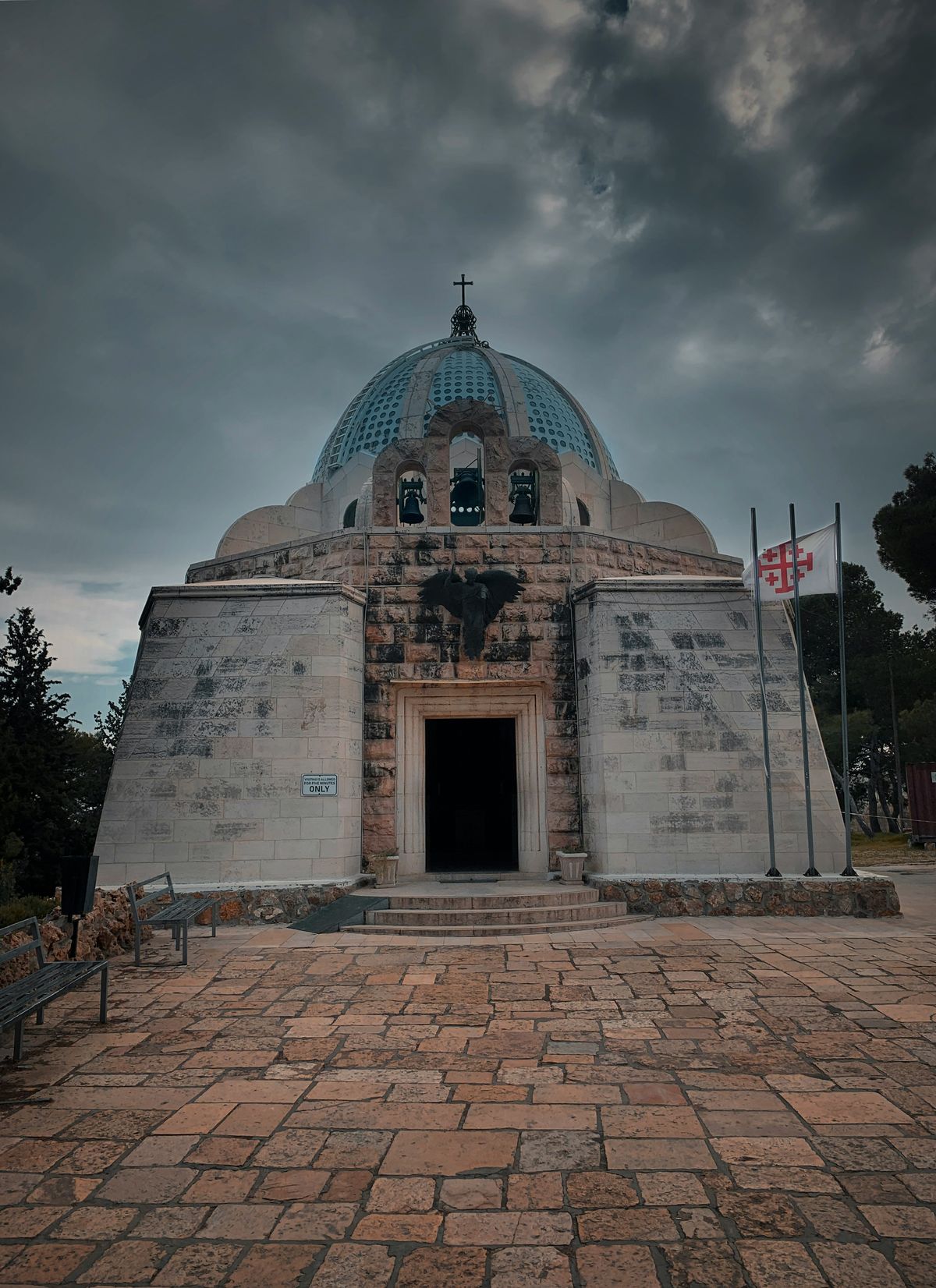
Beit Sahour, a small Christian Arab town immediately east of Bethlehem, is the traditional site of the Shepherds’ Fields, where the angels are said to have appeared to shepherds watching their flocks by night and announced the birth of Jesus: “Do not be afraid. I bring you good news that will cause great joy for all the people. Today in the town of David a Savior has been born to you; he is the Messiah, the Lord” (Luke 2:10-11). The name Beit Sahour means “House of the Night Watch” or “House of the Vigilant,” a name that may itself preserve the memory of shepherds keeping watch over their flocks in these fields.
The Shepherds and the Temple at Beit Sahour and the Shepherds’ Fields
The shepherds of Luke’s Gospel were not necessarily ordinary herdsmen. The Mishnah (Shekalim 7:4) records that flocks found in the area between Jerusalem and a place called Migdal Eder (“Tower of the Flock”) could be presumed to be intended for Temple offerings. Migdal Eder is mentioned in Genesis 35:21, placed near Bethlehem in the immediate aftermath of Rachel’s death, and again in the prophecy of Micah 4:8: “And you, O tower of the flock, hill of the daughter of Zion, to you shall it come, the former dominion shall come, the kingdom of the daughter of Jerusalem.” Ancient Aramaic translations of the Prophets (the Targumim) interpret Migdal Eder in messianic terms, and the Targum on Genesis 35:21 states that the King Messiah will be revealed from Migdal Eder at the end of days. The Gospel’s shepherds, then, may have been tending lambs destined for sacrifice at the Temple in Jerusalem, and the announcement of the birth came to them first because they were already, in a sense, in the business of preparing offerings to God.
A popular tradition takes the connection further: the “swaddling cloths” in which Mary wrapped the infant Jesus (Luke 2:7, 2:12) are said to echo the practice of wrapping newborn lambs destined for Temple sacrifice to keep them unblemished. Whether or not this specific practice is attested in ancient sources, the theological resonance is powerful: Jesus, identified by John the Baptist as “the Lamb of God who takes away the sin of the world” (John 1:29), was born among shepherds who raised lambs for sacrifice, wrapped in the same manner, and laid in a feeding trough. The imagery is not accidental.
Ruth and Boaz
Long before the shepherds, these same fields were the setting for one of the most beautiful stories in the Bible. During a famine in the time of the Judges, Elimelech and his wife Naomi left Bethlehem for Moab. After Elimelech and both their sons died, Naomi decided to return home. She urged her Moabite daughters-in-law to stay, but Ruth refused: “Where you go, I will go; where you lodge, I will lodge; your people shall be my people, and your God my God” (Ruth 1:16). Back in Bethlehem, Ruth went to glean in the fields, exercising the biblical right of the poor to gather leftover grain (Leviticus 19:9-10). She happened upon the field of Boaz, a wealthy kinsman of Elimelech, who noticed her, protected her, and instructed his workers to leave extra grain for her.
Following Naomi’s guidance, Ruth went to the threshing floor at night and asked Boaz to act as her kinsman-redeemer. He agreed, married her, and their son Obed became the father of Jesse, the father of King David. Ruth the Moabite, a convert and an outsider, became the great-grandmother of Israel’s greatest king and, according to Matthew’s Gospel (1:5), an ancestor of Jesus. The fields of Beit Sahour thus carry a layered biblical narrative: the place where a foreign woman’s faithfulness led to the Davidic line, and the place where the birth of the Davidic Messiah was first announced.
The Chapel of the Shepherds
The Franciscan Shepherds’ Field site, excavated by Father Virgilio Corbo in the 1950s, contains the remains of a 4th-5th century Byzantine monastery and church, natural and hewn caves used for habitation and shelter (consistent with shepherding), and agricultural installations including wine presses, olive presses, and cisterns. The chapel that stands today was designed by the Italian architect Antonio Barluzzi and completed in 1954. Its distinctive tent-shaped design, with a polygonal base and sloping roof panels, is meant to evoke a shepherd’s tent. Some have suggested a symbolic connection between the chapel’s design elements and the biblical tithe (ma’aser), though Barluzzi’s primary intent was to capture the atmosphere of the shepherds’ world. Inside, paintings depict the three key moments of the narrative: the angel appearing to the shepherds, the heavenly host singing “Glory to God in the highest,” and the shepherds adoring the infant in the manger. Light enters the chapel dramatically, evoking the heavenly light that broke the darkness of that night.
A separate Greek Orthodox site, slightly to the east, features a cave-church adapted for worship and the remains of a 5th-century church. Both sites have reasonable claims to antiquity, and the existence of two venerated locations reflects the broader pattern in the Holy Land of competing traditions preserved by different communities.
Beit Sahour Today
Beit Sahour has a population of approximately 15,000 and remains one of the more Christian towns in the Palestinian territories, with both Catholic and Greek Orthodox communities. During the First Intifada in 1988-1989, the town gained international attention when its residents organized a tax revolt against the Israeli military administration, invoking the American Revolutionary principle of “no taxation without representation.” The Israeli authorities responded with raids and property confiscations, but the townspeople persisted in what became one of the most noted examples of nonviolent civil disobedience during the Intifada.
Visit with Hoshen Tours
The Shepherds’ Fields in Beit Sahour mark the place where angels announced the birth of Jesus. Hoshen Tours pairs them with Bethlehem’s olive wood workshops, the Milk Grotto, the palace-fortress of Herodium, and the Tomb of Lazarus in Bethany.
Explore Our Tour Collection
Ready to experience Israel in true colors?
Plan Your TourPrivate tours designed around your interests, schedule, and pace.