



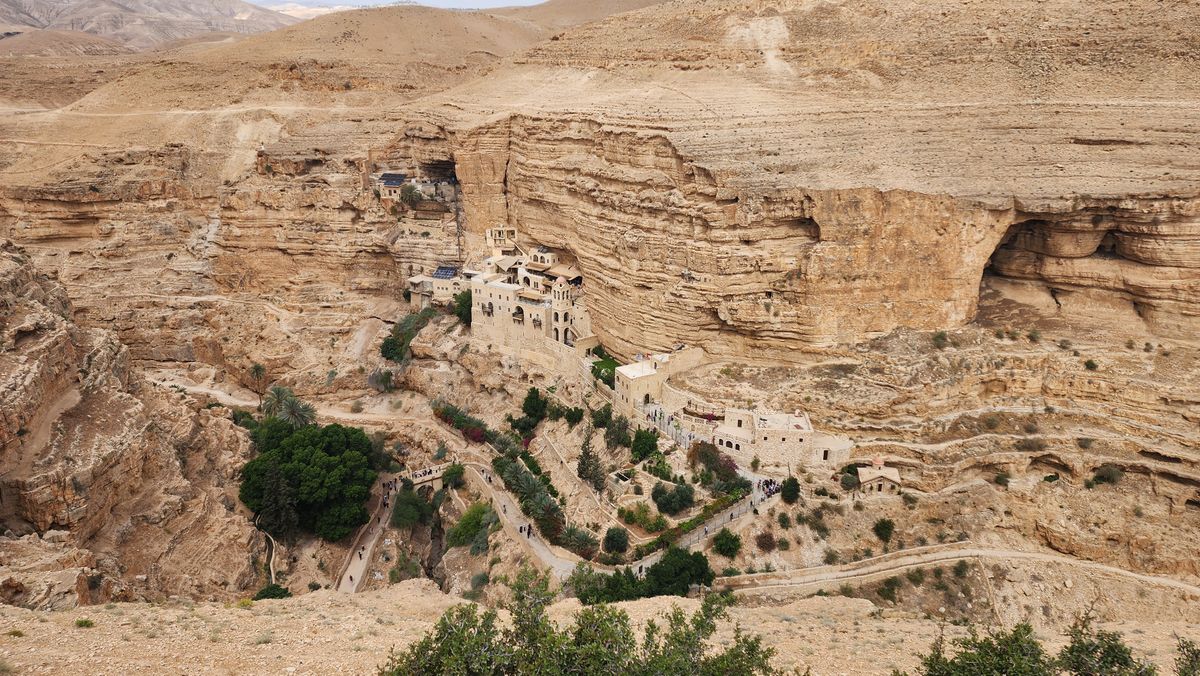
Wadi Qelt and the Monastery of St.Wadi Qelt is a deep canyon cutting through the Judean Desert between Jerusalem and Jericho, following the ancient route that travelers have used for thousands of years. The wadi carries water year-round from springs in the hills above, creating a ribbon of green in the brown desert. This is the road described in the Parable of the Good Samaritan (Luke 10:30), where “a man was going down from Jerusalem to Jericho” and fell among robbers. The terrain makes the parable vivid: isolated, steep, and far from help. Clinging to the cliff wall of the canyon is the Monastery of St. George of Koziba, one of the most dramatic monastery settings in the world.
Hiking Wadi Qelt to St. George’s Monastery
The classic Wadi Qelt hike follows the canyon from the springs near Jerusalem down to the monastery and on toward Jericho, a walk of several hours through stunning desert scenery. This path traces the ancient road connecting the two cities, the same route walked by pilgrims, merchants, and armies for millennia. The trail passes Herodian aqueducts still carrying water along the canyon wall, natural pools where ibex and hyrax come to drink, and cliff faces where griffon vultures nest. The contrast between the dry desert above and the green canyon below is extreme and beautiful.
Ein Qelt and Ein Fawwar
Two perennial springs feed the wadi and make life possible in this desert canyon. Ein Qelt, closer to the western end, produces a steady flow that collects in natural pools surrounded by reeds and tamarisk trees. Ein Fawwar, further east, is a larger spring whose waters were harnessed by ancient engineers to supply Jericho. Together, these springs create the year-round stream that has drawn hermits, monks, and wildlife to the canyon for centuries. The pools at Ein Qelt are a welcome rest stop for hikers on hot days.
The Monastery of St. George
The Monastery of St. George was founded in the 5th century by John of Thebes, who gathered hermits already living in caves in the area. Tradition holds that the monks chose this cliff because of its association with the prophet Elijah, who was fed by ravens beside a brook in the wilderness (1 Kings 17:5-6). The monastery was destroyed during the Persian invasion of 614 CE and rebuilt in the late 19th century by Greek Orthodox monks. The current building clings to the vertical cliff face in a way that seems to defy gravity, connected to the desert floor by a steep path. Inside, the main church contains icons, frescoes, and the skulls of monks killed in 614 CE, displayed in a glass case as relics. A cave chapel, believed to be where Elijah sheltered, is carved into the cliff beneath the church.
Along the canyon walls, sections of aqueducts built by Herod the Great are still visible. Herod channeled the spring water of Wadi Qelt to supply his winter palaces at Jericho, engineering a system of channels, tunnels, and pools that is a testament to Roman hydraulic technology. Some sections still carry water today, 2,000 years later.
Visit with Hoshen Tours
Wadi Qelt is one of the most scenic hikes in Israel, and Hoshen Tours tailors the route to your fitness level and interests. Visit St. George Monastery clinging to the cliff face, cool off at Ein Prat, or extend the day into the Judean Desert with a stop at Mar Saba Monastery. Every detail is planned so you can walk at your own pace.
Ready to experience Israel in true colors?
Plan Your TourPrivate tours designed around your interests, schedule, and pace.