



Jericho is the oldest city in the world. That claim, repeated so often it can lose its force, deserves a moment of reflection: people have lived here, continuously, for over ten thousand years. Long before the pyramids, before Stonehenge, before writing, before the wheel, a community of two to three thousand people built stone walls and a tower at this spot in the Jordan Valley, among the oldest monumental architecture ever found anywhere on Earth. The city’s Hebrew name, Yeriho (יריחו), is believed to derive from the Semitic root y-r-ḥ, meaning “moon”, tradition holds that it was named for the Canaanite moon god Yarikh, suggesting that this oasis in the desert was once a center of lunar worship. The Bible calls it the City of Palms (Deuteronomy 34:3), and it was the first of 31 Canaanite cities conquered by Joshua. Today it sits at 258 meters below sea level, one of the lowest inhabited places on Earth, fed by springs that have sustained life here since the end of the last Ice Age.
Ten Thousand Years of Habitation
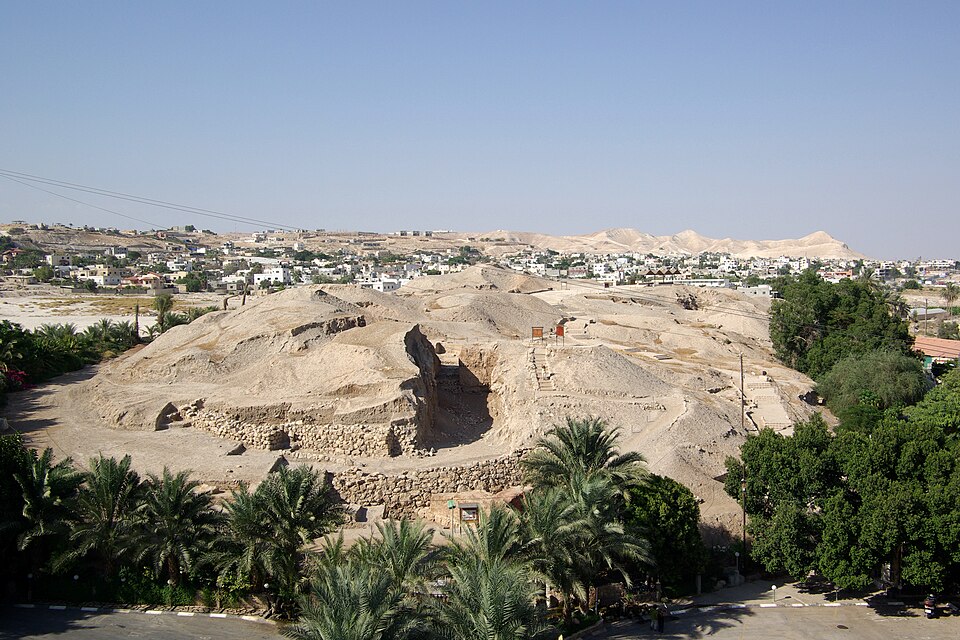
The archaeological mound of Tell es-Sultan, beside the great spring of Ein es-Sultan, tells a story that reaches back to the dawn of human settlement. The earliest traces date to the Natufian period, around 10,000–9,000 BCE, when semi-nomadic hunter-gatherers began settling near the spring. By the Pre-Pottery Neolithic A period (roughly 8,500–7,500 BCE), Jericho had become something unprecedented: a settled community of perhaps 2,000–3,000 people who built permanent mud-brick houses and, astonishingly, monumental stone structures. The Tower of Jericho, dating to approximately 8,300 BCE, rises 8.5 meters high with a diameter of 9 meters at its base, and contains an internal staircase of 22 steps. It predates the Egyptian pyramids by five thousand years. Scholars have debated its purpose, defense, flood protection, an astronomical marker aligned with the summer solstice shadow of the Mount of Temptation, or a symbol of communal power, but its very existence at this date is extraordinary. A stone wall 3.6 meters high and 1.8 meters thick, with a rock-cut ditch outside it, surrounded the settlement, the oldest known fortification walls in the world.
In the Pre-Pottery Neolithic B period (around 7,000 BCE), the inhabitants of Jericho practiced something that gives us a glimpse into the earliest human religious thought: they removed the skulls of their dead, covered them with plaster to recreate facial features, and inset cowrie shells in the eye sockets. These plastered skulls, seven were excavated by Kathleen Kenyon in the 1950s, are among the oldest evidence of ancestor worship and portraiture in human history. They suggest that the living kept the modeled faces of specific individuals as objects of reverence, believing in some continuing presence of the dead among them.
Joshua, the Walls, and Rahab
For Jews and Christians alike, Jericho is inseparable from the story of Joshua’s conquest. According to Joshua chapters 2 and 6, after the death of Moses, Joshua sent two spies to scout the city. They found shelter in the house of Rahab, a woman described as a prostitute or innkeeper, whose home was built into the city wall itself. When the king of Jericho sent men to find the spies, Rahab hid them under stalks of flax on her roof and misdirected the pursuers. She told the spies she knew their God had given them the land, and extracted a promise that her family would be spared. The spies instructed her to hang a scarlet cord from her window as a sign.
The conquest itself, as described in Joshua 6, was not a conventional siege but a ritual act of faith. For six days, the Israelite army marched around the city once each day in silence, led by seven priests carrying seven shofars before the Ark of the Covenant. On the seventh day, they circled the city seven times. On the seventh circuit, the priests blew a long blast and Joshua commanded the people to shout. The walls of Jericho fell flat, the Hebrew says they collapsed “in their place,” straight down, and the Israelites rushed in from every direction. The city was placed under ḥerem, total destruction, with only Rahab and her household spared. Joshua pronounced a curse on anyone who would rebuild the city (Joshua 6:26), a curse later fulfilled in 1 Kings 16:34. Jericho was the first of 31 cities conquered in Joshua’s campaign (Joshua 12:9).
The Gospel Connection
Rahab’s story does not end at the walls. Jewish tradition (Talmud, Megillah 14b) holds that she married Joshua himself, and that prophets descended from her, including Jeremiah and Huldah. Christian tradition, following the Gospel of Matthew (1:5), places her in the genealogy of Jesus, as the wife of Salmon, mother of Boaz, great-great-grandmother of King David, and one of only five women named in the lineage leading to Christ. The scarlet cord she hung from her window has been interpreted since the earliest Church Fathers as a symbol of redemption through blood.
Whether the biblical account corresponds to a specific archaeological event remains one of the most debated questions in the field. John Garstang, excavating in the 1930s, found collapsed walls, thick ash layers, and stores of grain that he dated to approximately 1400 BCE, a match for the biblical timeline. Kathleen Kenyon, whose more rigorous excavations in the 1950s set the standard for the discipline, re-dated that destruction to approximately 1550 BCE and attributed it to the Egyptian expulsion of the Hyksos, concluding that no fortified city existed at Jericho during the period traditionally assigned to Joshua’s conquest. Bryant Wood challenged Kenyon’s dating in 1990, arguing that her pottery analysis was flawed and that the evidence does support a 1400 BCE destruction. The debate continues, and visitors standing at the base of Tell es-Sultan can decide for themselves what to make of walls that have generated more scholarly argument per square meter than perhaps any other ruin in the world.
Elisha’s Spring and the City of Palms
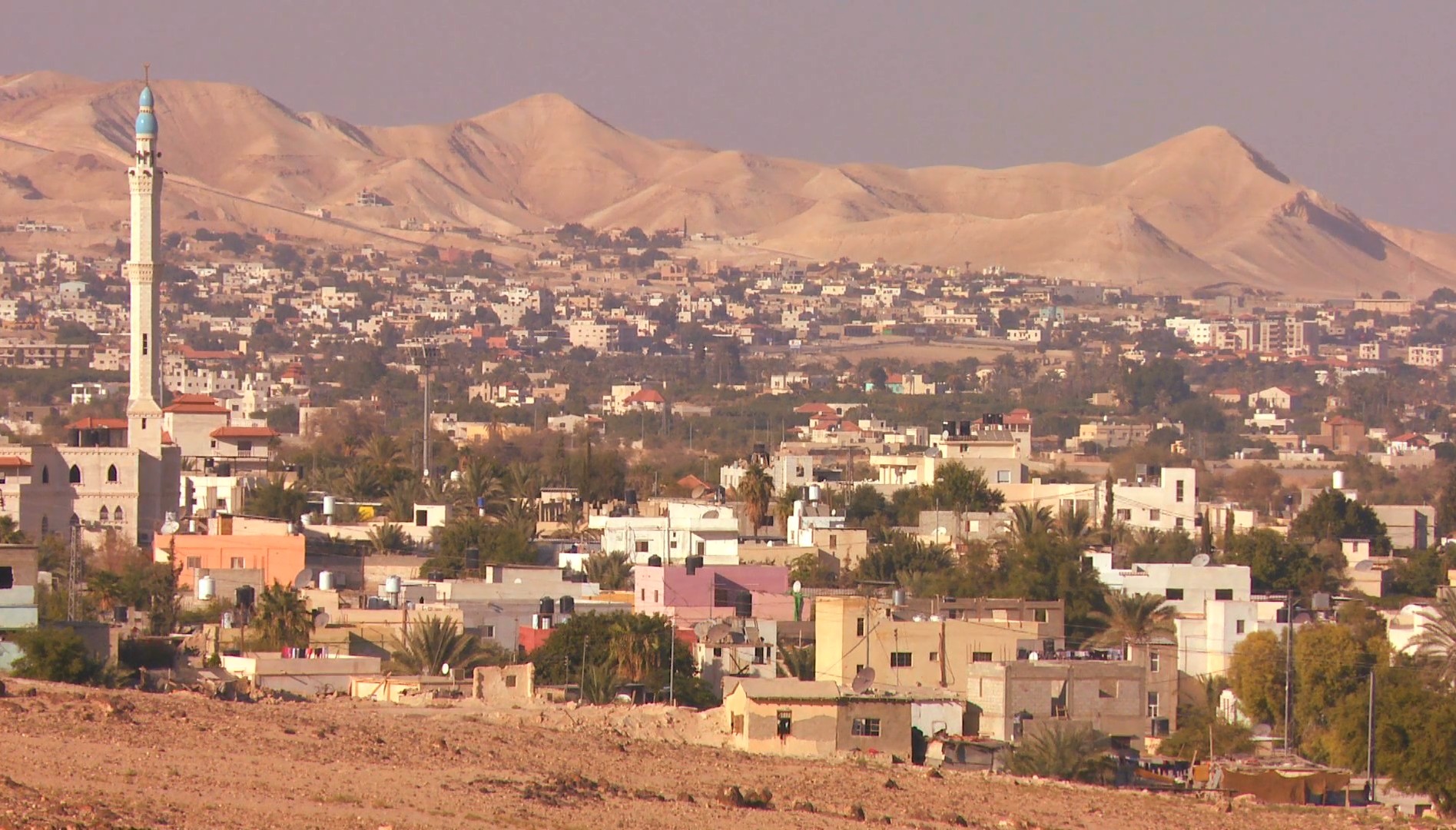
The spring that made Jericho possible, Ein es-Sultan, also known as Elisha’s Spring, produces roughly 1,000 gallons per minute and has been flowing for as long as anyone can measure. According to 2 Kings 2:19–22, the men of Jericho told the prophet Elisha that the water was bad and the land unfruitful. Elisha threw salt from a new bowl into the spring and declared: “Thus says the Lord: I have healed this water.” The spring has been abundant ever since. Combined with the warm climate, average temperatures rarely drop below 15°C even in January, while summers exceed 40°C, this water creates an oasis of extraordinary fertility in the middle of the desert. Date palms, balsam, and tropical agriculture have flourished here since antiquity, earning Jericho its biblical epithet: the City of Palms.
A City of Priests
During the Second Temple period, Jericho was far more than a frontier oasis, it was one of the most important priestly cities in the land. According to 1 Chronicles 24, King David divided the priestly families into 24 rotating courses (mishmarot). Each course served in the Temple in Jerusalem for one week at a time, twice a year, with all 24 serving together during the three pilgrimage festivals. This system ensured that every priestly family shared equally in the sacred work. The priests did not live in Jerusalem year-round, they maintained homes in towns across the country and traveled to the capital only for their assigned week of service. The Talmud and other rabbinic sources record that several of these 24 courses maintained their permanent homes in Jericho, and a famous inscription discovered at Caesarea lists which course settled in which town after the destruction of the Temple in 70 CE. When their turn came to serve in the Temple, these priestly families would ascend the 30-kilometer road through the Judean Desert to Jerusalem, perform their week of service, and return to the warmth and abundance of the Jordan Valley.
The connection between Jericho and the priesthood was not incidental. The city’s famous balsam groves and date plantations generated significant wealth, and priestly families, who received tithes and other agricultural contributions, were drawn to its prosperity. Josephus describes Jericho in this period as extraordinarily fertile, producing balsam, dates, honey, and cypros, luxury goods that were exported throughout the Roman world. The balsam of Jericho was so valuable that it was among the treasures displayed in Pompey’s triumphal procession in Rome after his conquest of Judea in 63 BCE. Mark Antony later gifted the balsam groves to Cleopatra, who leased them back to Herod, a source of constant friction between the two.
The priestly presence in Jericho also explains a detail in one of Jesus’s most famous parables. The Parable of the Good Samaritan (Luke 10:30–37) describes a man going “down from Jerusalem to Jericho” who fell among robbers. When a priest and a Levite pass by without helping, the audience of Jesus’s day would have understood immediately: priests and Levites traveled this road regularly, commuting between the Temple and their homes in Jericho. The road was notoriously dangerous, winding through the barren Judean Desert with countless hiding places for bandits, and the parable’s setting was entirely realistic.
Herod’s Winter Palace
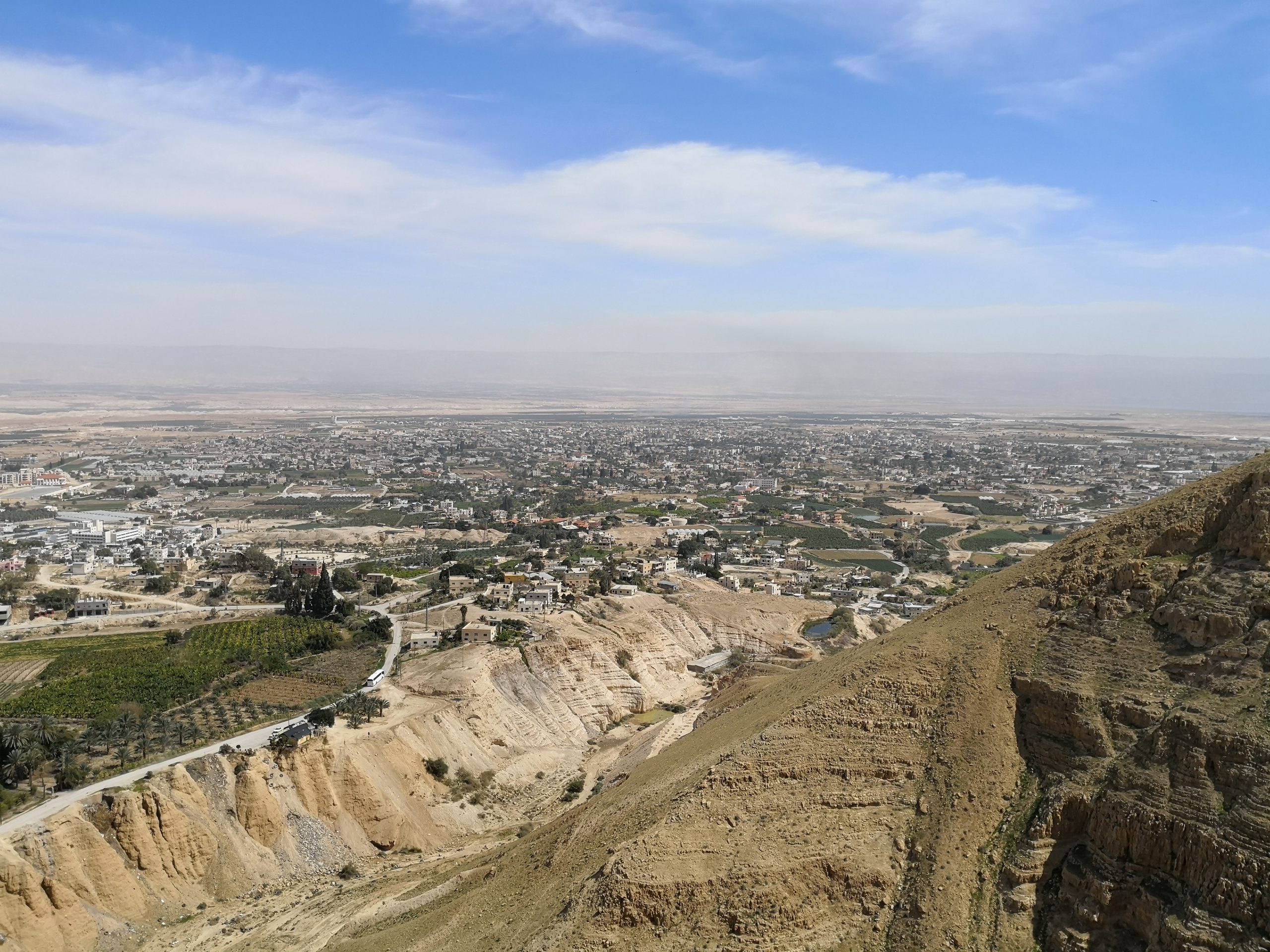
Jericho’s warm winters made it a favored retreat for rulers. Herod the Great built three successive palace complexes at Tulul Abu el-Alayiq, at the mouth of Wadi Qelt, about two kilometers southwest of the ancient tel. The grandest of the three straddled both sides of the wadi, connected by a bridge, and included a massive reception hall, Roman-style bathhouses with caldarium and frigidarium, elaborate sunken gardens, swimming pools, and facades built in opus reticulatum, a Roman construction technique so rare outside Italy that Herod must have imported the craftsmen themselves. It was at one of the swimming pools in the earlier Hasmonean palace on this site that Herod’s young brother-in-law, the 17-year-old high priest Aristobulus III, was drowned on Herod’s orders in approximately 36 BCE, held underwater by servants who made it look like a playful accident, according to Josephus.
Jesus in Jericho
Two of the most beloved Gospel stories take place in Jericho. As Jesus was leaving the city (Mark 10:46–52), a blind beggar named Bartimaeus sat by the roadside and cried out: “Jesus, Son of David, have mercy on me!” The crowd tried to silence him, but he shouted louder. Jesus stopped, called for him, and said: “Your faith has made you well.” Bartimaeus received his sight and followed Jesus along the road. And as Jesus passed through Jericho (Luke 19:1–10), a wealthy chief tax collector named Zacchaeus, short in stature and unable to see over the crowd, ran ahead and climbed a sycamore-fig tree. Jesus looked up and said: “Zacchaeus, hurry and come down, for I must stay at your house today.” The crowd grumbled that Jesus had gone to be the guest of a sinner, but Zacchaeus declared he would give half his goods to the poor and restore fourfold anything he had taken unjustly. Jesus responded: “Today salvation has come to this house.” A sycamore tree still grows in Jericho where tradition places this encounter.
Hisham’s Palace and the Tree of Life
Centuries after the Roman and Byzantine periods, Jericho gained another treasure. Khirbet al-Mafjar, known as Hisham’s Palace, is a grand Umayyad complex built in the 730s, 740s CE, likely by Caliph al-Walid II rather than Hisham himself, as once believed. The complex includes a palace, a mosque, and one of the largest bathhouses known from the early Islamic world. It was never fully completed and was severely damaged by an earthquake in 749 CE. The crown jewel is the Tree of Life mosaic in a private audience room off the bathhouse: a fruit tree with two deer grazing peacefully on one side and a lion attacking a deer on the other, a masterpiece of early Islamic art, commonly interpreted as representing war and peace. A new purpose-built museum, opened in 2021 with Japanese support, now protects the bathhouse’s enormous 827-square-meter mosaic floor, one of the largest surviving from antiquity, with a raised walkway allowing visitors to view it from above.
Visit with Hoshen Tours
Jericho, the oldest city in the world, sits at the heart of the Jordan Valley. Hoshen Tours designs private itineraries that include the Mount of Temptation, the Hasmonean Palaces at Jericho, the ancient mosaic at the Shalom Al Yisrael Synagogue, and the monastery of Deir Hajla Monastery. Every Jericho visit is tailored to your interests, whether biblical, archaeological, or both.
Explore Our Tour Collection
Ready to experience Israel in true colors?
Plan Your TourPrivate tours designed around your interests, schedule, and pace.