



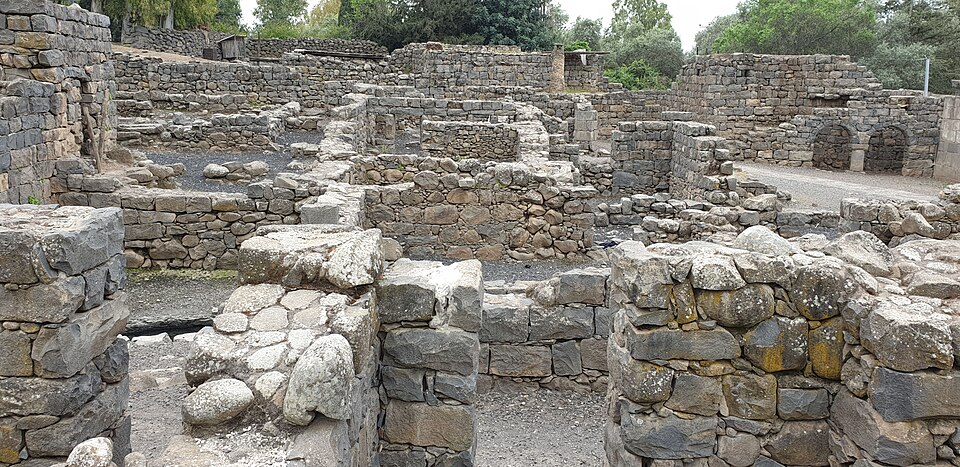
 The Katzrin Ancient Village is a partially reconstructed Talmudic-era settlement on the central Golan Heights, built around one of the finest ancient synagogues found on the plateau. The village gives visitors a tangible sense of what daily life was like for the Jewish communities that lived on the Golan from the Roman period through the Byzantine era, how they built their homes, pressed their olives, stored their grain, and worshipped in basalt synagogues that still stand. It is the most complete window available into that vanished world, combining archaeological reconstruction, a major museum collection, and one of the Golan’s best-preserved ancient synagogues in a single site.
The Katzrin Synagogue
The Katzrin synagogue, dating to the 4th, 6th century CE, has been partially reconstructed and is one of the most accessible ancient synagogues in Israel. Built from local black basalt in the basilica plan typical of Golan synagogues, it features a columned interior with stone benches along the walls, a carved basalt Torah ark facade, and decorative elements including a menorah relief and an eagle. The reconstruction allows visitors to walk inside the building and understand its proportions and atmosphere, the dark basalt walls, the columns supporting the upper gallery, the light filtering through the entrance, in a way that ruined synagogues cannot convey. The elaborately carved stone lintels and doorframes display the level of investment this community made in its house of worship. The synagogue was destroyed in the earthquake of 749 CE, which ended the Jewish presence on the Golan for more than a millennium.
The Reconstructed Houses
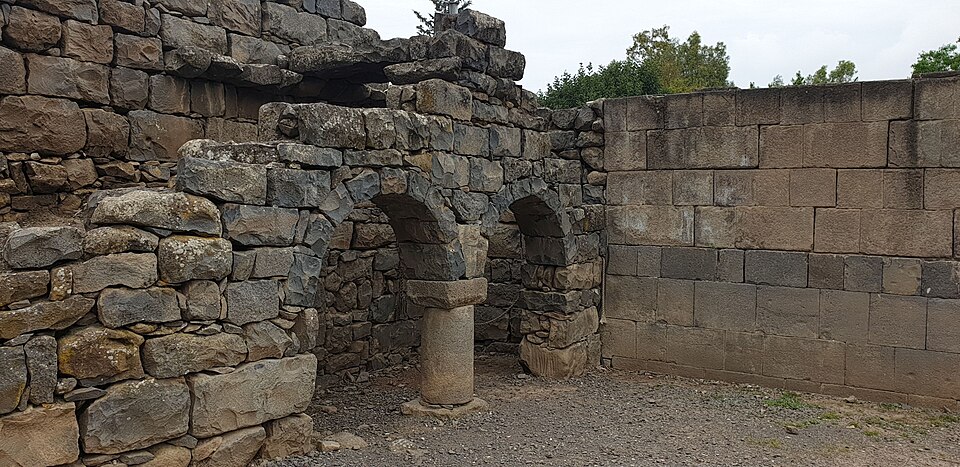 Around the synagogue, several houses have been reconstructed to show the domestic life of a Golan village in the Talmudic period. The houses are built of basalt with wooden-beam roofs covered in packed earth, cool in summer, insulating in the cold Golan winters at approximately 350 meters elevation. Visitors can enter the houses and walk through the rooms: the main living space with its stone floors, the storage room lined with large ceramic jars for oil, wine, and grain, the raised sleeping area separated from the work and cooking spaces below. Furnishings are replicas of period objects based on archaeological finds: stone grinding mills, clay ovens, oil lamps, woven baskets, and sleeping mats. The layout reflects how families actually organized their lives around the rhythms of agriculture, religious observance, and communal gathering, the same patterns described in Talmudic literature from this exact era.
The Ancient Olive Press
An olive press at the site demonstrates the process of crushing olives and extracting oil, the primary agricultural industry of ancient Katzrin and the broader Golan. The press consists of the crushing stone used to break the olives, the pressing mechanism to squeeze out the oil, and the collection vessels. Olive oil in this period was not simply a food product; it was the fuel for lamps, the base for medicines and cosmetics, and a significant trade commodity. A communal press like this one would have been used by multiple households in turn, making it a center of village social life during harvest season. A wine press and grain silos at the site complete the picture of a self-sufficient agricultural community tightly integrated with the land.
The Golan Archaeological Museum
The adjacent Golan Archaeological Museum, also called the Katzrin Museum, displays artifacts from excavations across the entire plateau, spanning from prehistoric times through the modern era. Highlights include carved basalt architectural fragments from Golan synagogues, pottery spanning millennia, coins, agricultural tools, and objects recovered from Gamla and other major sites. The collection gives visitors a sense of the full timeline of human habitation on the Golan and helps place Katzrin within the longer story of the plateau.
The Talmudic Period Connection
The community that lived at ancient Katzrin was part of the broader Jewish world that produced some of the foundational texts of Jewish tradition. The Talmudic period, roughly the 2nd through 7th centuries CE, was the era when the rabbinical academies of the Galilee compiled the Mishnah and contributed to the Jerusalem Talmud. The Golan’s Jewish communities were not isolated from this world: they shared its legal frameworks, its agricultural calendar, its religious practices, and its scholars. The stones of Katzrin are in dialogue with the texts of the Talmud in ways that few sites make as visible, the olive presses, the synagogue benches, the storage jars all appear in rabbinic discussions of the period, described as living realities rather than historical artifacts.
Modern Katzrin
The modern town of Katzrin, built nearby in 1977, serves as the administrative and commercial center of the Golan, the plateau’s largest town and its unofficial capital. It is a convenient base for touring the Golan, with hotels, restaurants, a winery, and access to sites across the plateau. The juxtaposition of the ancient village and the modern town gives the site an unusual quality: 1,500 years of absence separating two periods of Jewish settlement on the same plateau.
Visit with Hoshen Tours
Katzrin is the best place on the Golan to understand how ancient Jewish communities actually lived. Hoshen Tours visits the synagogue, the reconstructed houses, and the olive press, connecting the stones to the daily rhythms of a world that ended with an earthquake in 749 CE but whose traces are scattered across every hilltop on the plateau. The museum visit adds archaeological depth, and the walk through the ancient village makes the Talmudic period feel immediate rather than distant.
Explore Our Tour Collection
Ready to experience Israel in true colors?
Plan Your TourPrivate tours designed around your interests, schedule, and pace.