



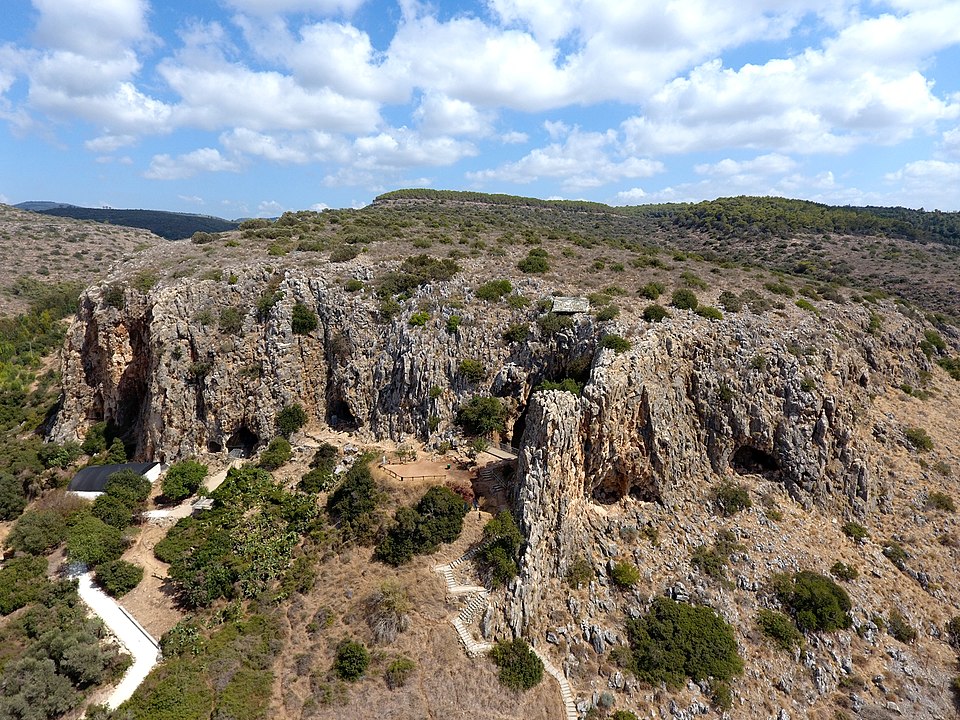
Nahal Me’arot (the Cave Stream), a UNESCO World Heritage Site inscribed in 2012 under the name “Sites of Human Evolution at Mount Carmel: The Nahal Me’arot / Wadi el-Mughara Caves,” occupies the western slope of Mount Carmel south of Haifa. Few places on earth compress so much of human history into a single limestone hillside. The four caves here, Tabun, Jamal, el-Wad (Nahal), and Skhul, were inhabited continuously for over 500,000 years, and the archaeological layers they contain document the entire arc of human evolution from Homo erectus to Homo sapiens. UNESCO recognized the site as one of the most important prehistoric localities anywhere in the world, and a visit here recalibrates your sense of deep time in a way few other places can.
Tabun Cave: Half a Million Years of Human Presence – Nahal Me’arot
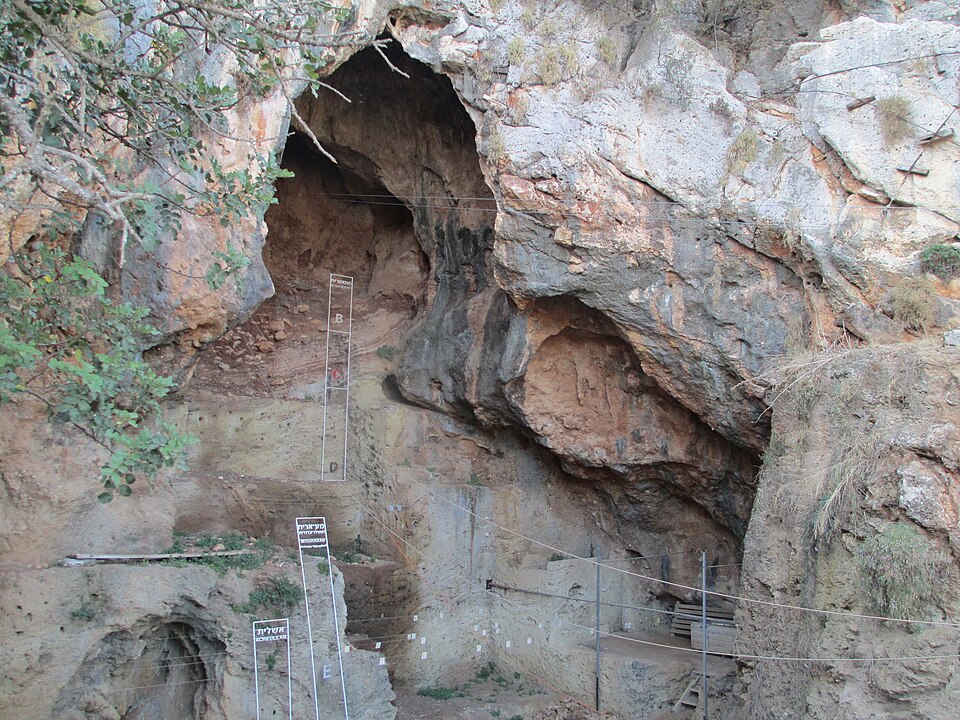
Tabun Cave is the deepest and most scientifically significant of the four. Its archaeological deposits reach back approximately 500,000 years, making it one of the longest continuous sequences of human occupation known anywhere on earth. Layer by layer, the cave records the tools, hearths, and bones of successive human populations across geological time. Archaeologists working through Tabun’s stratigraphy have identified distinct cultural phases spanning the Lower Paleolithic through the Middle Paleolithic. The earliest layers contain Acheulean hand axes, the teardrop-shaped stone tools that are among the oldest standardized tool forms in the human story, produced by Homo erectus and archaic humans who sat in this same cave entrance and shaped flint with practiced precision. Upper layers yield Mousterian tools: smaller, more refined flint implements, scrapers, points, and flakes, associated with Neanderthal populations who occupied the cave during the Middle Paleolithic. Alongside the tools, excavators found abundant animal bones, including the remains of fallow deer, gazelle, cattle, and rhinoceros, a record of the hunting and butchering activities that sustained life here across hundreds of millennia.
The cave’s most celebrated discovery is the Tabun Woman, a nearly complete Neanderthal female skeleton estimated to be around 120,000 years old. She represents one of the most intact Neanderthal individuals ever recovered and has been central to scientific debates about Neanderthal morphology, lifespan, and behavior ever since her discovery. Her skeleton shows the robust build, prominent brow ridges, and large nasal cavity typical of Neanderthals, physical adaptations shaped by hundreds of thousands of years of life in the landscapes of western Eurasia and the Levant. The sheer depth of time contained within Tabun’s walls, half a million years of unbroken human habitation, is difficult to fully absorb standing at its entrance.
Skhul Cave: The Earliest Modern Humans
A short distance from Tabun, the Skhul Cave yielded one of the most remarkable collections of skeletal remains in the prehistory of our species. The ten individuals buried here are among the earliest known Homo sapiens outside of Africa, dating to approximately 100,000 to 130,000 years ago. What makes Skhul extraordinary is not only the age of the remains but the behavior they reveal: these were intentional burials, carefully arranged, in some cases accompanied by grave goods including animal bones and shells. This is among the earliest evidence anywhere in the world of deliberate burial practices and symbolic thought, hallmarks of modern human cognition that distinguish our species from its predecessors. Skhul stands as evidence that the capacity for ritual and symbolic meaning reaches back to the very earliest modern humans in this region.
The Great Question: Did Neanderthals and Modern Humans Meet?
What makes Nahal Me’arot uniquely compelling in the field of paleoanthropology is the proximity of the Neanderthal remains in Tabun to the early Homo sapiens remains in Skhul. The two caves are meters apart, and the populations they represent overlapped in time. Neanderthals and early modern humans both lived in these caves at periods that may have coincided, or nearly so. Did they encounter one another on this limestone ridge? Did they trade, compete, or interbreed? The evidence from Mount Carmel has fueled decades of scientific debate. Genetic research has since confirmed that interbreeding between Neanderthals and modern humans did occur somewhere in the ancient Near East, and Mount Carmel remains one of the strongest candidate locations. The caves do not answer the question definitively, but they are perhaps the best place on earth to stand and ask it.
The Natufian Revolution at el-Wad Cave
Beyond the deep Paleolithic layers lies a story of transformation no less significant: the birth of settled human society. The el-Wad Cave contains some of the richest evidence of the Natufian culture, a population that inhabited the Levant from approximately 15,000 to 11,500 years ago. The Natufians stand at one of the great turning points in human history, the transition from nomadic hunting and gathering to permanent settlement, the threshold of the agricultural revolution. At el-Wad, archaeologists found permanent stone structures built directly into the hillside, among the earliest fixed stone dwellings known anywhere in the world. Ground stone tools for processing wild grains and elaborate burials with personal ornaments point to a society of growing complexity, and the evidence of communal life organized around a fixed place is unmistakable.
The Natufians did far more than settle down. On Mount Carmel they appear to have taken the earliest steps toward domesticating the dog, skeletal remains here include what may be some of the oldest evidence of humans and dogs buried together, suggesting a bond already formalized by shared life. They created art: carved bone figurines, beaded personal ornaments made from shells and animal teeth, and decorated objects that reveal a people for whom beauty and symbol mattered. Their burial practices, with grave goods carefully placed beside the dead, suggest a belief in something beyond death, perhaps the earliest glimmer of a spiritual life among people on this very hillside. The Natufians were not yet farmers, but they were becoming something entirely new: people who stayed, who invested in place, who built, who remembered their dead. The shift they pioneered on Mount Carmel would eventually produce agriculture, cities, writing, and all of recorded civilization.
Dorothy Garrod and the Excavations
The systematic excavation of Nahal Me’arot was largely the work of the British archaeologist Dorothy Garrod, who led digs here through the 1920s and 1930s. Garrod’s work at the Mount Carmel caves was among the most consequential archaeological projects of the twentieth century, establishing the stratigraphic framework that subsequent researchers have built upon ever since. Her discoveries helped define the Natufian culture as a distinct archaeological entity and placed the Levant at the center of debates about modern human origins. In 1939, Garrod became the first woman to hold a professorship at the University of Cambridge, the Disney Chair in Archaeology, a distinction that reflects both her extraordinary scholarly achievement and the barriers women faced in academic life at the time.
The Visitor Experience: Trails, Caves, and Coastal Views
A visit to Nahal Me’arot is as much an experience of landscape as it is of prehistory. The site sits within a protected nature reserve, and the approach along the wadi floor takes visitors through dense Mediterranean vegetation, maquis scrub, native oaks, and wild herbs, with the limestone cliffs rising above. Well-maintained trails wind up to the cave terrace, where visitors can enter several of the cave openings themselves and stand on the same ground where Neanderthals and early humans once lit fires and shaped stone. The views from the cave terrace are striking: the Carmel ridge stretches to the north and south, and the coastal plain opens westward toward the glittering line of the Mediterranean. On clear days, the horizon reaches far out to sea. The surrounding nature reserve adds an additional dimension to the visit, offering birdwatching, native wildflowers in season, and the quiet of a hillside that has witnessed more of human history than almost any other place on the planet. The whole experience rewards those who take their time.
Visitor Center and the National Park
The site is administered as a national park and includes a well-designed visitor center with exhibits explaining the geological formation of the caves, the archaeological finds, and the human populations that lived here across half a million years. Walking paths lead to the cave openings themselves, and the setting, a green wadi cutting through the Carmel limestone with views stretching toward the Mediterranean, is genuinely beautiful. Reconstructions of prehistoric life help visitors visualize what these caves looked like when they were homes rather than monuments. The combination of landscape and layered human history makes for an experience that is hard to replicate anywhere else.
Visit with Hoshen Tours
A visit to Nahal Mearot pairs beautifully with nearby destinations along your route. Consider combining it with a stop at Haifa or Ein Afek, both just a short drive away. Many travelers also enjoy exploring Druze Villages on the Carmel and Atlit Detention Camp on the same day, while Stella Maris offers another worthwhile addition to your itinerary. Your Hoshen Tours guide will craft a seamless route that brings each destination to life with expert commentary and insider knowledge.
Explore Our Tour Collection
Ready to experience Israel in true colors?
Plan Your TourPrivate tours designed around your interests, schedule, and pace.