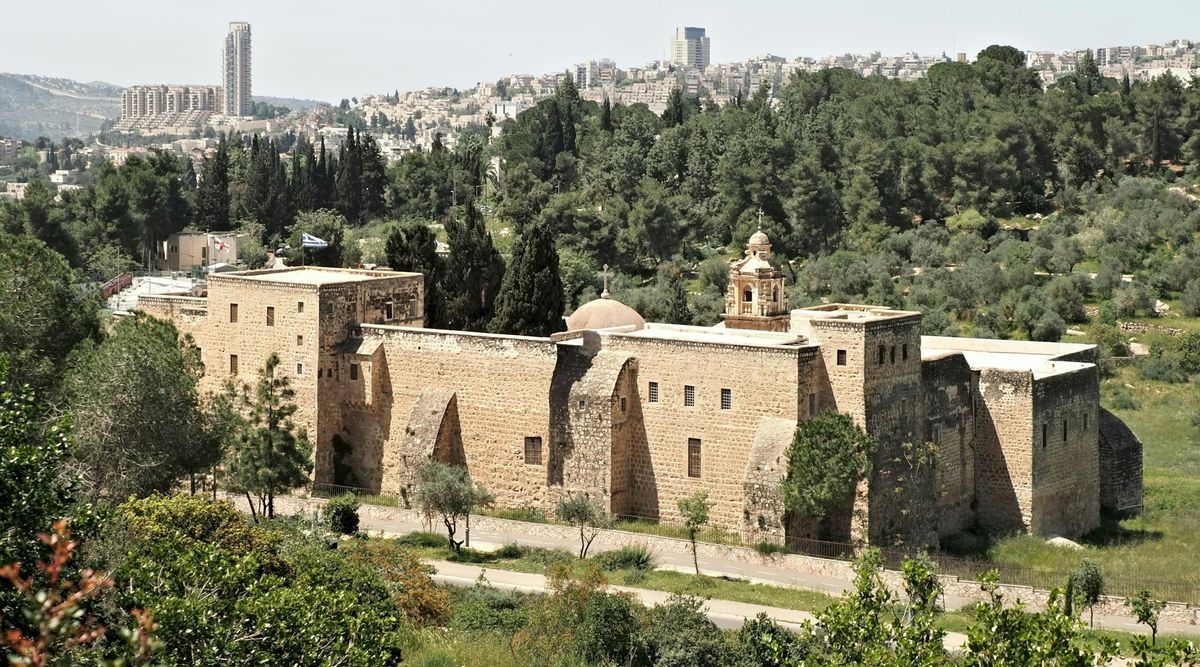
The Monastery of the Cross Jerusalem sits in the valley below the Israel Museum and the Knesset, surrounded by modern buildings but preserving the atmosphere of a medieval fortress. The site’s origins trace back to the 5th century, and the current fortress-like structure was rebuilt by Georgian monks in the 11th century. According to tradition, the tree from which the cross of Jesus was made grew on this very spot, making it one of Jerusalem’s most ancient and evocative holy sites.
The Legend of Lot’s Tree and the True Cross
According to tradition, when Lot fled the destruction of Sodom, he took three branches (of cypress, pine, and cedar) that merged into a single tree. The cutting grew into a tree in this valley. King Solomon ordered the tree cut down for use in the Temple, but it proved unsuitable and was discarded. Centuries later, the wood was used to make the cross for the crucifixion of Jesus. The spot where the tree allegedly grew is marked inside the monastery, and the story, however improbable, connects Genesis to Golgotha in a single piece of wood.
The Monastery of the Cross Jerusalem
The monastery looks like a fortress because it is one: its thick walls were built as a defense against Bedouin raids and other threats that plagued the Jerusalem countryside for centuries. Its windows are narrow and its entrance small, all designed to protect the monks from bandits and invaders. The interior includes a church with remarkable Georgian frescoes from the 12th century, and the courtyard, the refectory, and the cells create an atmosphere of monastic solitude that feels centuries removed from the busy streets of modern Jerusalem just outside the walls.
The Georgian Connection
The monastery was built and maintained by the Georgian Orthodox Church, whose presence in Jerusalem goes back to the 4th century. Its most famous patron was Queen Tamar the Great (1184–1213), the first woman to rule Georgia in her own right and one of the most powerful monarchs in the medieval Caucasus. Tamar sent diplomatic missions to Saladin himself to secure the monastery’s protection and its exemption from taxation, and she endowed churches and monasteries across the entire Christian East. According to one tradition, Tamar’s remains were brought to this monastery after her death, though Georgia claims she is buried at Gelati, and the question has never been resolved.
The monastery’s most celebrated resident was Shota Rustaveli, the author of Georgia’s national epic The Knight in the Panther’s Skin, a poem that holds the same place in Georgian culture as Shakespeare holds in English. Rustaveli is believed to have spent his final years in the monastery, and a medieval fresco portrait of him survives on one of the columns inside the church. The Georgians gradually lost control of many of their properties in Jerusalem due to mounting debts, and the monastery was sold to the Greek Orthodox Patriarchate in 1685. Today it is maintained by the Greek Orthodox Church, but the Georgian heritage lives on in the architecture, the inscriptions, and the frescoes.
Visit with Hoshen Tours
The Monastery of the Cross stands in the valley below the Israel Museum and the Knesset, a medieval Georgian fortress-monastery surrounded by modern Jerusalem. Hoshen Tours explores the 11th-century church, the mosaic floors, and the tradition that the Tree of the Cross grew in this valley. The monastery connects naturally to the Rehavia neighborhood above and the Bible Lands Museum nearby.
Ready to experience Israel in true colors?
Plan Your TourPrivate tours designed around your interests, schedule, and pace.