



Pools of Bethesda and the Church of St.Just inside the Lions’ Gate in Jerusalem’s Old City, two of the most significant Christian sites stand side by side: the Pools of Bethesda, where according to the Gospel of John Jesus healed a paralyzed man, and the Church of St. Anne, considered the most beautiful Crusader church in Jerusalem and renowned for the finest acoustics of any church in the Holy Land.
Healing at Bethesda
The Gospel of John tells the story with characteristic detail: near the Sheep Gate in Jerusalem there was a pool called Bethesda (or Bethzatha), surrounded by five covered colonnades, “where a great number of disabled people used to lie, the blind, the lame, the paralyzed” (John 5:3). Among them was a man who had been an invalid for 38 years. When Jesus asked him, “Do you want to get well?”, the man replied that he had no one to help him into the pool when the water was stirred: someone always got there before him. Jesus said to him: “Get up! Pick up your mat and walk.” At once the man was cured (John 5:6-9).
The healing took place on the Sabbath, which provoked the Jewish leaders: “The day on which this took place was a Sabbath, and so the Jewish leaders said to the man who had been healed, ‘It is the Sabbath; the law forbids you to carry your mat’” (John 5:9-10). Jesus’ response, “My Father is always at his work to this very day, and I too am working” (John 5:17), was understood as a claim to divine authority and became one of the reasons the authorities sought to kill him.
Five Porticoes
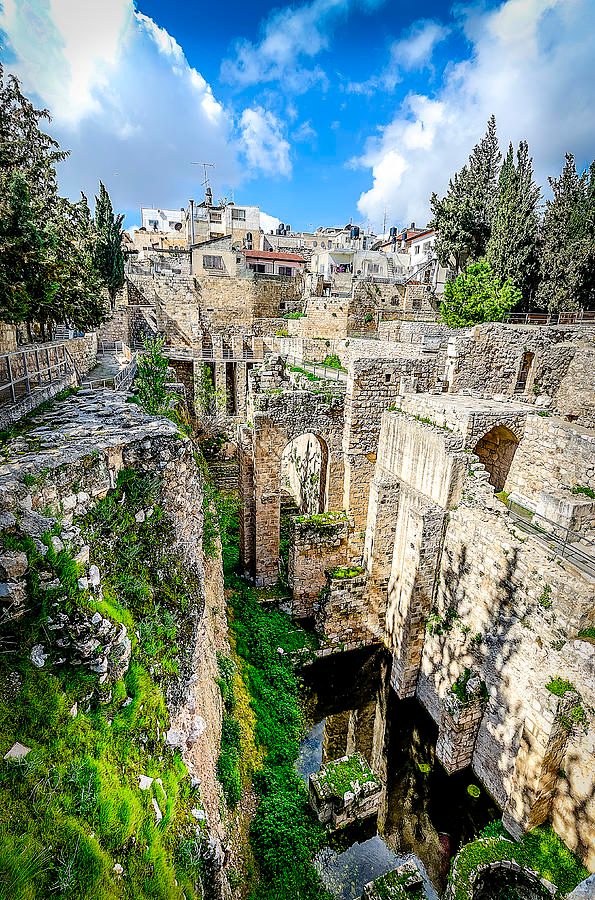
For centuries, the description of a pool with five porticoes puzzled scholars, because no known pool design had five sides. The puzzle was brilliantly solved when excavations revealed that the site consisted of two rectangular pools, side by side, separated by a central dam or wall. Colonnades ran along all four outer sides and one along the dividing wall between the pools, making five porticoes exactly as John described. The discovery was a significant vindication of the Gospel’s topographical accuracy and demonstrated that the author of John knew the physical layout of Jerusalem before the Roman destruction of 70 CE.
The Pools
The pools were originally constructed in the 8th century BCE as a reservoir for collecting rainwater, possibly to supply the Temple. In the Hellenistic and Roman periods, the site became associated with healing. A pagan healing shrine (an Asclepion, dedicated to the Greek god of medicine) may have operated here, and the sick gathered at the pools believing that supernatural healing occurred when the water was “stirred” (John 5:7). Some scholars suggest that the intermittent flow of water from an underground spring caused the periodic disturbance of the pool surface, which was interpreted as angelic activity. Jesus bypassed the entire system: he did not wait for the water to move, he simply spoke, and the man walked.
Archaeological Site
The excavated pools are deep, and visitors look down from viewing platforms into the ancient reservoir. The remains of the Byzantine and Crusader churches built over the pools are visible at various levels. The Crusaders built a chapel over the central dividing wall, and the remains of this chapel, with its arches and stone work, add to the layered archaeology. Roman-era votive offerings found at the site confirm its use as a healing shrine in the centuries before and after Jesus.
Church of St. Anne
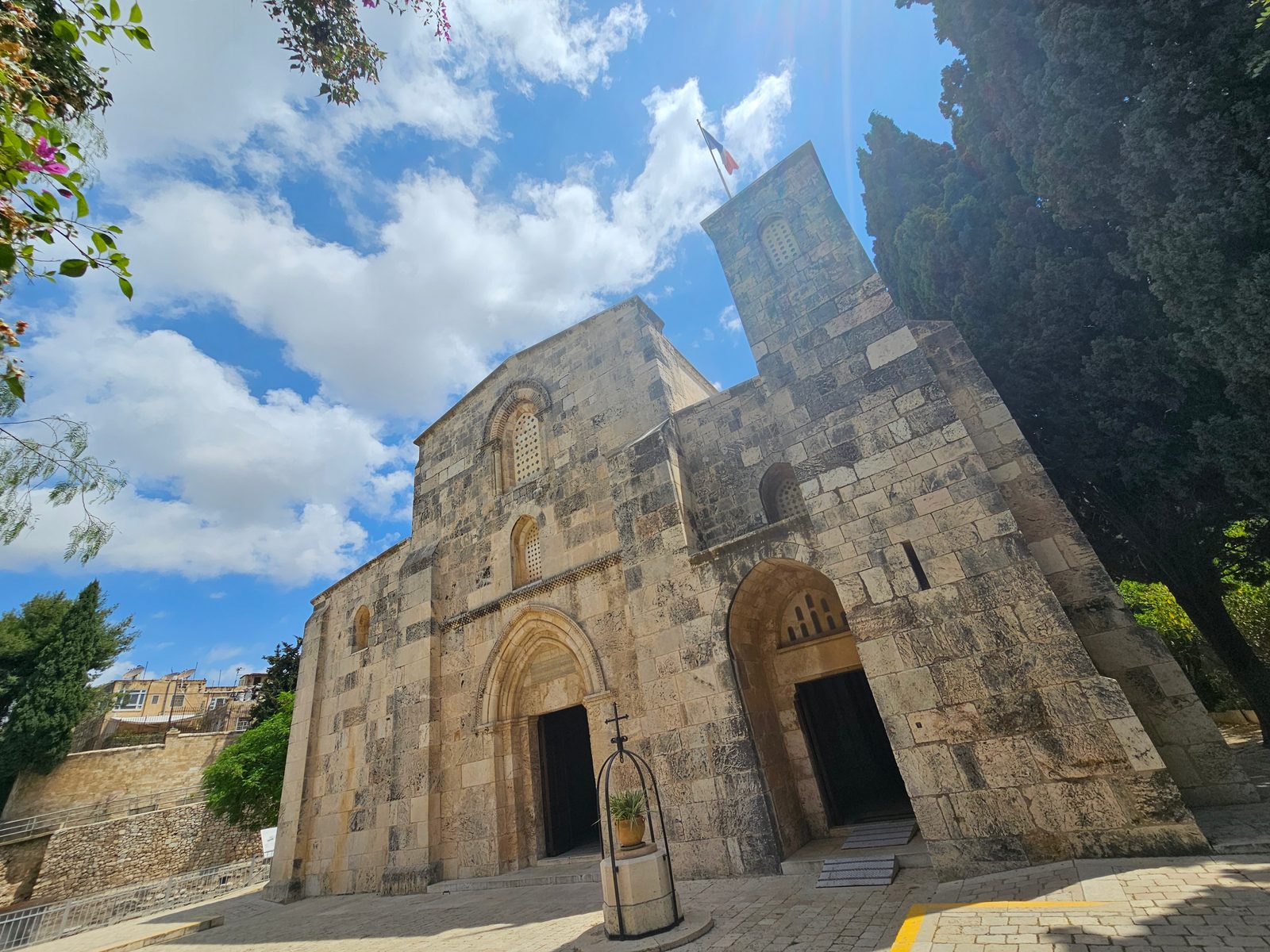
Beside the pools stands the Church of St. Anne, built by the Crusaders in 1138 and considered by many to be the most beautiful Crusader church in Jerusalem. The church marks the traditional birthplace of the Virgin Mary’s mother, Anne (Hannah in Hebrew). The tradition holds that Joachim and Anne lived in a house on this site, and that tradition holds that Mary was born here. A crypt beneath the church is identified as the room where the birth took place.
The church has survived nearly nine centuries in almost perfect condition because Saladin, after capturing Jerusalem in 1187, converted it to a madrasa (Islamic school) rather than destroying it, and the inscription above the entrance recording this conversion protected the building from damage. The French government acquired the church in 1856, and it has been maintained by the White Fathers (a Catholic missionary order) ever since.
The Finest Acoustics in Jerusalem
The most remarkable feature of St. Anne’s is its acoustics. The vaulted stone interior produces a natural reverberation that is simply extraordinary. A single voice singing in the church fills the space with sound that seems to come from every direction, and a small group of four or five voices sounds like a full choir. The reverberation time is approximately 6 to 8 seconds, meaning that each note hangs in the air long after it is sung, blending with the notes that follow. Groups who sing hymns inside the church, and many do, experience an acoustic phenomenon that is genuinely unforgettable. The acoustics are not designed; they are an accident of the stone, the vaulting, the proportions, and the absence of any sound-absorbing materials, and they have been drawing singers into the church for nearly 900 years.
Visit with Hoshen Tours
The Pools of Bethesda and the adjacent Church of St. Anne sit just inside Lions’ Gate, making them an ideal first stop on a guided walk through the Old City. From here, the Via Dolorosa begins its journey westward through the Muslim Quarter, passing the Sisters of Zion convent with its Roman pavement. Your Hoshen Tours guide will bring the Gospel account of healing at the pools to life while connecting the site to the broader history of the Temple Mount area just to the south.
Ready to experience Israel in true colors?
Plan Your TourPrivate tours designed around your interests, schedule, and pace.