



Tucked into the gentle hills of the Judean Shephelah, Beit Guvrin is one of Israel’s most rewarding and least crowded ancient sites. While its neighbor Maresha draws visitors with its remarkable underground caves, Beit Guvrin tells a different story: the story of a Roman provincial capital, a Byzantine town that flourished for centuries, and a Crusader stronghold that still stands in impressive ruins. Together, these layers make for a visit that spans more than a thousand years of history in a single afternoon.
The Setting: Where the Hills Meet the Plain
Beit Guvrin sits at the western edge of the Judean hills, where the rugged limestone ridges of the hill country gradually flatten out into the coastal plain. The landscape here is classic Shephelah: rolling chalk hills covered in scrub oak and wild sage, terraced slopes that have carried olive groves for millennia, and wide valleys that connect the interior of the land to the Mediterranean coast. In antiquity, whoever controlled Beit Guvrin controlled one of the most important road junctions in the region, the crossroads where the main east-west route from the coast to Hebron met the north-south road running the length of the country. That geography shaped everything that happened here.
Eleutheropolis: The Roman City of Free Men
The Romans understood the value of this junction immediately. After the destruction of nearby Maresha by Parthian raiders in 40 BCE, the population relocated slightly to the north, and the town that grew up on the new site became known as Beit Guvrin in Aramaic and as Eleutheropolis in Greek. The name means “City of Free Men,” a title that reflects a specific historical moment: around 200 CE, the Roman Emperor Septimius Severus formally elevated Beit Guvrin to the status of a free city, granting it the right to mint its own coins and govern its own affairs under Roman law.
At its peak in the 2nd and 3rd centuries CE, Eleutheropolis was one of the largest and most prosperous cities in the region. Estimates of its population range up to 10,000 or more, substantial for the ancient world. The city had paved colonnaded streets, public baths, temples, markets, and all the civic architecture that Roman urban culture required. The surrounding countryside was productive agricultural land, and the city’s position on major trade routes kept commerce flowing through its markets year-round.
The Roman Amphitheater
The most striking Roman structure still visible at Beit Guvrin is the amphitheater, dating to the 2nd century CE. This is a true amphitheater in the Roman sense: an oval arena surrounded by tiered seating on all sides, designed for gladiatorial combat and animal hunts rather than for theater or music. It seated approximately 3,500 spectators, which tells you something about the scale of the city that built it. True Roman amphitheaters are rare in Israel; most ancient entertainment venues here were semicircular theaters. Finding an oval arena of this size in the Shephelah is a reminder that Eleutheropolis was a fully Roman city, not just a Romanized provincial town, with all the spectacles and entertainments that Roman city life entailed.
The Byzantine Period: A Christian Town Flourishes
When the Roman Empire became Christian in the 4th century, Beit Guvrin adapted and continued to thrive. The city became a bishopric, an important center of the early Christian church in the region. Churches were built over older Roman structures, and the city’s mosaics from this period show the rich decorative tradition that Byzantine craftsmen brought to the region. Several mosaic floors have been uncovered at the site, featuring the geometric patterns, stylized animals, and floral motifs typical of Byzantine-era synagogues and churches across the land. The town remained prosperous well into the early Islamic period, only declining gradually as trade routes shifted and the urban population dispersed into smaller agricultural settlements.
The Crusader Church of St. Anne
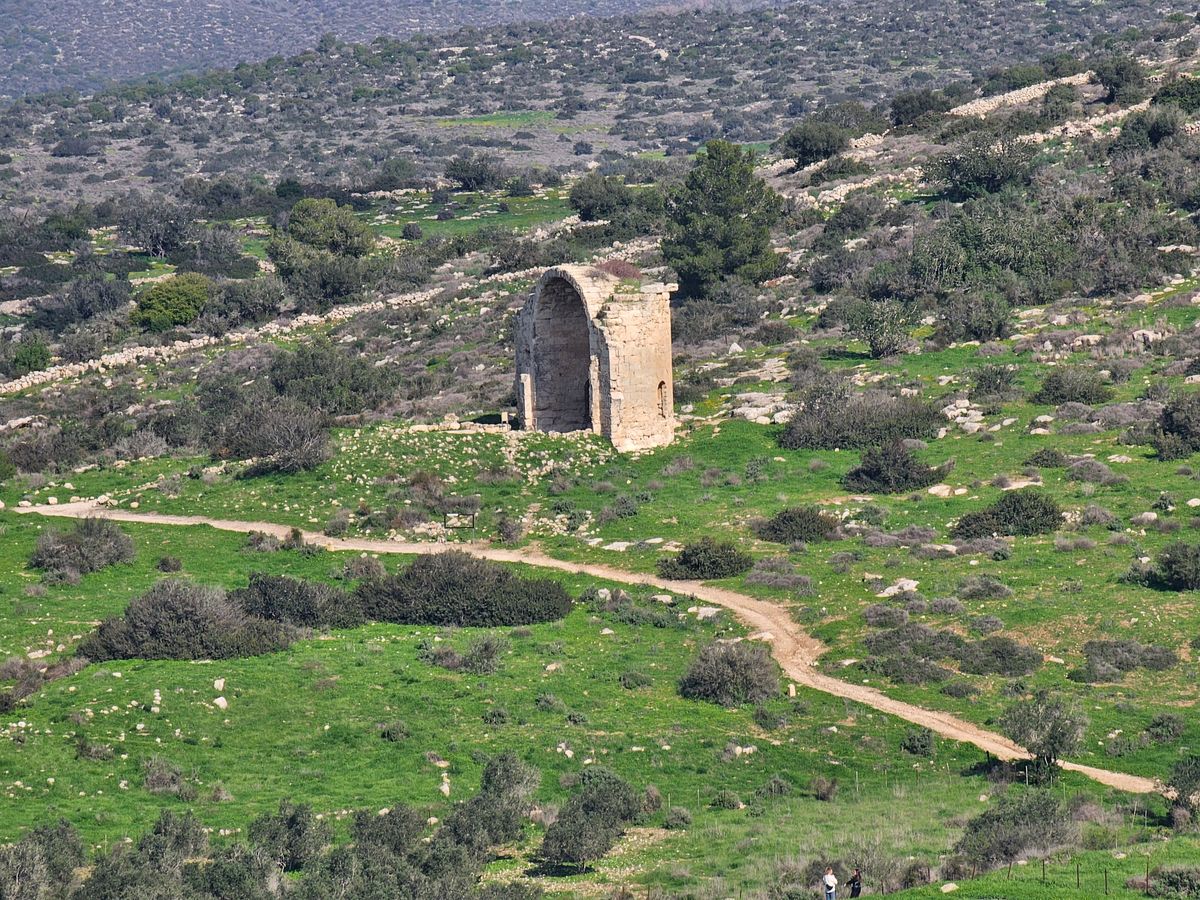
The most visually memorable structure at Beit Guvrin is the Crusader Church of St. Anne, built in the 12th century on top of much older remains. The church was a substantial Romanesque building with thick stone walls, a long nave, and a semicircular apse that still stands to its full original height. Walking around it today, you can appreciate the care that went into its construction: the carefully dressed limestone blocks, the proportions that seem simple but were carefully calculated, and the narrow windows designed to keep the interior cool and to direct filtered light toward the altar. The apse in particular is one of the best-preserved examples of Crusader ecclesiastical architecture anywhere in the Shephelah, and it gives a genuine sense of what these buildings felt like when they were new and active.
The Crusader Fortress
Alongside the church, the Crusaders built a fortress designed to control the road junction that had made Beit Guvrin strategically valuable since ancient times. The fortifications included strong outer walls, corner towers, and an inner keep. For roughly a century, this fortress was a key link in the Crusader defensive network protecting the road between the coastal port cities and the interior of the kingdom. After Saladin’s victory at the Battle of Hattin in 1187, the region changed hands repeatedly. The Crusaders briefly regained control before the Mamluk sultan Baybars ended Crusader power in the Shephelah for good in the late 13th century, and the fortress fell into ruin. What remains is still substantial enough to make the military logic of the site very clear.
Visiting Beit Guvrin
Beit Guvrin is part of the Beit Guvrin-Maresha National Park, so a visit here fits naturally alongside a walk through the extraordinary underground world of Maresha. The two sites complement each other well: Maresha takes you underground into the Hellenistic and earlier layers, while Beit Guvrin keeps you above ground in the Roman, Byzantine, and Crusader periods. Allow at least half a day to do both properly, and come in the morning when the light on the old stone is at its best and the site is quietest. The site pairs well with other Shephelah stops on the same day: the Ella Valley, where tradition places the battle between David and Goliath just a few kilometers north, and Latrun, which guards the old road to Jerusalem at the valley entrance.
Visit with Hoshen Tours
Beit Guvrin’s caves are unlike anything else in the country. Hoshen Tours pairs them with the ancient city of Maresha, the hands-on archaeology at Dig for a Day, the inscriptions at Beit Loya, and the hermitage at Horvat Burgin.
Explore Our Tour Collection
Ready to experience Israel in true colors?
Plan Your TourPrivate tours designed around your interests, schedule, and pace.