



Kafr Kanna is an Arab town in the Lower Galilee, about six kilometers northeast of Nazareth, identified by Christian tradition as the biblical Cana of Galilee, believed to be the site where Jesus performed his first miracle: turning water into wine at a wedding feast (John 2:1-11). The town is one of the most important pilgrimage sites in the Galilee and a required stop on any journey through the land of the Gospels.
The Wedding at Cana
A Jewish wedding in the 1st century was not a brief ceremony but a week-long celebration involving the entire village. The wedding at Cana according to Jewish tradition, took place on a Tuesday, the third day of the week. In Jewish tradition, Tuesday was the preferred day for weddings because in the creation account in Genesis, the third day is the only day on which God said “ki tov” (“it was good”) twice (Genesis 1:10, 1:12). A day blessed twice was considered doubly auspicious for beginning a marriage.
The celebration began with a procession. The groom, accompanied by musicians and friends, would walk through the village to the bride’s family home, then bring her back to his home or his father’s house for the feast. The wedding feast lasted seven days. Wine was not a luxury but a necessity: running out of wine was a serious social humiliation for the host family, a failure of hospitality that could shame the family for years.
It is into this setting that the Gospel of John places Jesus’ first miracle. Jesus, his mother Mary, and his disciples were guests at a wedding in Cana. When the wine ran out, Mary turned to Jesus and said, “They have no wine.” Jesus replied, “Woman, what does this have to do with me? My hour has not yet come” (John 2:4). But Mary, undeterred, turned to the servants and said simply, “Do whatever he tells you.” It is a remarkable moment: Mary does not argue, does not plead, she just tells the servants to obey. She knows her son.
The Gospel Connection
There were six stone water jars, each holding twenty to thirty gallons, used for the Jewish rites of purification. Stone was preferred over clay because, according to Jewish law, stone vessels cannot become ritually impure. Jesus told the servants to fill them with water, then to draw some out and take it to the master of the feast. When the master tasted it, he was astonished: “Everyone serves the good wine first, and then the inferior wine after the guests have become drunk. But you have kept the good wine until now” (John 2:10).
This was, according to John, “the first of his signs,” and through it Jesus “revealed his glory, and his disciples believed in him” (John 2:11). The fact that Jesus chose these specific vessels, containers of Jewish purification, to perform his first miracle was understood by later Christian readers as deeply symbolic: the old ways of purification were being transformed into something new.
From Cana to Calvary
The way Jesus addresses his mother at Cana carries a deeper significance than the miracle itself. He calls her “Woman” (Greek: gynai). To modern ears this sounds cold, even disrespectful. But in the ancient world, this was a formal, respectful address, the way a man would address a queen or a woman of standing. What is unusual is that a son would use it for his mother, rather than the more intimate “Mother” (imma in Aramaic).
Jesus uses this same word only one other time in the Gospel of John: on the cross, in his final moments, when he says to Mary, “Woman, behold your son,” entrusting her to the care of the beloved disciple (John 19:26). The word creates a deliberate arc from Cana to Calvary, from the first sign to the last breath, from a celebration of life to the moment of death. At Cana, Jesus says “my hour has not yet come.” On the cross, the hour has arrived.
The echo deepens at the moment of Jesus’ death. In John 19:34, a Roman soldier pierces his side with a spear, “and at once there came out blood and water.” The soldier, unnamed in the Gospel but identified by later tradition as Longinus, pierced Jesus’s side with a spear. Separately, a centurion present at the crucifixion, witnessing the manner of Jesus’s death, declared, “Truly this was the Son of God” (Matthew 27:54). At Cana, water became wine, a sign of joy and abundance. At the cross, blood and water flowed from Jesus’s body, a sign of sacrifice and redemption. The first sign and the last moment mirror each other, and together they frame the entire Gospel.
The Wedding Church
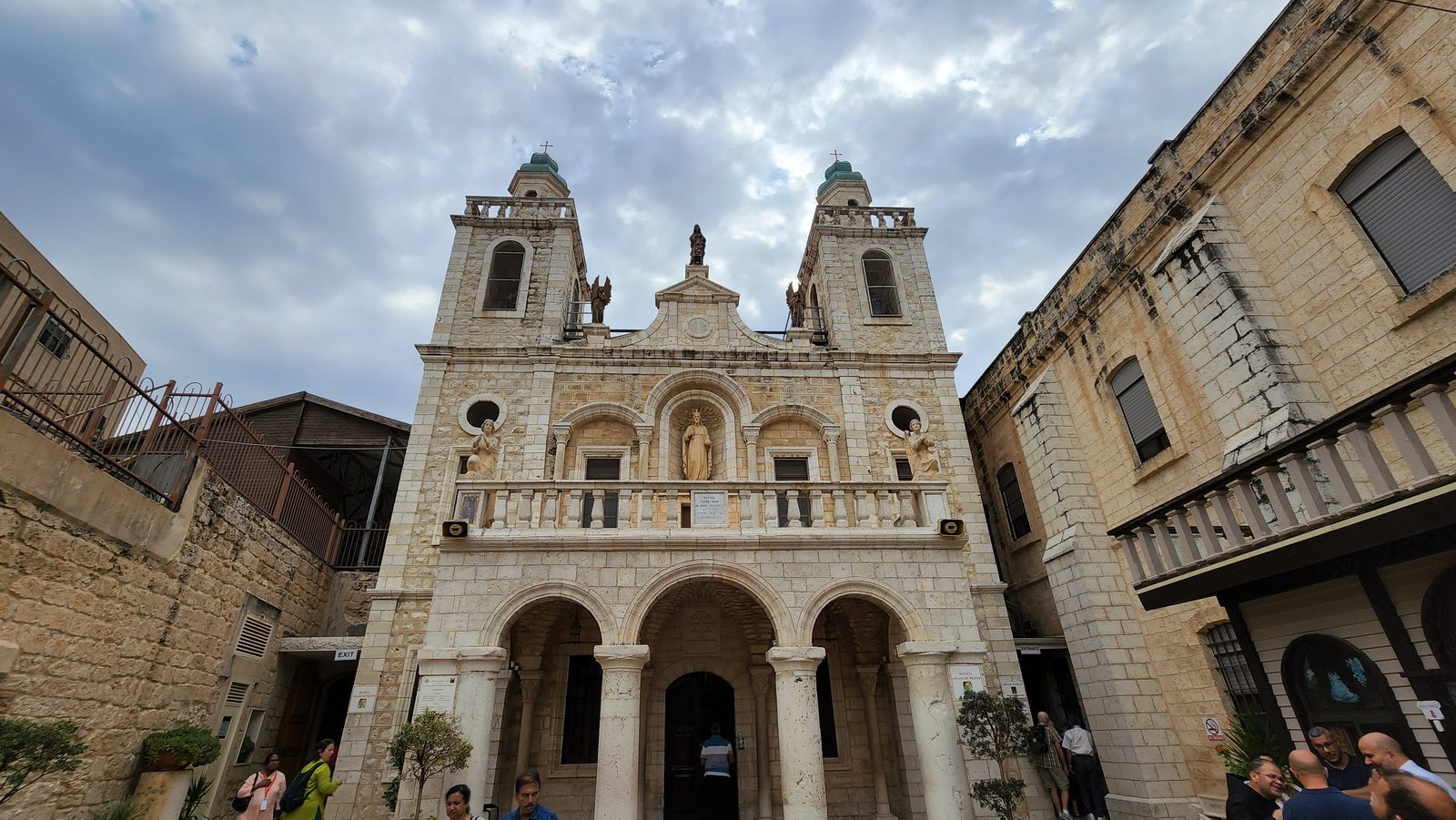
The Franciscan Wedding Church, built in 1881 on the remains of earlier churches, is the main pilgrimage site in Kafr Kanna and the place most visitors come to see. The church was built over the ruins of a Byzantine-era church, and beneath it archaeologists found a mosaic floor with Aramaic inscriptions and what may be the remains of a 1st-century Jewish house. The church’s interior features frescoes depicting the miracle, and the altar is decorated with reliefs showing the water jars. A stone jar displayed inside the church is venerated as one of the original six jars mentioned in the Gospel.
Thousands of couples come to the Wedding Church each year to renew their marriage vows in the place tradition identifies with Jesus’s first miracle at a wedding with his first miracle. The ceremony, conducted by the Franciscan friars, is one of the most moving experiences available to Christian pilgrims in the Holy Land.
A short walk away stands the Greek Orthodox Church of St. George, which also claims to mark the site of the miracle. The Orthodox church, smaller and older in atmosphere, displays its own ancient stone jar in the crypt, which it, too, identifies as one of the original vessels from the wedding. Each church insists its jar is authentic, a quiet rivalry that reflects the broader pattern of competing traditions at holy sites across the Land of Israel.
Healing the Official’s Son
John’s Gospel records a second miracle at Cana. A royal official from Capernaum, likely a servant of Herod Antipas, traveled approximately 30 kilometers to find Jesus in Cana and begged him to come down and heal his son, who was close to death. The man’s desperation is clear: he was a figure of status and authority, yet here he was pleading with an itinerant preacher from a Galilean village.
Jesus did not go with him. Instead, he said simply, “Go; your son will live” (John 4:50). No journey, no laying of hands, no dramatic gesture, just a word spoken across the distance. The official believed and left. On his way home, his servants met him with the news that the boy had recovered. When he asked what hour the fever had broken, they told him: the seventh hour, the exact moment Jesus had spoken.
This was “the second sign that Jesus did after coming from Judea to Galilee” (John 4:54). Where the first sign at Cana revealed abundance and joy, the second revealed authority over life and death, a healing performed from a distance, by word alone. And in both cases, the key was the same: believing before seeing. The official left Cana not knowing whether his son was alive. He trusted the word and walked home. That, for John, is what faith looks like.
“Can Anything Good Come from Nazareth?”
Cana is also the hometown of Nathanael (also called Bartholomew), one of the twelve apostles. When Philip told Nathanael that he had found the one Moses and the prophets wrote about, Jesus of Nazareth, Nathanael’s response became one of the most quoted lines in the Gospels: “Can anything good come out of Nazareth?” (John 1:46). The dismissal reflects a real rivalry between Galilean villages: Nazareth was tiny, obscure, and apparently not well regarded even by its neighbors. Philip did not argue. He simply said, “Come and see.”
When Nathanael came to Jesus, Jesus greeted him with the words, “Here is truly an Israelite in whom there is no deceit.” Nathanael, startled, asked how Jesus knew him. Jesus answered, “I saw you under the fig tree before Philip called you.” The detail was enough. Nathanael declared, “Rabbi, you are the Son of God! You are the King of Israel!” (John 1:47–49). The skeptic from Cana became one of the first to recognize who Jesus was.
Question of Location
Is Kafr Kanna really the biblical Cana? The identification has been debated for centuries. An alternative site, Khirbet Qana, lies about 9 kilometers north-northwest of Nazareth on a hilltop overlooking the Beit Netofa Valley. Archaeological excavations at Khirbet Qana have uncovered a 1st-century Jewish village with ritual baths (mikvaot), a cave with Christian graffiti mentioning the miracle, and stone vessel fragments. Many scholars now believe Khirbet Qana has a stronger archaeological claim to being the biblical Cana.
Kafr Kanna’s identification as Cana dates primarily to the Crusader period, when pilgrims looking for convenient sites near the main road between Nazareth and Tiberias settled on this town. Regardless of the archaeological debate, Kafr Kanna has been the site of continuous Christian veneration for over 700 years, and the faith and devotion of millions of pilgrims have made it a holy place in its own right.
Visit with Hoshen Tours
Kafr Kanna is a mixed town of about 21,000 residents, mostly Muslim and Christian Arabs. The old center preserves the narrow streets, stone houses, and the atmosphere of a traditional Galilean village, with shops selling olive wood carvings, wine, and religious souvenirs. Hoshen Tours visits the Wedding Church, tells the story of the miracle, and for couples who wish, helps arrange a vow renewal ceremony. The site pairs beautifully with Mount Tabor, Nazareth, and the other Gospel sites of the Lower Galilee.
Explore Our Tour Collection
Ready to experience Israel in true colors?
Plan Your TourPrivate tours designed around your interests, schedule, and pace.