



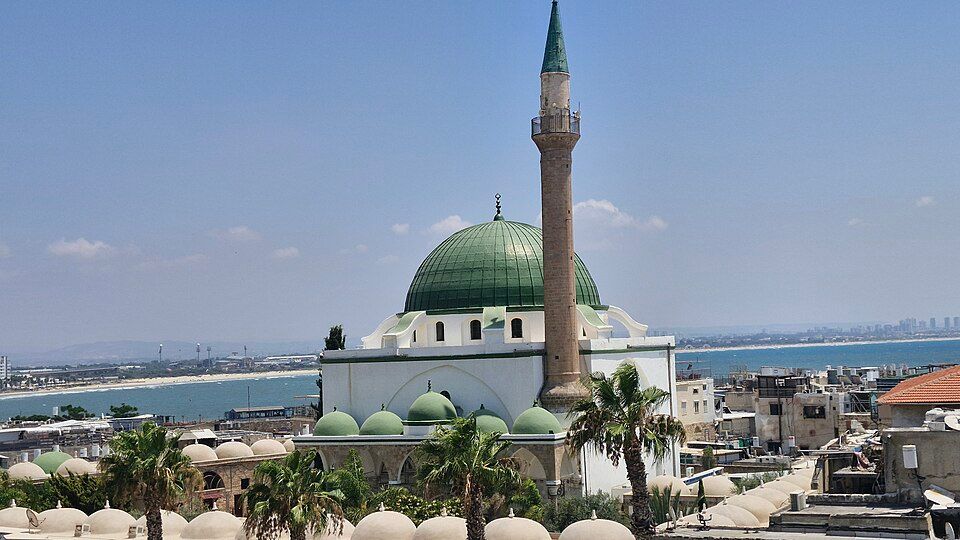
 The Al-Jazzar Mosque is the dominant landmark of Akko’s Old City and the largest mosque in Israel outside of Al-Aqsa in Jerusalem. Completed in 1781 by Ahmad Pasha al-Jazzar, the Ottoman governor who transformed Akko into a major regional power, the mosque stands at the heart of the walled town with its green dome and slender minaret visible from across the bay and from the hills above Haifa.
Ahmad Al Israel-Jazzar
Ahmad Pasha al-Jazzar was one of the most powerful and feared figures in the late Ottoman Levant. Born in Bosnia around the 1720s, he was sold into slavery as a young man in Egypt and rose through the Ottoman military system with a combination of political cunning, administrative skill, and a reputation for extreme cruelty that earned him the nickname “the Butcher.” By 1776 he had secured the governorship of the Sidon province, which included Akko, and he made the city his capital.
Al-Jazzar was both brutal and effective. He rebuilt Akko’s fortifications, expanded its commercial life, constructed the great Khan al-Umdan for merchants, built a Turkish bathhouse (the Hammam al-Basha), and turned a declining port town into the most important city on the coast. The mosque that bears his name was the crown of his building program, a statement of power and piety that still dominates the Akko skyline nearly 250 years later. He and his successor Suleiman Pasha are buried in a small mausoleum adjacent to the mosque.
The Al-Jazzar Mosque
 The mosque was built in the Ottoman imperial style, with a large central dome, a spacious courtyard with a fountain for ablutions (sabil), and arcaded galleries supported by columns that al-Jazzar had transported from the ruins of Roman Caesarea and other ancient sites along the coast. The reuse of ancient columns was both practical and symbolic, connecting Ottoman Akko to the grandeur of the classical past.
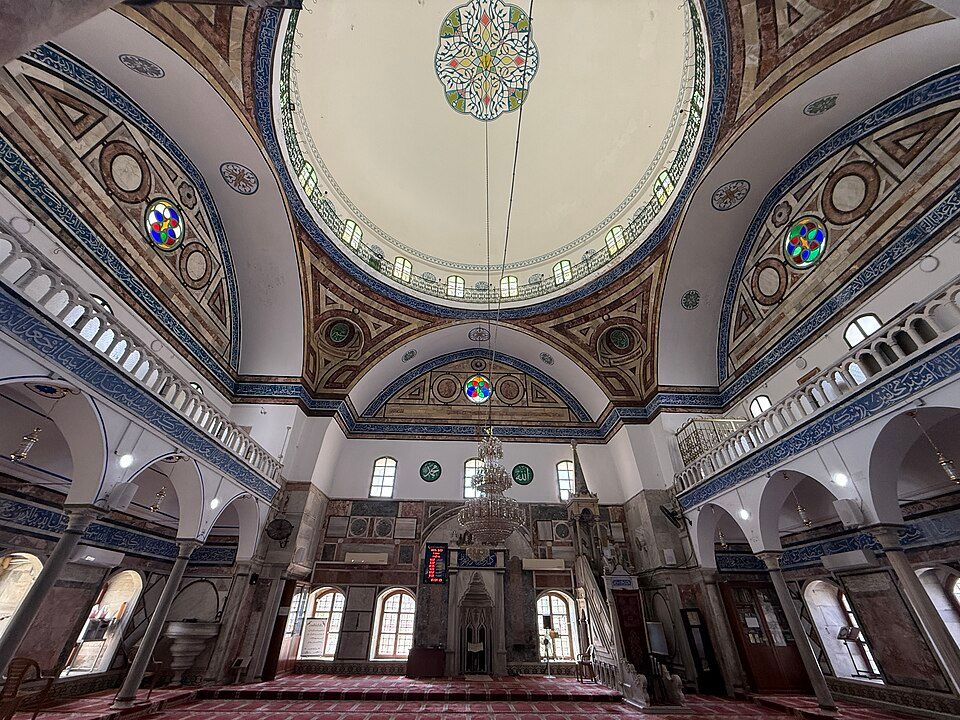
Inside, the prayer hall is richly decorated with Quranic calligraphy, painted panels, Ottoman tilework, and stained glass windows that fill the space with colored light. The mihrab (prayer niche indicating the direction of Mecca) is ornately carved. Beneath the courtyard, massive vaulted cisterns, some possibly dating to the Crusader period, stored water for the mosque and surrounding neighborhood.
The mosque’s status as the largest in Israel outside the Al-Aqsa compound in Jerusalem is not merely a matter of size. It reflects the importance of Akko in the Ottoman period as the administrative capital of the region and al-Jazzar’s ambition to build a monument worthy of that status.
The Hair of the Prophet
Tradition holds that the mosque houses strands of hair believed to have belonged to the Prophet Muhammad, kept in a specially crafted container and displayed on certain religious occasions. Relics of this kind are found in a small number of mosques across the Islamic world, and their presence elevates a mosque from a local house of worship to a site of broader spiritual significance. For Muslim visitors and pilgrims, the hair of the Prophet is the reason some travel specifically to Akko. The tradition is treated with deep reverence by the local community, and visitors who happen to be present when the relic is brought out describe it as a moment of intense collective devotion.
Napoleon at the Gates
In the spring of 1799, Napoleon Bonaparte marched north along the coast from Egypt with an army that had taken Gaza, Jaffa, and Haifa in quick succession. Akko was next, and its fall would have opened the road to Damascus, to the Ottoman heartland, and to an eastern empire that Napoleon believed could rival Alexander’s. He expected the city to fall within days.
It did not. Al-Jazzar directed the defense from within these walls with fierce determination, rallying his garrison and organizing the city’s population for a prolonged siege. At sea, Commodore Sir Sidney Smith of the British Royal Navy intercepted a French flotilla carrying Napoleon’s heavy siege artillery, denying him the guns he needed to breach Akko’s fortifications. Without those weapons, the French assault stalled. Napoleon threw his forces at the walls repeatedly over more than two months, suffering heavy casualties from disease as well as combat. In May 1799, he ordered the retreat south to Egypt. It was one of the few outright defeats of his career, and historians have argued that the failure at Akko prevented a French consolidation of the eastern Mediterranean that might have reshaped the map of Europe and the Middle East entirely.
Visit with Hoshen Tours
A visit to Al-Jazzar Mosque pairs beautifully with nearby destinations along your route. Consider combining it with a stop at Knights Halls in Akko or Tunisian Synagogue in Akko, both just a short drive away. Many travelers also enjoy exploring Akko Prison and Templar Tunnel in Akko on the same day, while Rosh HaNikra offers another worthwhile addition to your itinerary. Your Hoshen Tours guide will craft a seamless route that brings each destination to life with expert commentary and insider knowledge.
Ready to experience Israel in true colors?
Plan Your TourPrivate tours designed around your interests, schedule, and pace.