



You walk to the edge, and the world drops away.
There is no warning. One moment you are standing in the Negev, a landscape of low scrub and dusty roads that feels familiar in its emptiness. The next moment, the ground is simply gone. In its place: a chasm so vast your brain needs a second to catch up. Forty kilometers long. Nine kilometers wide. Five hundred meters straight down. Makhtesh Ramon is the largest erosion crater on the face of the earth, and nothing — not the photographs, not the descriptions — prepares you for the first time you stand on the rim and look in.
Not a Crater — Something Rarer
Here is the thing most people get wrong: this is not a meteor impact. It is not a volcano. It is something far stranger — a geological formation so rare that the only word for it is Hebrew, because it does not exist anywhere else.
A makhtesh — literally “mortar,” as in mortar and pestle — forms when a dome of hard limestone rises over millions of years, pushed up by tectonic forces. Beneath that hard shell, softer layers of sandstone and clay sit waiting. Cracks appear. Rainwater seeps in. And slowly, over tens of millions of years, the soft interior is hollowed out from the inside, like a tooth decaying beneath its enamel, until all that remains is the hard outer rim standing guard over an enormous bowl of exposed rock.
There are only five makhteshim in the world. Three are in Israel’s Negev. Two more in Egypt’s Sinai. That is it. Geologists worldwide have adopted the Hebrew word because no other language needed one.
A Desert Painted in Color
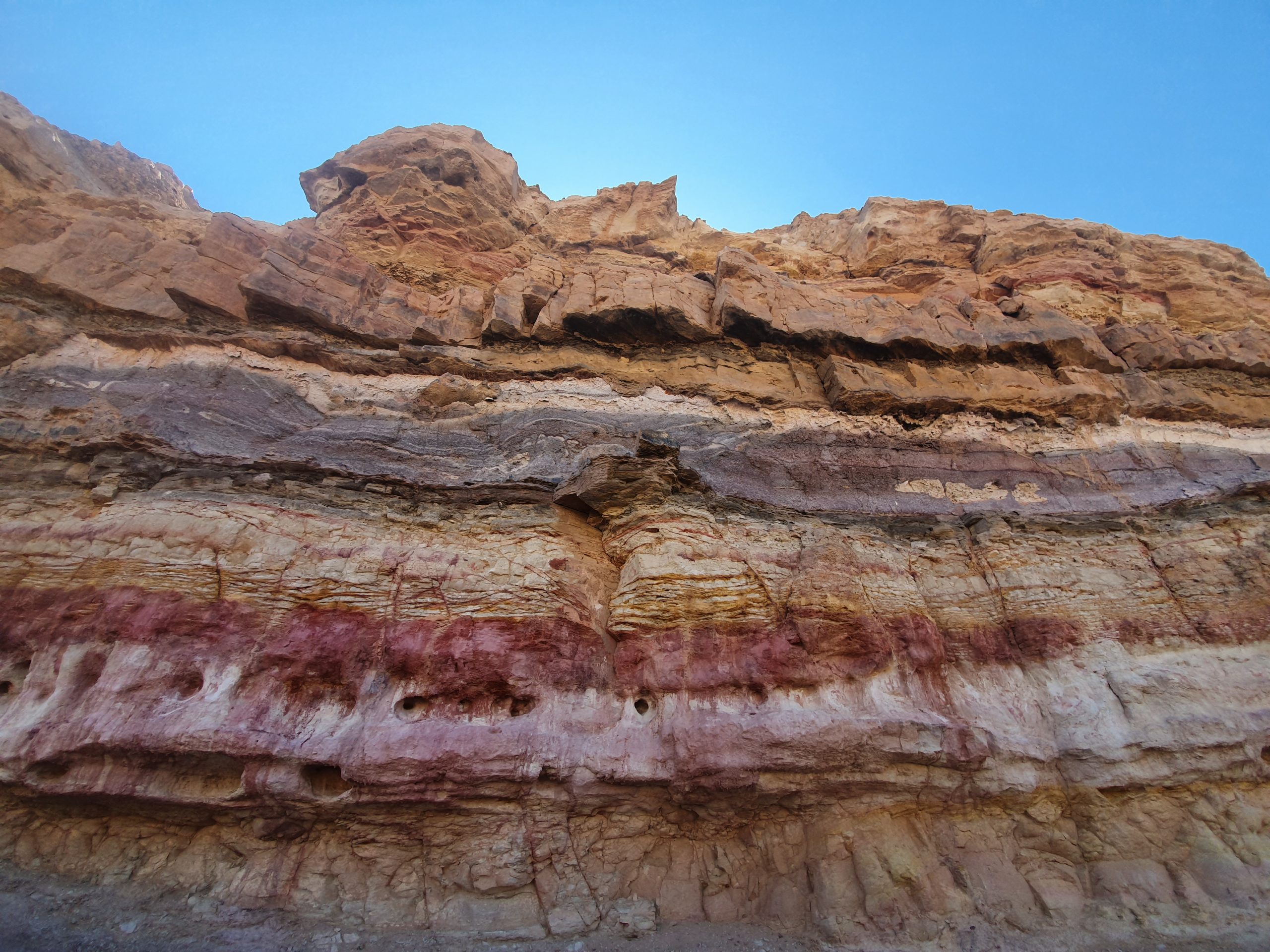
Step inside the crater and you step into a painting. The walls are striped in bands of deep red iron oxide, bright yellow limonite, purple, white, and black — each color a different geological age, each layer a chapter in a story that stretches back over 200 million years to the Triassic period. At sunrise, the low-angle light rakes across the rock and the colors catch fire. Red walls go crimson. Yellow turns to burnt orange. Shadows pool at the crater floor while the rim glows gold.
And then there are the fossils. The Negev was once the floor of an ancient sea called the Tethys, and the proof is everywhere. Ammonites — the spiral-shelled relatives of the nautilus — lie embedded in the rock, some over a meter across. Marine creatures, fossilized in stone, baking in the desert sun 500 meters above the valley floor. It is one of those facts that reshapes how you see the landscape: this was ocean, then swamp, then desert, and the rock remembers all of it.
One site inside the crater stops every visitor in their tracks. Prism Hill — known locally as HaNagariya, “the Carpentry” — is a hillside covered with prismatic columns of black basalt so perfectly shaped they look machined, as if a giant carpenter cut and stacked them. Nearby, an exposed wall of ammonite fossils shows dozens of spiral shells embedded in the rock face, each one a record of a creature that swam in warm shallow waters where the desert floor now shimmers with heat.
Adventures on the Crater Floor
Makhtesh Ramon is not a place you admire only from the rim. The crater is alive with trails, wildlife, and experiences that draw you down into it.
Marked hiking trails descend from the rim to the crater floor and lead to the ammonite wall, Prism Hill, and the ancient Ein Saharonim spring — where Nabatean caravans once stopped to water their camels on the Incense Route from Arabia to the Mediterranean. The ruins of their caravanserai still stand, and the spring still flows, drawing Nubian ibex to a small grove of acacia trees. Watching an ibex pick its way down a sheer cliff face with calm, unhurried confidence is worth the hike alone.
For those who want more adrenaline, there is rappelling down the crater walls, jeep tours across the floor, and mountain biking through terrain that feels like another planet. Above it all, Egyptian vultures ride the thermals and Tristram’s starlings flash their orange wing patches from the cliff faces.
And when the sun goes down, Makhtesh Ramon offers something else entirely. The crater has been designated a dark-sky area, and on a clear night — with no light pollution for many kilometers in any direction — the Milky Way stretches overhead in a clarity that most visitors have never experienced. The silence is total. No traffic, no voices. Just the stars and the ancient rock beneath you.
Visit Makhtesh Ramon with Hoshen Tours
Makhtesh Ramon is the Negev at its most dramatic — the kind of place that changes how you think about Israel and about deserts. Hoshen Tours takes you beyond the rim viewpoint and down into the crater itself for close encounters with the colored rock, the fossils, and the wildlife. We combine it with the Nabatean ruins at Avdat, Ben-Gurion’s desert retreat at Sde Boker, the desert canyon pools of Ein Avdat, and the smaller makhteshim nearby for a full Negev day that you will not forget. This is one of those rare places where geology, history, and raw natural beauty converge — and standing on that rim for the first time is a moment that stays with you.
Explore Our Tour Collection
Ready to experience Israel in true colors?
Plan Your TourPrivate tours designed around your interests, schedule, and pace.