



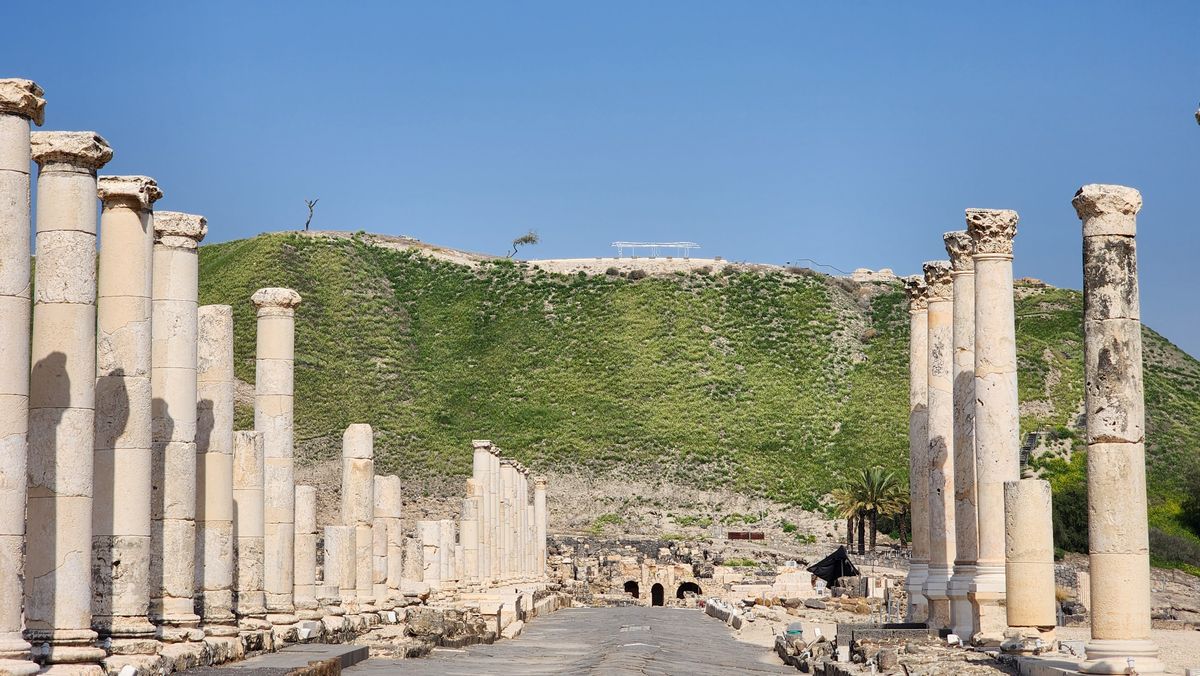
Beit She’an is the best-preserved Roman city in Israel and one of the most impressive archaeological sites in the entire Middle East. Walking down its colonnaded main street, past the bathhouse, the theater, and the public toilets (yes, Roman public toilets, and they are fascinating), you get a visceral sense of what urban life looked like two thousand years ago. Then you look up at the tel towering above the ruins, and you realize that people have been living here for five thousand years.
5,000 Years of Settlement
Beit She’an sits at one of the most strategically important crossroads in the ancient world: the junction of the Jezreel Valley and the Jordan Valley. Whoever controlled Beit She’an controlled the road from Egypt to Mesopotamia, the road from the coast to the Jordan crossing, and some of the most fertile agricultural land in the region. People figured this out early. The tel above the Roman city contains settlement layers going back to the Chalcolithic period, roughly 5,000 years ago.
The Egyptians were here. A governor’s residence from the Late Bronze Age has been excavated on the tel, complete with Egyptian artifacts and administrative records. Beit She’an was an Egyptian garrison town for centuries, controlling the Canaanite population and protecting the trade routes that connected Egypt to its northern territories. Scarabs, stelae, and Egyptian-style buildings confirm a strong and sustained Egyptian presence.
Saul’s Last Stand
Beit She’an’s most dramatic biblical connection comes at the end of King Saul’s life. After the battle of Mount Gilboa, where Saul and his sons were killed by the Philistines, the victors took Saul’s body and hung it on the walls of Beit She’an as a trophy (1 Samuel 31). The men of Jabesh Gilead, across the Jordan, risked a night mission to recover the bodies and give them a proper burial. Standing on the tel and looking toward Gilboa, the geography of the story becomes painfully clear.
Scythopolis: The Roman-Byzantine City
The city that visitors see spread out below the tel is Scythopolis, the Roman name for Beit She’an. It was one of the ten cities of the Decapolis, a league of Greco-Roman cities in the eastern Mediterranean, and the only member of the Decapolis located west of the Jordan River. At its peak in the Byzantine period, Scythopolis had a population of roughly 40,000 and was one of the most important cities in Palestine.
The excavated city center is extraordinary in its scale and preservation. The main street, Palladius Street, runs straight through the heart of the city, lined with columns and flanked by shops whose stone counters are still in place. You can see where the merchants displayed their goods, where the customers stood, and where the street drainage carried rainwater away. It is the closest thing to walking through a living Roman city that exists anywhere in Israel.
The Theater
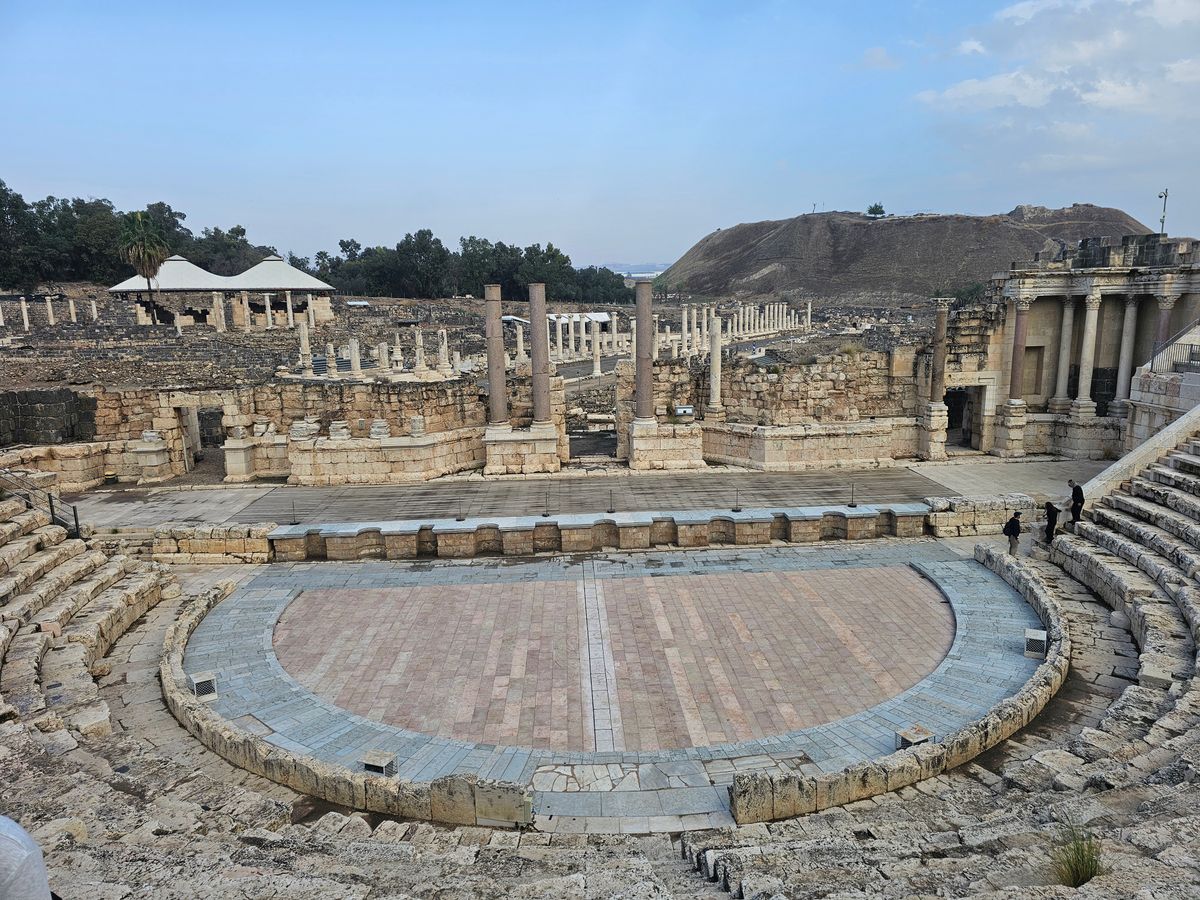
The Roman theater, built in the 2nd century CE, seated approximately 7,000 spectators and is one of the best-preserved theaters in the country. The semicircular seating area (cavea) rises in tiers from the orchestra floor, and the acoustics remain impressive. Sitting in the upper rows and imagining a full house watching a Greek tragedy or a Roman comedy, you understand that Scythopolis was not a provincial backwater. It was a city that took its entertainment seriously.
The Bathhouse
The Roman bathhouse complex is one of the highlights of the site. The rooms follow the classic Roman bathing sequence: the frigidarium (cold room), tepidarium (warm room), and caldarium (hot room). The hypocaust system, which heated the floors and walls by circulating hot air through channels beneath and behind them, is clearly visible. The engineering is remarkable, and the fact that it was built in a city in the Jordan Valley, where summer temperatures routinely exceed 40 degrees Celsius, suggests that the Romans valued their bathing rituals regardless of the climate.
The Public Toilets
Yes, the public toilets. The Roman latrine at Beit She’an is a long bench with keyhole-shaped openings, positioned over a channel of running water. The seats are side by side with no partitions. Privacy was not a Roman priority. A shallow channel in front of the seats carried water for the shared sponge-on-a-stick that served as toilet paper. Visitors find this either horrifying or hilarious, and guides use it to illustrate just how different daily life was in the ancient world.
The Earthquake of 749 CE
On January 18, 749 CE, a massive earthquake struck the Jordan Valley and destroyed Scythopolis. The destruction was sudden and total. Columns toppled in rows, walls collapsed, and the city’s inhabitants fled. The city was never rebuilt on the same scale. The earthquake preserved the Roman-Byzantine city under a layer of rubble, and modern excavations have brought it back to light in a condition that is remarkably close to the moment of destruction.
Walking through the ruins, you can see fallen columns lying where they landed, crushed shops, and buildings frozen in the moment of collapse. It is archaeology as time capsule, and the effect is powerful.
The Night Show
Beit She’an offers an evening sound and light show that illuminates the ruins and tells the city’s history through projections on the ancient stones. The show uses the theater, the main street, and the bathhouse as its stage, and the combination of ancient architecture and modern technology creates an experience that is both educational and genuinely dramatic. The night show is one of the best evening activities in northern Israel.
Visit Beit She’an with Hoshen Tours
Beit She’an deserves a full visit, not a quick stop. The site is large enough to require at least two hours, and a knowledgeable guide makes the difference between admiring old stones and understanding the city that once lived among them. Hoshen Tours combines Beit She’an with Beit Alpha, Gan HaShlosha, and the Jordan Valley for a day that covers Roman engineering, ancient art, and a swim in natural warm springs. Because after two hours of walking through a Roman city in the Jordan Valley heat, you will want that swim.