



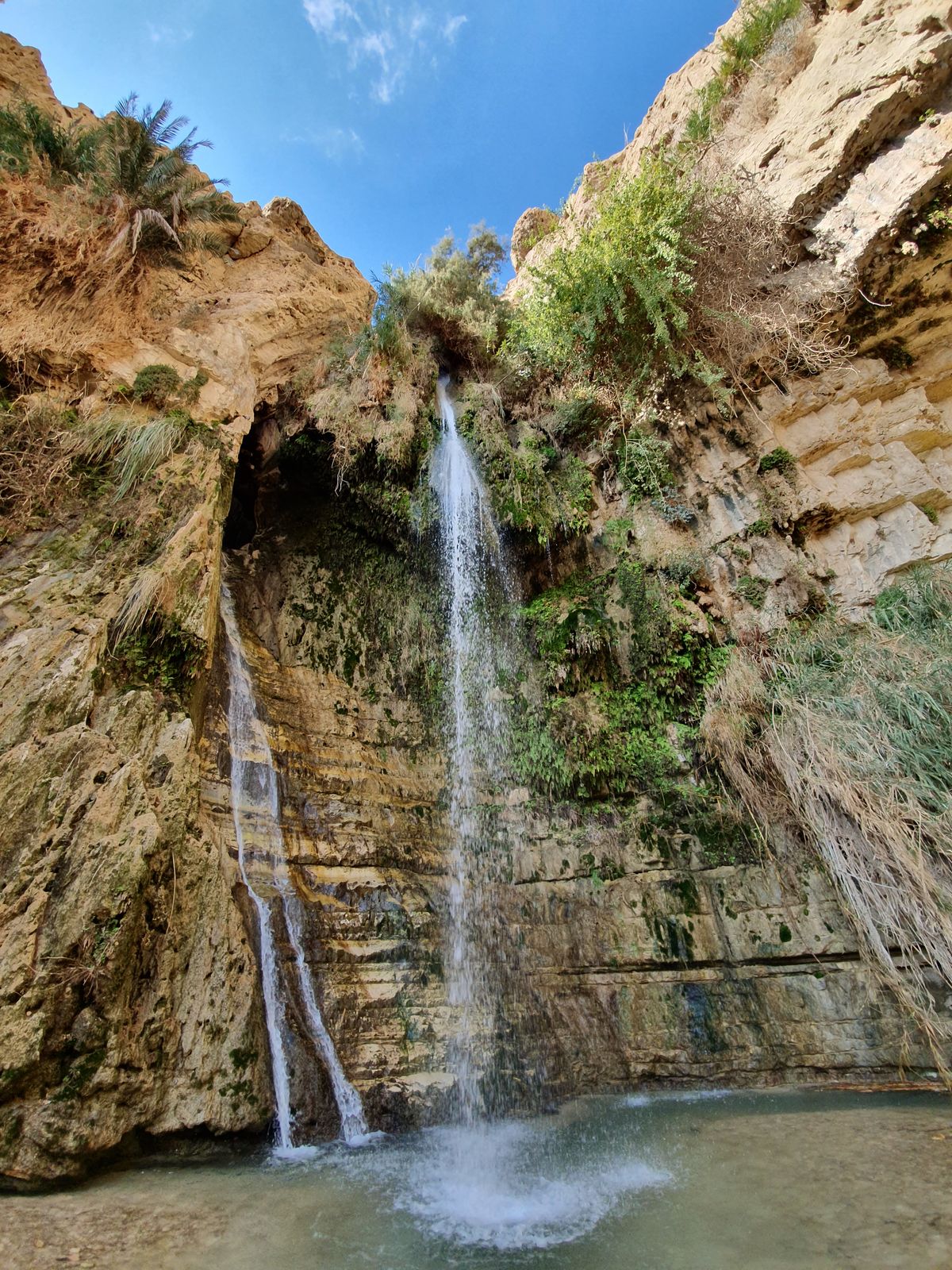
Ein Gedi is a miracle of geography: a lush, green oasis fed by freshwater springs in the middle of the driest, most barren landscape in Israel. Waterfalls cascade over desert cliffs, ibex climb the rocks with impossible grace, and hyraxes sun themselves on the boulders. The contrast between the green canyon and the surrounding desert is so dramatic that it feels like walking through a crack in reality.
David and Saul: A Story About Mercy
The caves above Ein Gedi are where David hid from King Saul, who was hunting him across the Judean Desert with 3,000 soldiers. David had done nothing wrong. He was the man Samuel had anointed king, the hero who had killed Goliath, the beloved son-in-law of Saul himself. And Saul was trying to kill him anyway, driven by jealousy and fear. David and his men had taken refuge in the caves of Ein Gedi, knowing this wild, waterfall-threaded terrain the way a shepherd knows his own hillside. Then Saul walked right into the cave where they were hiding.
“He came to the sheep pens along the way; a cave was there, and Saul went in to relieve himself. David and his men were far back in the cave” (1 Samuel 24:3). The soldiers with David saw it immediately: here was God delivering the king’s enemy into his hand. Kill him now. End this. David crept forward in the darkness while Saul was occupied, and with his knife he cut off the corner of Saul’s robe.
Even that small act troubled him. “The Lord forbid that I should do such a thing to my master, the Lord’s anointed, or lay my hand on him; for he is the anointed of the Lord” (1 Samuel 24:6). He held his men back. He let Saul leave the cave. And then, when Saul was at a safe distance and walking away, David stepped out and called after him. He bowed to the ground. He held up the piece of robe. Look, he said. Look at this. I could have killed you. I was close enough to cut your robe. But I did not touch you, because you are God’s anointed, and it is not for me to harm you. Judge for yourself whether I am your enemy.
Saul wept. “You are more righteous than I. You have treated me well, but I have treated you badly” (1 Samuel 24:17). It is one of the most powerful scenes in the Bible, not a story about warfare or conquest but a story about restraint and honor. David, who would have been completely justified in killing his persecutor, chose mercy because of his understanding of what was sacred. And that choice was made here, in the dark caves above the springs of Ein Gedi.
The caves of Ein Gedi, dark, deep, and interconnected, make the story physically vivid. You can see how a man could hide in the back of a cave and remain unseen, how the terrain could shelter a fugitive band, and why David, who knew every hiding place in this desert, was never caught.
Song of Songs
Ein Gedi appears in the Song of Songs, the Bible’s great love poem: “My beloved is to me a cluster of henna blossoms from the vineyards of Ein Gedi” (Song of Songs 1:14). Henna, known in Hebrew as kofer, grew abundantly in the oasis, and its fragrant white blossoms were used to make perfume and dye. The mention of Ein Gedi’s vineyards, in a desert landscape where nothing should grow, makes the image more powerful: love, like an oasis, flourishes in unexpected places.
The image is also commercially specific. Ein Gedi was famous throughout the ancient world for its production of Judean balsam, an extraordinarily valuable perfume ingredient extracted from the Ein Gedi balsam plant. This perfume was worth more than its weight in gold in the Roman period, and the Ein Gedi community grew wealthy producing it. When the Song of Songs invokes Ein Gedi’s vineyards and blossoms, its ancient listeners would have heard the mention of one of the most luxurious products in the known world. The beloved is being compared to something exquisite and rare.
The Ancient Perfume Industry
The balsam trade made Ein Gedi prosperous for centuries. The ancient synagogue at Ein Gedi, which dates from the Byzantine period, contains a mosaic floor with an inscription that famously curses anyone who reveals “the secret of the town.” Scholars believe the secret was the cultivation technique for the balsam plant, which produced the prized perfume. The plant was so valuable that the Jewish community guarded the knowledge of how to grow it as a community asset. When the Byzantine period ended and the community dispersed, the secret was lost, and the plant disappeared from Ein Gedi. The balsam of Ein Gedi is gone, but the mosaic inscription is still there.
Sicarii Massacre
Ein Gedi’s history includes one of the darkest episodes of the Great Revolt against Rome. According to Josephus, the Sicarii based at Masada raided Ein Gedi during the Passover festival around 68 CE, killing over 700 inhabitants, including women and children, and plundering the settlement for supplies. The victims were fellow Jews, and the massacre is one of the reasons that historians view the Masada defenders with more complexity than the heroic narrative suggests. The people who made their last stand against Rome had first turned their swords on their own neighbors.
Nahal David and Nahal Arugot: Two Canyons, Two Worlds
The reserve has two main hiking canyons. Nahal David, the more popular of the two, follows a year-round stream through lush vegetation to David’s Waterfall, a cascade that drops into a cool pool surrounded by ferns and tropical plants. The hike is short (about 30 minutes each way) and accessible to most visitors. Above the waterfall, a longer trail continues to the upper pools and a Chalcolithic temple site dating to approximately 4000 BCE, one of the oldest ritual structures ever found in the region. The temple, roughly six thousand years old, was used by a community that lived near the spring and apparently practiced a form of organized worship at this desert oasis millennia before the Israelites arrived.
Nahal Arugot, the second canyon, is quieter, longer, and arguably more dramatic. The trail follows a stream bed into a narrow gorge with vertical cliff walls rising over 200 meters on both sides. The main destination is the Hidden Waterfall (Mapal HaNistar), reached after about 90 minutes of walking through a landscape of pools, boulders, and desert vegetation that seems impossible in such an arid environment. Nahal Arugot is Ein Gedi for those who want to go deeper and escape the crowds.
The Nature Reserve: Flora and Fauna
Ein Gedi is a biological island. Fed by four freshwater springs, the reserve supports a unique mix of tropical, desert, and Mediterranean plant species growing side by side, including acacia, jujube, poplar, and the rare Sodom apple. The most iconic animals are the Nubian ibex, with their spectacular curved horns, visible almost daily on the cliff faces and along the trails. Rock hyrax (the biblical coney) sun themselves on boulders near the springs. Foxes, wolves, and hyenas inhabit the more remote areas. And the Ein Gedi leopard, one of the last surviving leopards in Israel, still roams the upper canyons, rarely seen but confirmed by camera traps. The combination of water, cliffs, and desert creates a habitat found nowhere else in the country.
Visit with Hoshen Tours
Ein Gedi pairs naturally with Masada and the Dead Sea. Hoshen Tours designs itineraries that balance the hike with the swim, the history with the nature, and the desert with the oasis.
Ein Gedi is one of the most popular stops on our Israel family tours, with trails suited to every age and fitness level.
Ready to experience Israel in true colors?
Plan Your TourPrivate tours designed around your interests, schedule, and pace.