



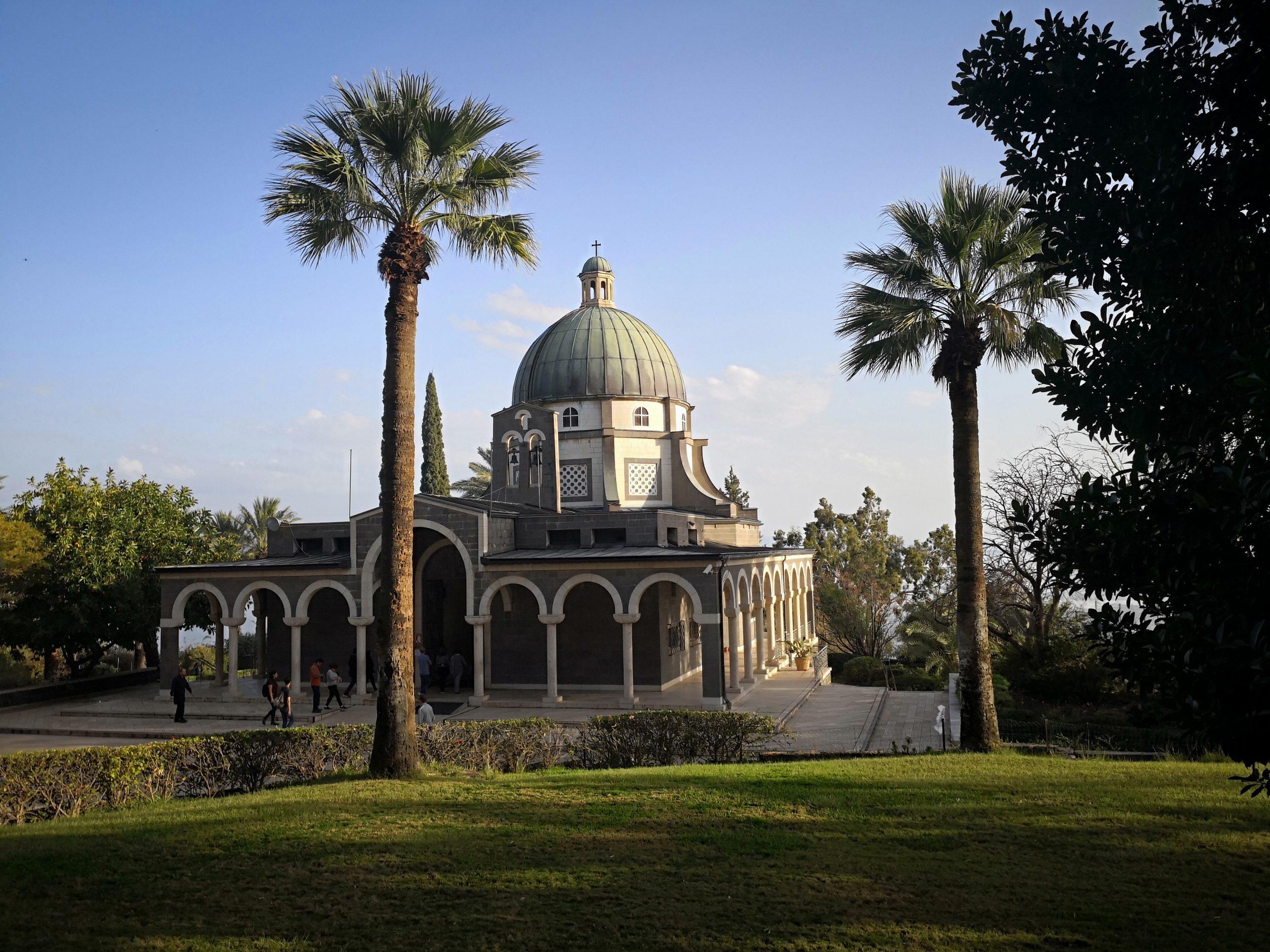
The Mount of Beatitudes is the hilltop above the Sea of Galilee where tradition holds that Jesus delivered the Sermon on the Mount, the most important sermon in the history of Christianity, and, many would argue, the most influential speech ever given. The sermon, recorded in Matthew 5–7, contains the ethical and spiritual core of Jesus’ teaching, and its setting on a hillside overlooking the lake where he spent most of his ministry gives the words a landscape that has not changed in two thousand years. Pilgrims from every corner of the Christian world come to this quiet hilltop to read the Beatitudes aloud, hold worship services on the grass, and stand where tradition says those words were first spoken.
The Sermon on the Mount
The Sermon on the Mount is the longest continuous teaching of Jesus recorded in the Gospels, spanning three full chapters in Matthew (Matthew 5–7). It opens with the eight Beatitudes, a series of blessings that turned the values of the ancient world upside down: “Blessed are the poor in spirit, for theirs is the kingdom of heaven. Blessed are those who mourn, for they will be comforted. Blessed are the meek, for they will inherit the earth” (Matthew 5:3–5). In a world that valued power, wealth, and status, Jesus declared that the kingdom belongs to the humble, the grieving, the merciful, and those who hunger for justice. The Beatitudes are not commandments, they are descriptions of the kind of person who lives in alignment with God. From that opening, the sermon builds a complete picture of moral and spiritual life: how to pray, how to fast, how to relate to enemies, how to manage money, how to resist anxiety, how to judge others, and how to build a life that will last.
The Eight Beatitudes
The eight Beatitudes (Matthew 5:3–12) form the opening movement of the sermon. Each follows the same pattern, a blessing and a promise, and together they describe a character entirely at odds with worldly ambition. Jesus blesses the poor in spirit, those who mourn, the meek, those who hunger for righteousness, the merciful, the pure in heart, the peacemakers, and those persecuted for doing right. In a world that rewarded power and status, every one of these blessings pointed the other way.
Two Beatitudes land with particular force on this hillside. “Blessed are the peacemakers, for they will be called children of God” speaks to a region that has known conflict for millennia, and visitors standing here often hear these words with fresh weight. And “Blessed are the meek, for they will inherit the earth” overturns the logic of empire in a single sentence: not the conquerors, but the gentle and the patient will inherit. The Beatitudes are the ethical core of the Sermon on the Mount. Everything that follows in Matthew 5–7 expands on the character they describe.
Salt and Light, the Lord’s Prayer, and the Golden Rule
After the Beatitudes, the sermon moves through a series of teachings that have each become foundational to Christian thought and to broader moral culture. Jesus describes his followers as “the salt of the earth” and “the light of the world” (Matthew 5:13–16), two metaphors that call not for withdrawal from society but for visible, flavoring, illuminating engagement with it. He then addresses the relationship between his teaching and the Law of Moses, insisting he has come not to abolish the Law but to deepen it (5:17–20), before offering a series of contrasts: “You have heard it said… but I say to you.” Anger, lust, oath-breaking, and retaliation are each addressed not merely as outward behaviors but as matters of the heart. “You have heard it was said, ‘An eye for an eye and a tooth for a tooth.’ But I say to you, do not resist the one who is evil. But if anyone slaps you on the right cheek, turn to him the other also” (5:38–39). “Love your enemies and pray for those who persecute you” (5:44).
The teaching on prayer at the center of the sermon gives the Lord’s Prayer, “Our Father, who art in heaven, hallowed be thy name; thy kingdom come, thy will be done, on earth as it is in heaven. Give us this day our daily bread, and forgive us our trespasses, as we forgive those who trespass against us. And lead us not into temptation, but deliver us from evil” (Matthew 6:9–13). These lines have been prayed aloud on this hillside by pilgrims for centuries, and many Christian groups who visit today make a point of praying the Lord’s Prayer together here, where tradition says Jesus first taught it. The sermon closes with two of the most quoted teachings in the Gospels: “Do not judge, or you too will be judged” (7:1) and the Golden Rule, “In everything, do to others what you would have them do to you, for this sums up the Law and the Prophets” (7:12), before ending with the parable of the house built on rock versus sand: the wise person who hears Jesus’ words and puts them into practice builds on a foundation that stands, while the one who hears and does not act builds on sand that will not hold when the storm comes (7:24–27).
The New Moses
For early Christians and many scholars since, the parallels between the Sermon on the Mount and the giving of the Torah at Sinai were deliberate. Moses ascended a mountain and brought down the Law. Jesus ascended a mountain and reinterpreted that Law, not abolishing it but deepening it: “Do not think that I have come to abolish the Law or the Prophets; I have not come to abolish them but to fulfill them” (Matthew 5:17). Where the Torah said “Do not murder,” Jesus said anger itself is the problem (5:21–22). Where the Torah said “Do not commit adultery,” Jesus said lust itself is the problem (5:27–28). Where the Torah said “An eye for an eye,” Jesus said “turn the other cheek” (5:38–39). The sermon does not reject the Law of Moses, it internalizes it, moving from external obedience to the transformation of the heart. Matthew’s Gospel, written for a Jewish audience, presents Jesus as a new Moses delivering a new Torah from a new mountain.
Luke’s Parallel: The Sermon on the Plain
Luke’s Gospel records a parallel but shorter version of Jesus’ teaching in what has come to be called the Sermon on the Plain (Luke 6:17–49). In Luke’s account, Jesus “went down with them and stood on a level place” before teaching, and the sermon contains four Beatitudes rather than eight, each paired with a corresponding “Woe”: “Blessed are you who are poor, for yours is the kingdom of God… But woe to you who are rich, for you have already received your comfort.” Scholars have debated for centuries whether these represent two different sermons, two accounts of the same occasion, or a common oral tradition adapted independently by each evangelist. The traditional site on this hilltop serves both accounts: it is understood as the location of the extended Matthean sermon, while the natural slope of the hill below could equally represent the “level place” of Luke’s version. Many pilgrimage groups read both accounts here, allowing the two Gospel perspectives to speak alongside each other in the same landscape.
Why It Matters
The Sermon on the Mount has been called the greatest ethical discourse ever delivered. Mahatma Gandhi, who was not a Christian, said it was the Sermon on the Mount that “endeared Jesus to me.” Martin Luther King Jr. built his philosophy of nonviolent resistance on its principles. Leo Tolstoy reorganized his entire life around its teachings. For two billion Christians, these three chapters of Matthew are not merely advice, they are the voice of God speaking through Jesus about how human beings should live with each other. And they were spoken, according to tradition, on this quiet hilltop above a lake in the Galilee. There is something irreplaceable about standing in a place and reading the words that are associated with it. However historians assess the question of whether this particular hill is the precise location of the sermon, pilgrims have been coming to pray and reflect here for over sixteen hundred years, and the site has accumulated a depth of devotion that is itself part of its meaning.
The Church
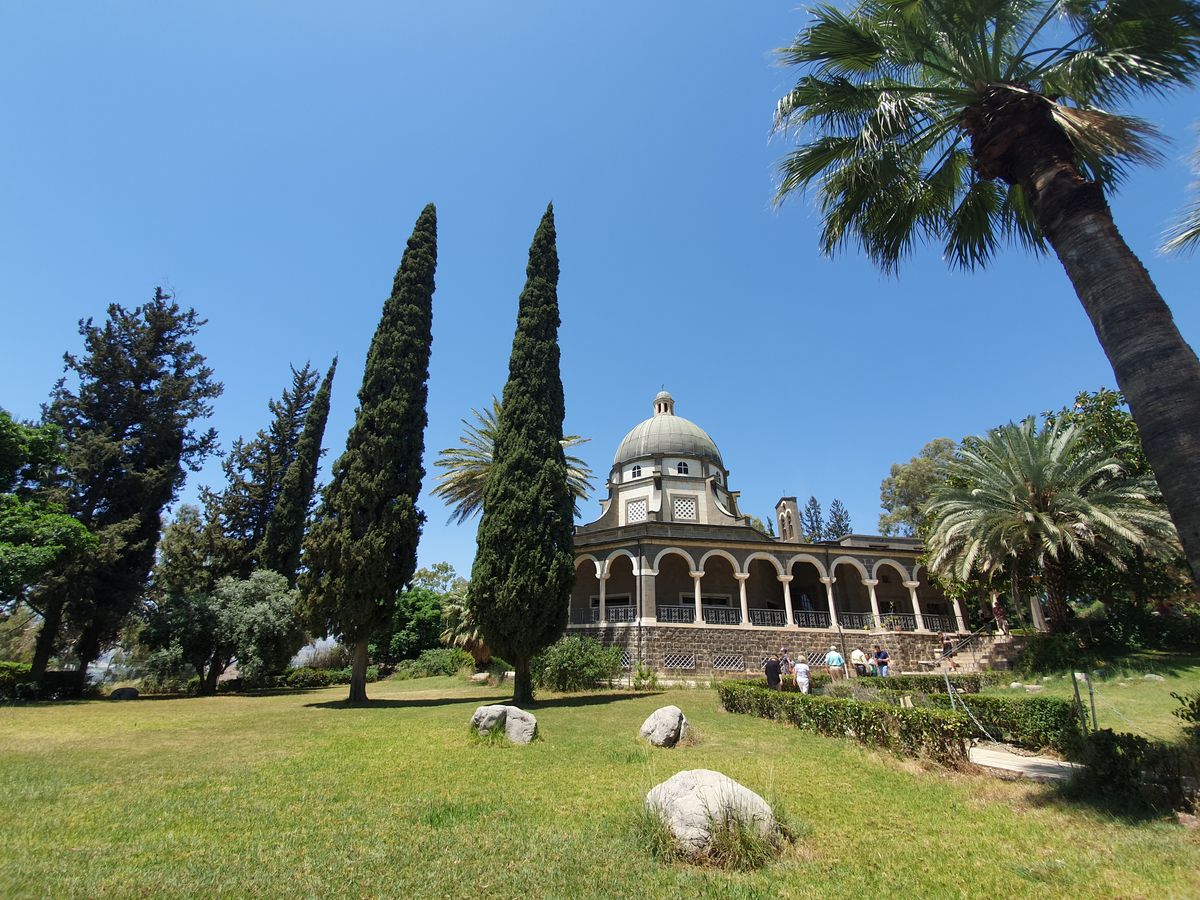
The Church of the Beatitudes was designed by Antonio Barluzzi, the Italian architect responsible for many of the finest churches in the Holy Land, and completed in 1938. The building is octagonal, eight sides representing the eight Beatitudes. Each of the eight windows bears the text of one Beatitude in Latin, so that the light entering the church carries the words of the sermon. A colonnaded veranda wraps around the exterior, framing views of the lake and the surrounding hills from every direction. The dome is lined with gold mosaic, and the overall effect is of light descending from above onto those seated below, as if the words are still being spoken from this hilltop. The interior is intentionally simple: the architecture serves the text, not itself. The surrounding gardens, maintained by the Italian Franciscan Sisters who have cared for the site since the church was built, are among the most tranquil spaces in the Galilee, manicured lawns, flower beds, and paths shaded by palm trees and cypresses, all overlooking the lake below.
The Landscape and Natural Amphitheater
The Mount of Beatitudes sits on a hill above the northwestern shore of the Sea of Galilee, rising gently from the lakeside villages of Tabgha and Capernaum below. The hillside below the church slopes in a natural bowl, an organic amphitheater that allows sound to carry remarkably well across the grass. Acousticians who have studied the site note that a speaker standing at the crest of the slope can be heard clearly by thousands of people seated on the hillside without any artificial amplification. This geography may itself explain why Jesus chose this spot: the hill gave him both height and reach, allowing him to address large crowds in the open air while remaining in the intimate landscape of the lake that defined his Galilean ministry.
The view from the garden is one of the most beautiful vistas in the Holy Land. The full breadth of the Sea of Galilee opens below, with the Golan Heights rising on the eastern shore and the hills of the Lower Galilee stretching to the south. On a clear morning, the light on the water reflects the sky and the mountains beyond in a panorama that has changed very little over two thousand years. The lake, the hills, the sky, this is the world Jesus looked out on when, according to tradition, he opened his mouth and said, “Blessed are the poor in spirit.”
Pilgrimage and Worship at the Site
The Mount of Beatitudes has been a place of Christian pilgrimage since at least the fourth century, when early church travelers noted a church on this hill. Today it receives pilgrims from across the world, and the experience of visiting is shaped as much by the living worship that takes place here as by the archaeology or the architecture. Many groups , Protestant, Catholic, Orthodox, and non-denominational, hold outdoor services on the grassy hillside, reading the Beatitudes aloud together, praying the Lord’s Prayer in the open air, and celebrating Communion with the Sea of Galilee spread below them. The lawn below the church accommodates large gatherings, and it is not unusual to encounter a choir singing, a pastor preaching, or a small group kneeling in prayer on the grass. For pilgrims who have spent years reading these words in a pew or a classroom, hearing them spoken aloud on this hillside , in the open air, above the lake, with the same hills in the background, is often a defining moment of their journey.
Visit with Hoshen Tours
The Mount of Beatitudes is where the words of Jesus meet the landscape of the Galilee. Hoshen Tours reads the Sermon on the Mount on the hillside, connecting the text to the view and the view to the life that Jesus lived on this lake. The Beatitudes are read one by one, in sequence, with time for reflection between each. The Lord’s Prayer is prayed together in the garden. Groups are given time in the church, in the gardens, and on the hillside, space to sit, to think, and to let the place speak. For many visitors, hearing the Beatitudes spoken aloud on the hill where tradition holds they were first delivered is the moment their journey to the Holy Land becomes personal.
The Mount of Beatitudes is one of the most peaceful stops on a Holy Land pilgrimage tour. Many groups choose this setting for a time of worship and Scripture reading.
Ready to experience Israel in true colors?
Plan Your TourPrivate tours designed around your interests, schedule, and pace.