



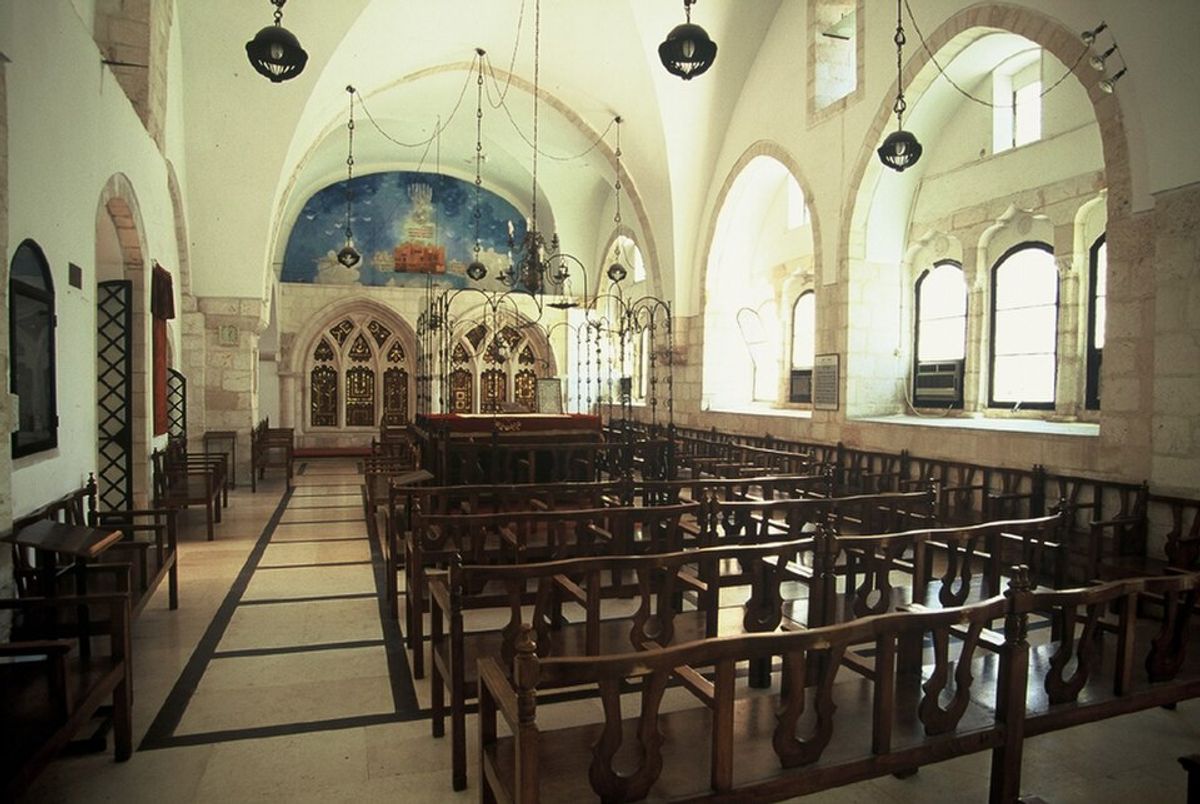
Tucked below street level in the heart of the Jewish Quarter, a modest courtyard leads into four interconnected synagogues that served as the spiritual center of Jerusalem’s Sephardic community for more than 400 years. The complex does not announce itself with grand facades or towering domes. Instead, visitors descend a few steps from the bustling square above and enter a quiet world of vaulted ceilings, ancient arks, and softly lit prayer halls. The four synagogues are the Yochanan Ben Zakkai, the Istanbul (Constantinople), the Eliyahu HaNavi (Prophet Elijah), and the Emtza’i (Middle). Together they form a single architectural complex, each room flowing into the next through arched doorways. The light is soft, the stone cool, and the silence a world away from the busy quarter above.
From Spain to Jerusalem
The story begins with the expulsion of Jews from Spain in 1492. In the decades that followed, Sephardic refugees made their way across the Mediterranean, and some settled in Jerusalem under Ottoman rule. By the 16th and 17th centuries, the Sephardic community had established itself as the leading Jewish group in the city, and these four synagogues became their central institutions. The oldest, the Yochanan Ben Zakkai Synagogue, was in use by the early 1600s. The others were added over the following century as the community grew. Ottoman law prohibited synagogues from rising above neighboring buildings, which is why the complex was built partially underground, a restriction that turned out to give it its distinctive intimate character.
The Four Synagogues
The Yochanan Ben Zakkai is the largest and most prominent, named after the 1st-century sage who, according to tradition, escaped besieged Jerusalem during the Roman war by being carried out in a coffin and then established a center of learning at Yavne that preserved rabbinic Judaism after the Temple’s destruction. The synagogue features a high vaulted ceiling, two ornate Torah arks along the southern wall facing the Temple Mount, and a central bimah surrounded by iron railings. The interior has been restored with colored tiles and painted walls in the Sephardic style.
Adjacent is the Istanbul Synagogue, funded by Jews from Constantinople who maintained close ties with Jerusalem’s community. It is a smaller, more intimate space with a single Torah ark. The Emtza’i (Middle) Synagogue occupies the space between the two, originally a courtyard that was eventually roofed over and used for weekday services and study. The Eliyahu HaNavi Synagogue is the most atmospheric of the four. A long-standing tradition holds that a chair was always reserved for the prophet Elijah, who, it is believed, may appear to complete a prayer quorum in times of need. The synagogue features an arched ceiling, Sephardic liturgical furnishings, and an intimacy that makes it feel more like a family prayer room than a public space.
Destruction and Restoration
When the Jewish Quarter fell to the Jordanian Arab Legion in May 1948, the synagogue complex was systematically destroyed along with every other synagogue in the quarter. The buildings were reduced to rubble, the Torah scrolls were burned or looted, and the site remained in ruins for nineteen years. After Israel liberated the Old City in 1967, architects worked from historical photographs, drawings, and the memories of former worshippers to reconstruct the four synagogues as faithfully as possible. They recovered fragments of the original stonework, tracked down Torah scrolls that had been scattered across the country, and restored decorative elements using the same techniques that Sephardic craftsmen had used centuries earlier. The work took years. The builders found that the underground vaults had protected some of the original stonework from complete destruction, and that the Jordanian fill used to level the site had, paradoxically, preserved fragments that would have been lost to weathering above ground. When the restored rooms were finally opened, elderly Jerusalemites who had prayed here before 1948 wept at the doorways. The restored complex was rededicated in 1972 and today functions both as an active house of worship, where Sephardic services are held in the traditional melodies brought from Spain and the Ottoman Empire, and as a museum open to visitors throughout the week.
Visit with Hoshen Tours
The Four Sephardic Synagogues offer a window into centuries of Jerusalem’s Jewish life. Hoshen Tours includes them in walking tours of the Jewish Quarter, connecting the expulsion from Spain to the Ottoman period, the 1948 destruction, and the restoration that brought these prayer halls back to life. The complex is a short walk from the Hurva Synagogue and the Cardo.
Ready to experience Israel in true colors?
Plan Your TourPrivate tours designed around your interests, schedule, and pace.