



The road to Tabgha drops steeply from the ridge above, and as you descend, the air changes. It grows warmer, thicker, fragrant with eucalyptus. The lake appears below, flat and silver in the morning light, and by the time you reach the shore the sounds of the highway have faded to nothing. There is a stillness here that visitors notice immediately, a quiet that seems to belong to the place itself.
Tabgha (from the Greek Heptapegon, meaning “Seven Springs”) is a small area on the northwestern shore of the Sea of Galilee where three of the most important Gospel events are said to have taken place within a few hundred meters of each other: the feeding of the five thousand, the resurrection appearance to Peter, and, according to some traditions, the Sermon on the Mount. The concentration of sacred sites in such a compact stretch of shoreline makes Tabgha the most intensely meaningful kilometer of lakeside in the Christian world.
The Name and the Springs
The name Tabgha is an Arabic contraction of the Greek Heptapegon, “seven springs”, which accurately describes the geology of the site. Warm, mineral-rich springs rise along the northwestern shore here and flow into the cool waters of the Sea of Galilee. The mixing of warm and cold water creates a microclimate particularly hospitable to fish, drawing them in large numbers to this stretch of the shore. This natural abundance almost certainly explains why so many of the Gospel’s lakeside encounters, with fishermen, with crowds, with disciples, are set in this vicinity. Jesus did not wander into a random spot on the shore; he came to a place where fishermen worked and people gathered. The springs are still active today, and the warm water flowing visibly into the lake along the shoreline gives the site a living, animate quality that photographs rarely capture.
Church of the Multiplication
The Church of the Multiplication of the Loaves and Fishes marks the site where tradition holds that Jesus fed 5,000 people with five loaves and two fish (Matthew 14:13-21). The church preserves a magnificent 5th-century mosaic floor depicting the birds, fish, and plants of the lakeside landscape, with the famous central panel of two fish flanking a basket of four loaves: one of the most recognized images in Christian art. The altar sits above a natural limestone rock believed to be the stone on which Jesus placed the bread before the miracle. The church is maintained by the German Benedictine Order, whose monastery sits in a garden of eucalyptus and flowering shrubs just inland from the shore. The gardens are open to visitors and offer a quiet place to sit between the churches.
Church of the Primacy of Peter
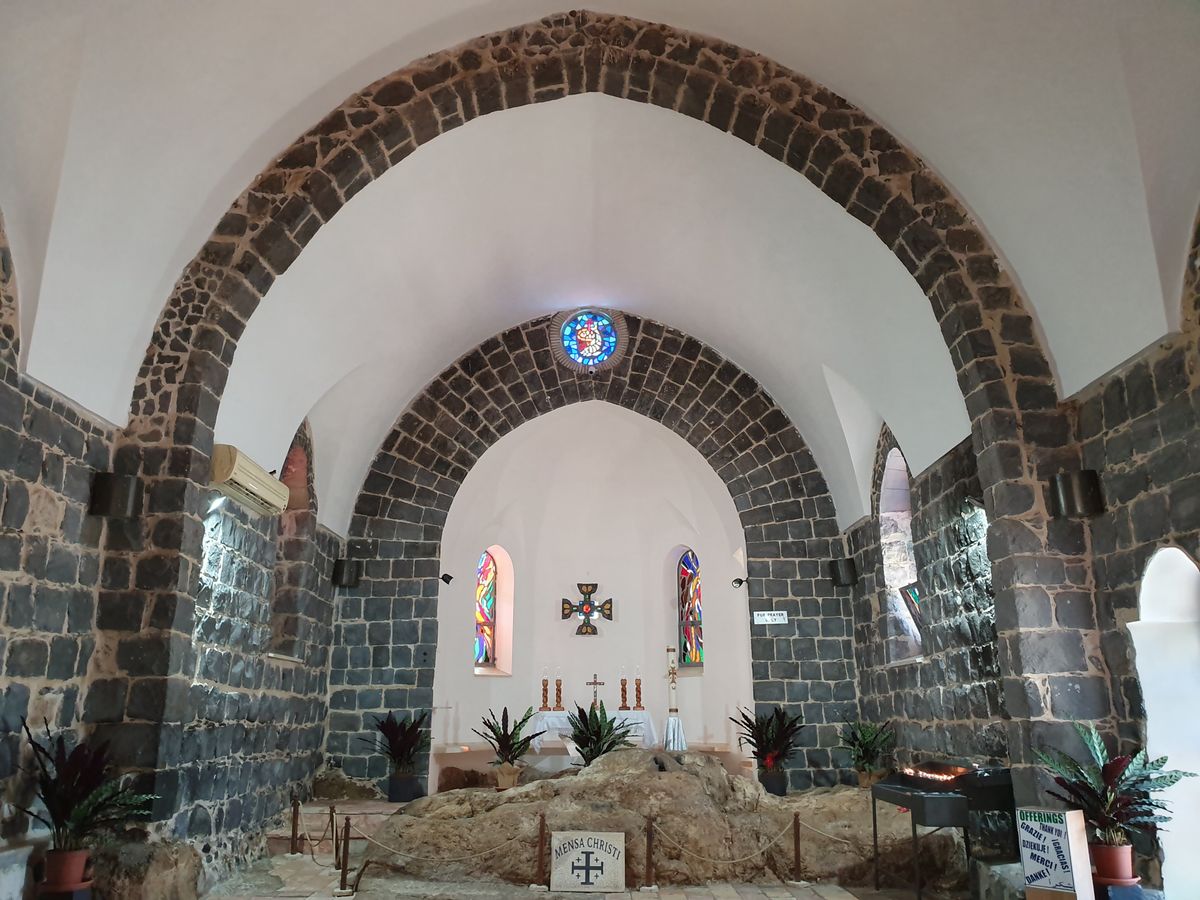
A few steps along the shore, the small Franciscan Church of the Primacy of Peter (Mensa Christi) marks the spot where the risen Jesus is believed to have appeared to the disciples on the beach, cooked them breakfast over a charcoal fire, and restored Peter after his threefold denial. Jesus asked Peter three times, “Do you love me?” and three times Peter answered yes, and three times Jesus commanded, “Feed my sheep” (John 21:15-17). The flat limestone rock inside the chapel, known as the Mensa Christi (Table of Christ), is identified by tradition as the stone on which Jesus prepared the meal: “Jesus said to them, ‘Come and have breakfast’” (John 21:12). The chapel is built of black local basalt and sits so close to the water that the lake laps at its threshold: the intimacy of the setting matches the intimacy of the story.
The Springs
The seven springs that give Tabgha its name flow with warm, mineral-rich water that attracts fish to the northwest shore of the lake. In antiquity, the warm springs created a natural gathering point for fishermen, and the concentration of fish in the warm current running along the shoreline may be part of what drew Jesus and his disciples repeatedly to this location. The springs are still visible today, and visitors who walk the path between the two churches will find the warm water seeping into the lake at several points, carrying a faint sulfurous mineral scent that has likely remained unchanged for two thousand years.
Tabgha as a Pilgrimage Circuit
For Christian pilgrims, Tabgha functions as a self-contained circuit. The three churches, the Multiplication, the Primacy of Peter, and the Mount of Beatitudes above, represent three distinct moments in Jesus’ ministry: his miracle of provision, his post-resurrection restoration of Peter, and his great teaching sermon on the hillside above the lake. A pilgrim who spends a morning walking between these sites, reading the Gospel texts at each location, traces a story that begins with the crowd and the loaves, passes through the intimate breakfast on the shore, and rises to the hillside where the Beatitudes were taught with the lake glittering below. The Benedictine monastery at the Church of the Multiplication provides a natural anchor point for the circuit, with its grounds, guesthouses, and gardens offering a place for reflection between sites.
Visit with Hoshen Tours
Tabgha is where the Gospel story is closest to the water. Hoshen Tours visits both lakeside churches, reads the texts on the shore, and connects the multiplication, the primacy, and the sermon in the landscape where these events are said to have occurred, giving each site its full context within the broader story of Jesus’ ministry in the Galilee.
Ready to experience Israel in true colors?
Plan Your TourPrivate tours designed around your interests, schedule, and pace.