



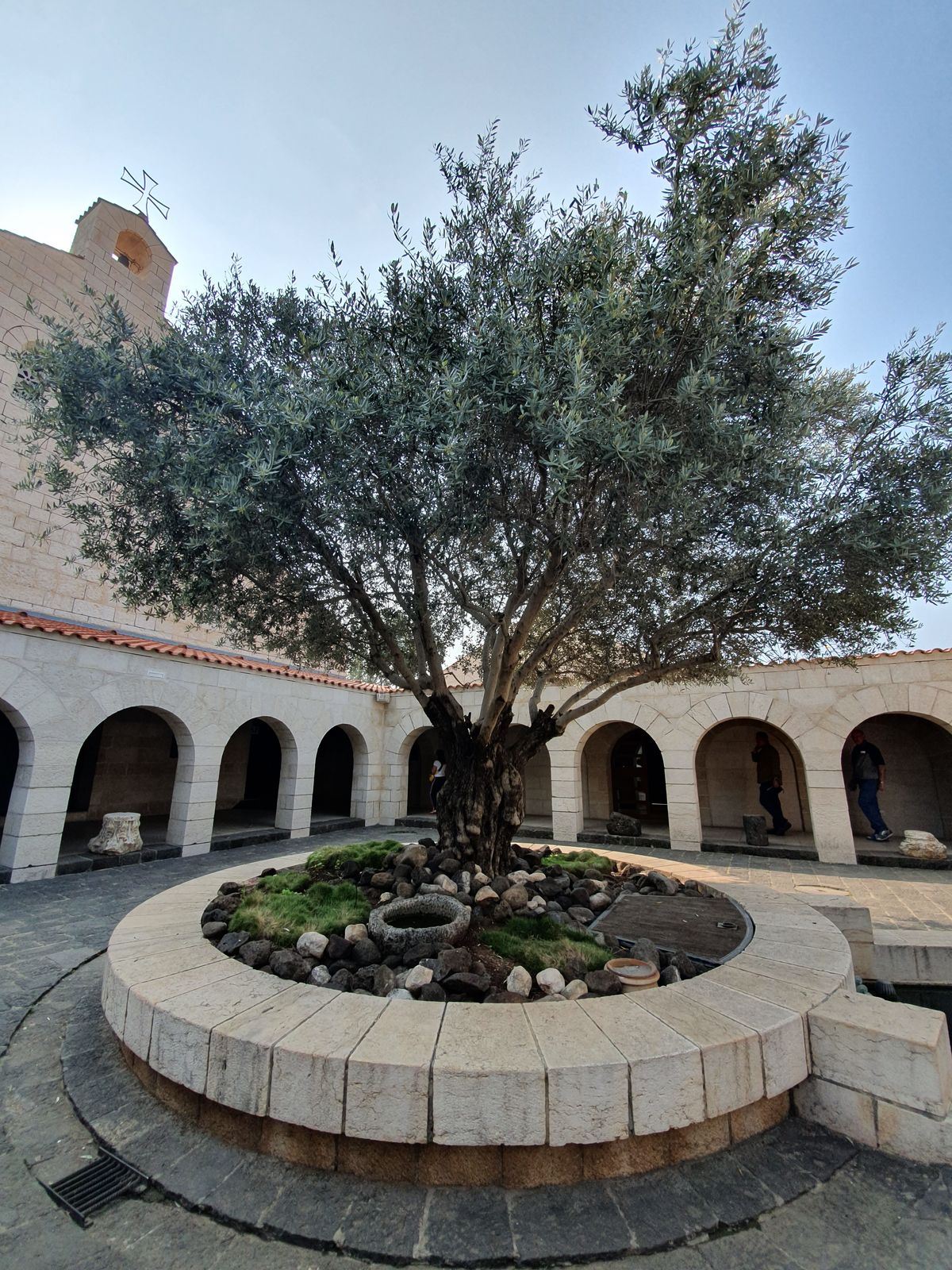
The Church of the Multiplication of the Loaves and Fishes Israel at Tabgha marks the site where, tradition holds, Jesus fed 5,000 people with five loaves of bread and two fish, the only miracle, apart from the Resurrection, recorded in all four Gospels (Matthew 14:13–21, Mark 6:30–44, Luke 9:10–17, John 6:1–15). The church preserves one of the finest early Christian mosaic floors in the Holy Land, and the site has drawn pilgrims to this stretch of the Galilean shore since at least the 4th century.
The Miracle of the Five Loaves and Two Fish
According to the Gospel accounts, Jesus had withdrawn by boat to a remote place, but crowds followed him on foot from the surrounding towns. Seeing the multitude, he had compassion on them and healed the sick. As evening approached, his disciples urged him to send the crowd away to find food in the villages. Jesus told them: “You give them something to eat.” A boy offered five barley loaves and two fish, a modest meal for one person. Jesus took the food, looked up to heaven, gave thanks, broke the bread, and distributed it through the disciples to the crowd. All ate and were satisfied, and twelve baskets of fragments were collected afterward. The crowd numbered 5,000 men, plus women and children. Christians have understood this miracle as a prefiguration of the Eucharist, the breaking and sharing of bread that would become the central sacrament of the Church, which is precisely why the site became a place of worship so quickly after Jesus’ ministry.
The 5th-Century Mosaic Floor
The church’s 5th-century mosaic floor (dated to around 480 CE) is one of the jewels of early Christian art. It survived the church’s destruction, most likely during the Persian invasion of 614 CE, by lying buried beneath the rubble for more than thirteen centuries, until excavations in 1932 brought it back to light. The floor depicts the flora and fauna of the lakeside landscape with extraordinary naturalism: lotus flowers, water birds, herons, ducks, cormorants, a swan, a flamingo, a pelican, all rendered in tiny tessera with a quality of observation that suggests an Egyptian-trained mosaicist who knew these creatures from life.
The most famous panel sits directly in front of the altar: a wicker basket containing four round loaves of bread, each marked with a cross, flanked on either side by a fish. The basket holds only four loaves, though the miracle involves five. The traditional interpretation holds that the fifth loaf is on the altar itself, the bread of the Eucharist being celebrated above the mosaic, so that the artwork is not merely illustrating a past event but actively participating in the ongoing celebration of Communion. This liturgical reading of the image has been part of Christian teaching at this site for over fifteen hundred years.
History of the Church
The first church at this site was built in the 4th century, likely around 350 CE. The Spanish pilgrim Egeria, who visited the Holy Land in the 380s and left one of the most detailed travel accounts from antiquity, described a small church at Tabgha built around a stone on which the Lord placed the bread. This 4th-century structure was modest and simple. It was replaced in the late 5th century by a much larger Byzantine basilica, the one whose magnificent mosaic floor survives, which may have been funded by a wealthy Byzantine official. That basilica was destroyed in the 7th century, probably during the Persian conquest of 614 CE, and lay in ruins through the medieval and Ottoman periods. Archaeological excavations beginning in the 1930s uncovered the mosaic and the foundations. A new church was then built by the German Benedictine Order over the Byzantine foundations, incorporating the mosaic floor and the Mensa Christi rock. This structure was itself rebuilt and significantly expanded in 1982, creating the current church, a modern building designed in a Byzantine style, with a broad nave that allows pilgrims to view the mosaic floor without walking on it.
Mensa Christi
Beneath the altar, a large block of undressed limestone known as the Mensa Christi (Table of Christ) is held by tradition to be the stone on which Jesus placed the bread and fish before the miracle. The rock is a natural outcropping that predates the church entirely, the original 4th-century chapel was built around it, and every subsequent structure has placed the altar directly above it. The continuity of veneration from Egeria’s time to the present represents one of the longer unbroken chains of Christian memory at any site in the Holy Land.
The 2015 Arson Attack
On June 18, 2015, the church suffered a serious arson attack. Hebrew graffiti was spray-painted on the walls of the complex, and fire was set to the atrium and exterior entrance buildings. The ancient mosaic floor inside the main church was not damaged. The attack drew immediate condemnation from Israeli political and religious leaders across all parties, and the Benedictine community received an outpouring of support from Jewish, Muslim, and Christian communities in Israel and internationally. Restoration work was carried out carefully over the following year and a half, and the church fully reopened in early 2017.
Visit with Hoshen Tours
The Church of the Multiplication is maintained by the German Benedictine Order, whose monastery and gardens sit adjacent to the church. Hoshen Tours visits the mosaic, explains the four-loaves mystery and its Eucharistic meaning, and connects the miracle of the loaves and fishes to the broader Gospel narrative at Tabgha, where two other churches within walking distance mark two more defining moments in Jesus’ ministry on the shore of the Sea of Galilee.
Visitors exploring the Galilee often combine Church of the Loaves and Fishes with nearby destinations such as Tabgha, Capernaum, and Church of the Primacy of Peter, each offering its own distinctive perspective on the region’s layered history and landscape. A broader itinerary might also include Sea of Galilee and Twelve Apostles, both within easy reach and rich in their own right.
Every Hoshen Tours itinerary is private and fully customizable. Contact us to begin planning your journey through the Galilee.
Ready to experience Israel in true colors?
Plan Your TourPrivate tours designed around your interests, schedule, and pace.