



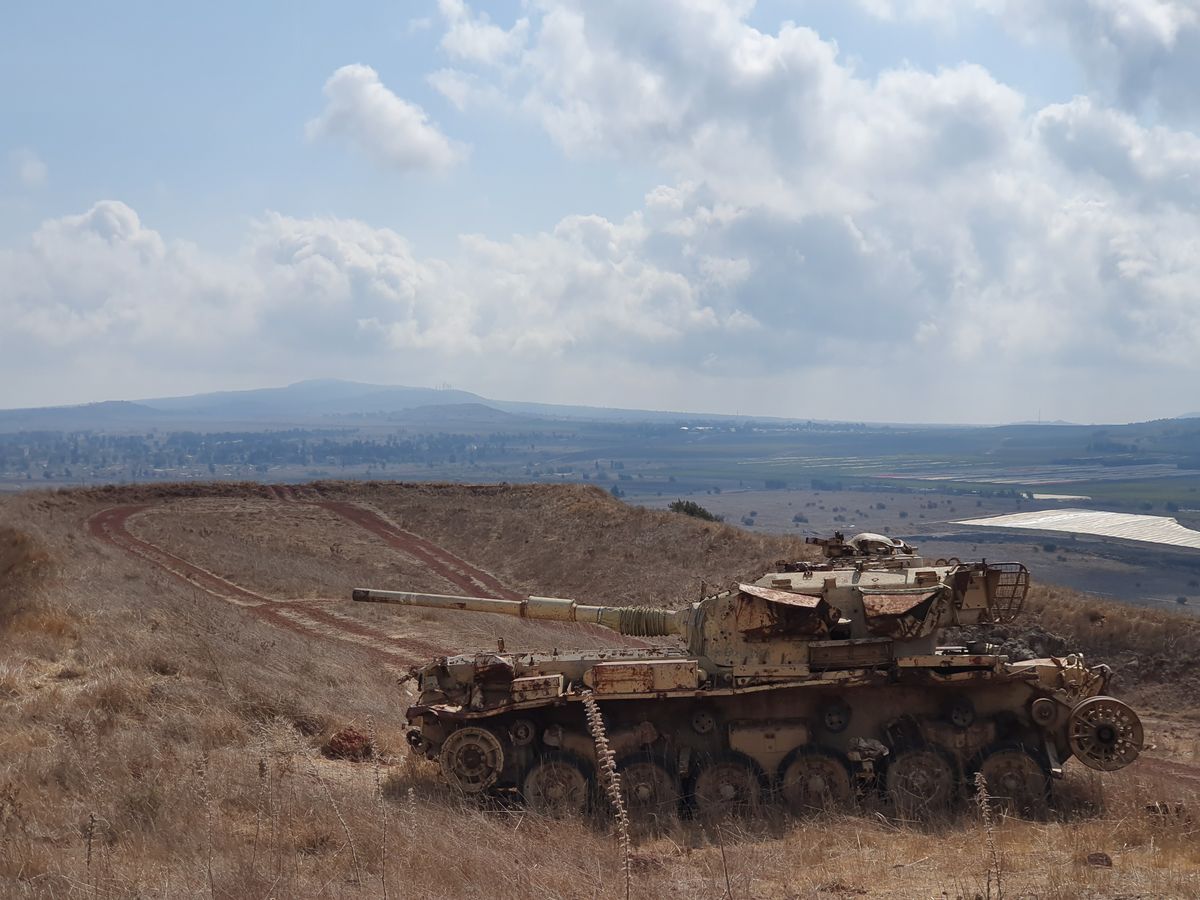
On the afternoon of October 6, 1973, Yom Kippur, the holiest day in the Jewish calendar, Syria launched a massive surprise attack on the Golan Heights. Approximately 1,400 tanks and tens of thousands of soldiers surged across the ceasefire line in two main thrusts: one aimed at the southern Golan, the other at a volcanic valley in the northern Golan, between the Hermonit ridge and the Booster position, just northwest of the abandoned Syrian city of Quneitra, that would soon earn a name no one intended to give it. The Valley of Tears, Emek HaBakha, is the site of one of the most dramatic defensive battles in modern military history, a four-day stand by a handful of Israeli tank crews against an armored force many times their size.
The Odds
The entire Golan Heights was defended by two Israeli armored brigades: the 7th Armored Brigade in the northern sector and the Barak Brigade in the south. Together they fielded roughly 177 tanks against a Syrian force of approximately 1,400. The 7th Brigade, one of the most storied units in the IDF, was responsible for holding the area around the volcanic ridgeline between Mount Hermonit and the Booster position, overlooking the flat valley below. This valley, a natural corridor between the volcanic hills, was the most direct route for Syrian armor to break through to the Bnot Yaakov Bridge and from there into the Galilee. If the 7th Brigade fell, there was nothing between the Syrian army and the communities below.
The Syrian attack plan called for a massive artillery barrage followed by a three-division armored thrust. The 7th Infantry Division, equipped with modern T-62 tanks, was directed straight at the valley defended by the 7th Brigade. The Syrians expected to overwhelm the defenders within hours. They did not account for what would happen next.
Four Days and Nights
The 77th Tank Battalion, the 7th Brigade’s primary fighting force, was commanded by Lieutenant Colonel Avigdor Kahalani, a veteran of the Six-Day War who still bore severe burn scars from a tank hit in the Sinai. Kahalani commanded from the turret of his own Centurion tank, exposed to fire, because he believed a commander had to see the battlefield with his own eyes. For four days and nights, from October 6 to October 9, Kahalani’s crews fought almost without pause. They slept in their tanks for minutes at a time, ate nothing, and fired until their ammunition was nearly gone.
The Syrian attacks came in waves, by day and by night, sometimes with dozens of tanks at once pushing through the narrow valley. Israeli crews knocked out tank after tank, but the Syrians kept coming. When a tank was hit and its crew survived, the men climbed out, found another damaged tank that could still fire, and went back into the fight. Tanks that lost their turret traverse were positioned as fixed guns. Crews who ran out of shells for their main gun used machine guns against infantry. The valley floor filled with burning hulks, Syrian and Israeli alike, and the smoke made visibility almost impossible.
The Turning Point
By October 9, the 7th Brigade was on the edge of collapse. Kahalani later described that morning as the moment he believed it was over. The brigade had been reduced to perhaps six or seven operational tanks. Ammunition was critically low. Reinforcements had not arrived. Kahalani radioed brigade commander Colonel Yanosh Ben-Gal and told him he was not sure he could hold. Ben-Gal’s response, now legendary in IDF lore, was to order Kahalani to hold at all costs, and then to scrape together every last tank, including headquarters vehicles and supply escorts, and push them to the line.
And then something remarkable happened. As Kahalani’s remaining tanks crested the ridge for what he feared would be a final stand, they saw the Syrian force in the valley below beginning to turn around. The Syrian 3rd Armored Division, battered, exhausted, having lost hundreds of tanks, was withdrawing. They had reached their breaking point just minutes before the Israelis reached theirs. The valley that had swallowed so many tanks and so many lives was suddenly quiet.
How the Valley of Tears Got Its Name
The name Emek HaBakha, the Valley of Tears, was not given by generals, historians, or mapmakers. It came from the soldiers themselves. In the days after the battle, the men who had fought there began calling it that, and the name spread. Its origin is biblical: Psalm 84:6-7 speaks of those “who pass through the Valley of Baca” (עוברי בעמק הבכא), a metaphorical name with no known geographical location, used in the psalm to describe a place of deep pain and suffering that pilgrims must cross on their way to the Temple in Jerusalem. The psalm imagines these faithful travelers transforming a valley of tears into a place of springs and blessing through their devotion. For the tank crews who survived October 1973, the name carried all of that weight: grief for the friends they had lost, awe at what they had endured, and something close to disbelief that they had come through it at all. The valley floor, still scattered with the rusting hulks of Syrian and Israeli tanks when the fighting ended, looked exactly like a place that had earned its name.
The Oz 77 Memorial
Today, the Oz 77 Memorial stands on the ridge overlooking the Valley of Tears, near Mount Bental. “Oz” means courage or strength in Hebrew. The memorial, a simple, powerful installation of steel and stone, honors the soldiers of the 77th Battalion and the entire 7th Brigade who held the line in October 1973. It is one of the most visited military memorial sites in Israel, and the IDF holds regular ceremonies here. Kahalani, who received the Medal of Valor (the highest Israeli military decoration) for his actions, went on to serve as a general and later as a member of the Knesset. But it is this valley, and the four days he spent in it, for which he is most remembered.
Visit with Hoshen Tours
Standing on the ridge above the Valley of Tears, with the Syrian positions visible to the east and the Galilee spread out to the west, the strategic reality of October 1973 becomes viscerally clear. Hoshen Tours combines this site with Mount Bental the former Syrian military headquarters and Tel Fakher for a comprehensive understanding of the battles that shaped the Golan Heights. A private guide who knows the terrain and the stories can turn a hillside overlook into one of the most powerful experiences in Israel.
Visitors exploring the Golan Heights often combine Valley of Tears with nearby destinations such as Mount Bental, Kibbutz El Rom, and Tel Saki, each offering its own distinctive perspective on the region’s layered history and landscape. A broader itinerary might also include Tel Fakher and Syrian HQ, both within easy reach and rich in their own right.
Every Hoshen Tours itinerary is private and fully customizable. Contact us to begin planning your journey through the Golan Heights.
Explore Our Tour Collection
Ready to experience Israel in true colors?
Plan Your TourPrivate tours designed around your interests, schedule, and pace.