



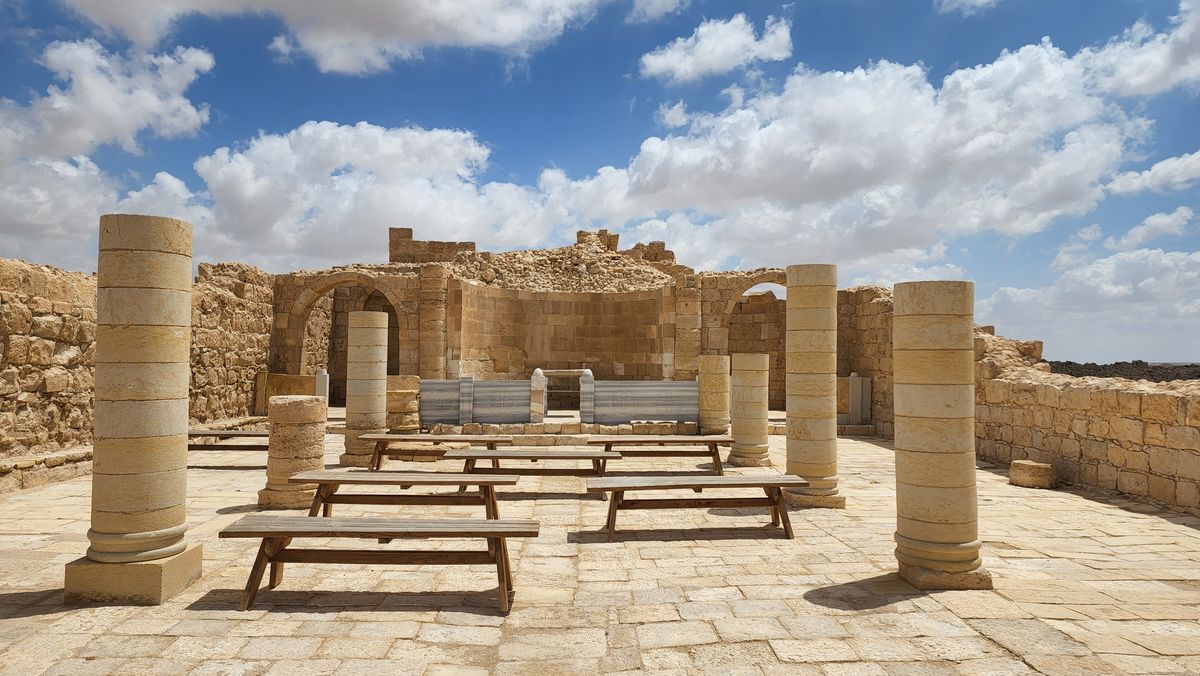
Avdat is a ruined Nabatean city perched on a hilltop in the central Negev, part of the Incense Route that carried frankincense and myrrh from southern Arabia to the Mediterranean. The Nabateans, an Arab people who thrived from the 4th century BCE to the 2nd century CE, were masters of desert survival, and Avdat is the most dramatically situated of their Negev cities, rising from the desert floor on a flat-topped hill with views stretching to the horizon in every direction. In 2005, Avdat was inscribed as a UNESCO World Heritage Site as part of the Incense Route, one of four Nabatean cities in the Negev recognized for their outstanding universal value.
A King Who Became a God Negev
The city takes its name from a king. Obodas I was a Nabatean ruler who reigned in the 1st century BCE and, after his death, was venerated as a deity by the Nabatean people. This was not unusual in the ancient world, but it was unusual enough among the Nabateans to mark Obodas as a figure of extraordinary significance. A temple was built in his honor at Avdat, and his name, Oboda in Nabatean, gave the city its name: Avdat in Hebrew, Oboda in Greek and Latin. Tradition holds that Obodas I may be buried somewhere on or near the hill where the city stands, though no tomb has been definitively identified.
The deification of Obodas reflects something important about Nabatean religion: it was not a rigid system but one that absorbed and celebrated figures who embodied the ideals the Nabateans admired most. A king who brought his people through the desert, who kept the trade routes open, who protected his people from their enemies, could become something more than a king in memory. Walking through Avdat, you are walking through a city that was, in part, a religious site built around the memory of a man who became a god.
Nabatean City
Avdat was founded as a way station on the incense trade route, providing water, food, and shelter for the caravans crossing the Negev. A single caravan could carry hundreds of camels laden with frankincense and myrrh from the Arabian Peninsula, and a stop at Avdat meant water, fodder, repairs, and rest. The Nabatean remains include a temple, a bathhouse, and the remarkable water-collection systems that made life possible in a region that receives less than 100 millimeters of rain per year. The city was not a small outpost: at its height it was home to thousands of people, and its streets, courtyards, and buildings testify to a settled, prosperous urban life in the middle of the desert.
Byzantine City: Grapes and Churches in the Desert
After the Roman annexation of the Nabatean kingdom in 106 CE, Avdat continued to flourish and reached its peak in the Byzantine period (4th to 6th centuries CE). Two large churches were built on the acropolis, along with a monastery, a wine press, and residential quarters. Cave dwellings cut into the soft limestone cliffs on the slopes of the hill housed families who farmed the surrounding terraced land. The acropolis itself, with its two churches side by side and the remnants of a baptistery, gives Avdat a skyline that still carries the silhouette of a living city.
The wine press is particularly remarkable. The Nabateans and their Byzantine successors grew grapes in the desert using elaborate runoff agriculture, and the wine they produced was exported across the Mediterranean. Byzantine wine from the Negev was considered a fine product, traded as far as Constantinople. The wine press at Avdat, with its treading floor, collection vats, and storage areas, shows the full process. That a sophisticated wine industry operated in a place where summer temperatures exceed 40 degrees Celsius and annual rainfall is measured in millimeters tells you something about the determination and ingenuity of the people who called this place home.
The Water System: Engineering a Desert
The most impressive achievement at Avdat is the water system. The Nabateans developed one of the most sophisticated ancient agricultural systems in the world, capturing every drop of rain that fell on the surrounding hillsides. Channels carved into the rock directed runoff water into cisterns. Terraces on the slopes slowed the water and allowed it to seep into the soil. Dams across the wadis captured flash-flood water before it could race away. Loess fields were shaped to funnel runoff toward specific plots, concentrating the moisture of many square meters of catchment into a single growing area.
The system was so effective that the Nabateans were able to grow wheat, barley, grapes, olives, and fruit trees in a landscape where modern agriculture without mechanical irrigation is impossible. Israeli researchers have revived Nabatean runoff agriculture in experimental farms near Avdat, demonstrating that the ancient system still works. The fields around Avdat today are not barren desert by necessity: they are barren because the knowledge and labor to maintain the system was lost when the Byzantine civilization collapsed. The Nabateans did not just survive the desert. They changed it.
The Acropolis and Its Churches
The acropolis at the top of the hill is the heart of the Byzantine city. Two churches stand side by side: the Church of Saint Theodore and a second church whose dedication is less certain. The churches were built from the same dressed limestone used throughout the site, and their walls still stand to a substantial height, giving a real sense of enclosed interior space. A baptistery, with a cross-shaped font where new believers were immersed, stands adjacent to one of the churches. The floor of the baptistery preserves its original stone paving, and the font is intact. Standing in it, looking out over the Negev from the top of the hill, you get a vivid sense of what it meant to be baptized at Avdat: brought into a community of faith in the middle of the wilderness, with the desert stretching away in every direction.
The View from the Avdat Negev Acropolis
The view from the top of the Avdat acropolis is one of the most sweeping in the Negev. The desert stretches in every direction, its surface broken by the outlines of ancient field systems, the scars of wadis, and the distant ridgelines of the Negev highlands. On a clear day, the horizon seems infinite. The light in the Negev changes dramatically through the day: harsh and bleaching at noon, golden and warm at the hour before sunset, when the limestone walls of Avdat glow as if lit from within.
The isolation of the site, combined with the quality of the ruins, creates an atmosphere that is unlike any other archaeological site in Israel. You are not peering at ruins behind barriers: you are walking through a city, past recognizable streets and doorways, with an unobstructed view of the desert that the city’s inhabitants looked at every day of their lives.
Visit with Hoshen Tours
Avdat is the crown jewel of the Nabatean cities in the Negev, and Hoshen Tours places it in the larger story of the Incense Route and the Nabateans. Combine it with the desert retreat of Sde Boker and the canyon of Ein Avdat for a day that spans two thousand years of desert civilization. Hoshen Tours often combines this site with Red Canyon, Mitzpe Ramon, and Negev Brigade Memorial for a memorable day exploring the region.
Explore Our Tour Collection
Ready to experience Israel in true colors?
Plan Your TourPrivate tours designed around your interests, schedule, and pace.