



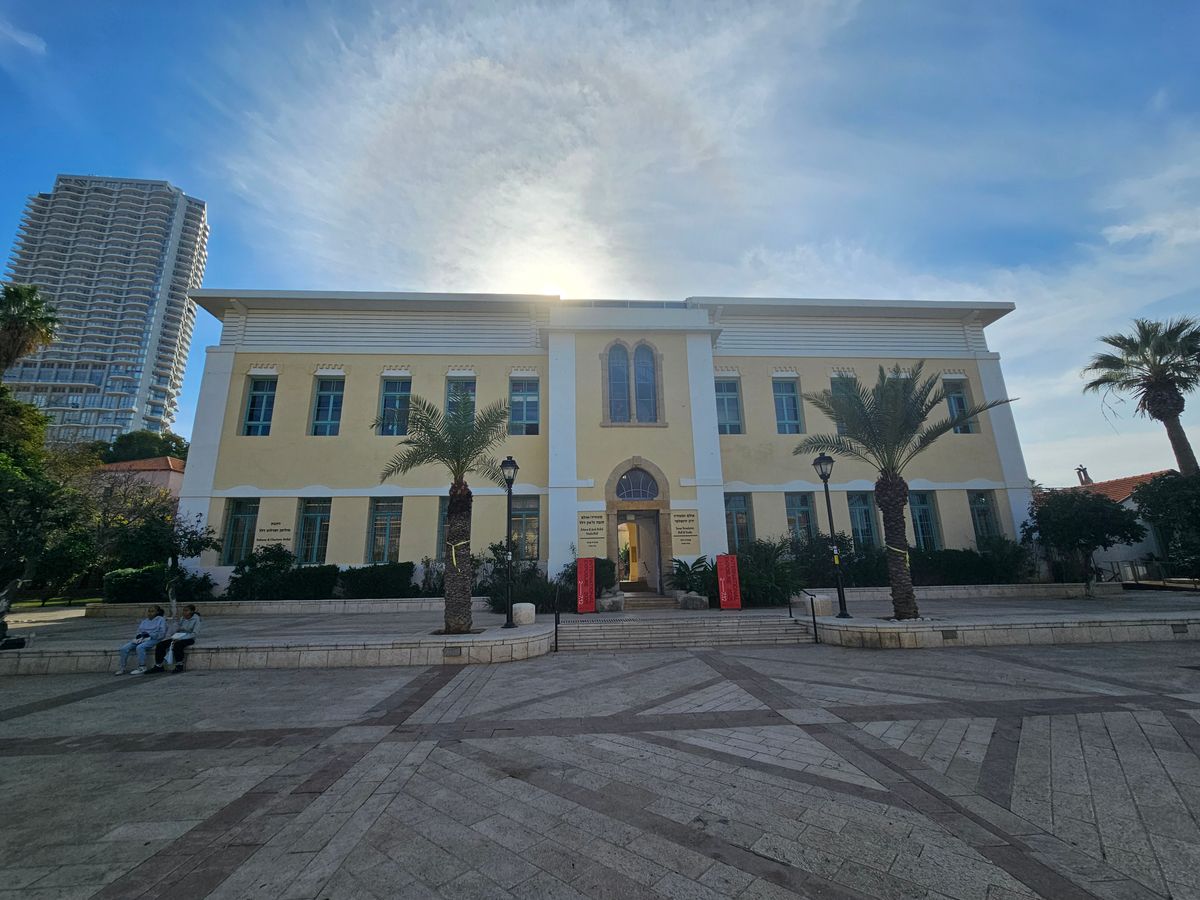
Neve Tzedek was the first Jewish neighborhood built outside the walls of Jaffa, founded in 1887, twenty-two years before Tel Aviv was established on the sand dunes to the north. For over a century, this small neighborhood of stone houses and narrow streets has been a mirror of Jewish life in the Land of Israel: pioneering hope, cultural brilliance, immigrant poverty, neglect, and, in one of the most dramatic urban transformations in the country’s history, rebirth as one of the most desirable and expensive neighborhoods in the Middle East.
Aharon Chelouche and the Founding
Aharon Chelouche was born in 1840 in Oran, Algeria and immigrated to Ottoman Palestine with his family eventually settling in Jaffa in the 1850s. By the 1880s, the Chelouche family had become prominent merchants in the city, with deep roots in the Sephardic community and strong relations with both the Ottoman authorities and their Arab neighbors. Life inside Jaffa’s walled city, however, was becoming impossible: the streets were cramped, disease was common, and the growing Jewish population had no room to breathe.
In 1887, Chelouche purchased land on the sand dunes between Jaffa and the sea and began building a neighborhood he called Neve Tzedek, “Oasis of Justice,” a phrase from Jeremiah 50:7. The first families were mostly Sephardic Jews from Jaffa, Ladino and Arabic speakers who had been part of the Ottoman Levant for centuries. Ashkenazi immigrants from the First Aliyah soon joined them. The houses were modest, single-story structures built from local kurkar sandstone with thick walls, arched windows, and inner courtyards, a blend of Ottoman, Mediterranean, and European influences that would later make the neighborhood architecturally unique.
The Chelouche House at 32 Chelouche Street still stands, restored and in use. Aharon Chelouche died in 1920, but his memoirs remain an invaluable source for understanding the birth of Jewish urban life outside Jaffa’s walls. Among the other founding families were the Rokach family, the Rokach House on Shimon Rokach Street, built in 1887, is one of the oldest surviving buildings in the neighborhood and today serves as a museum.
Cradle of Hebrew Culture
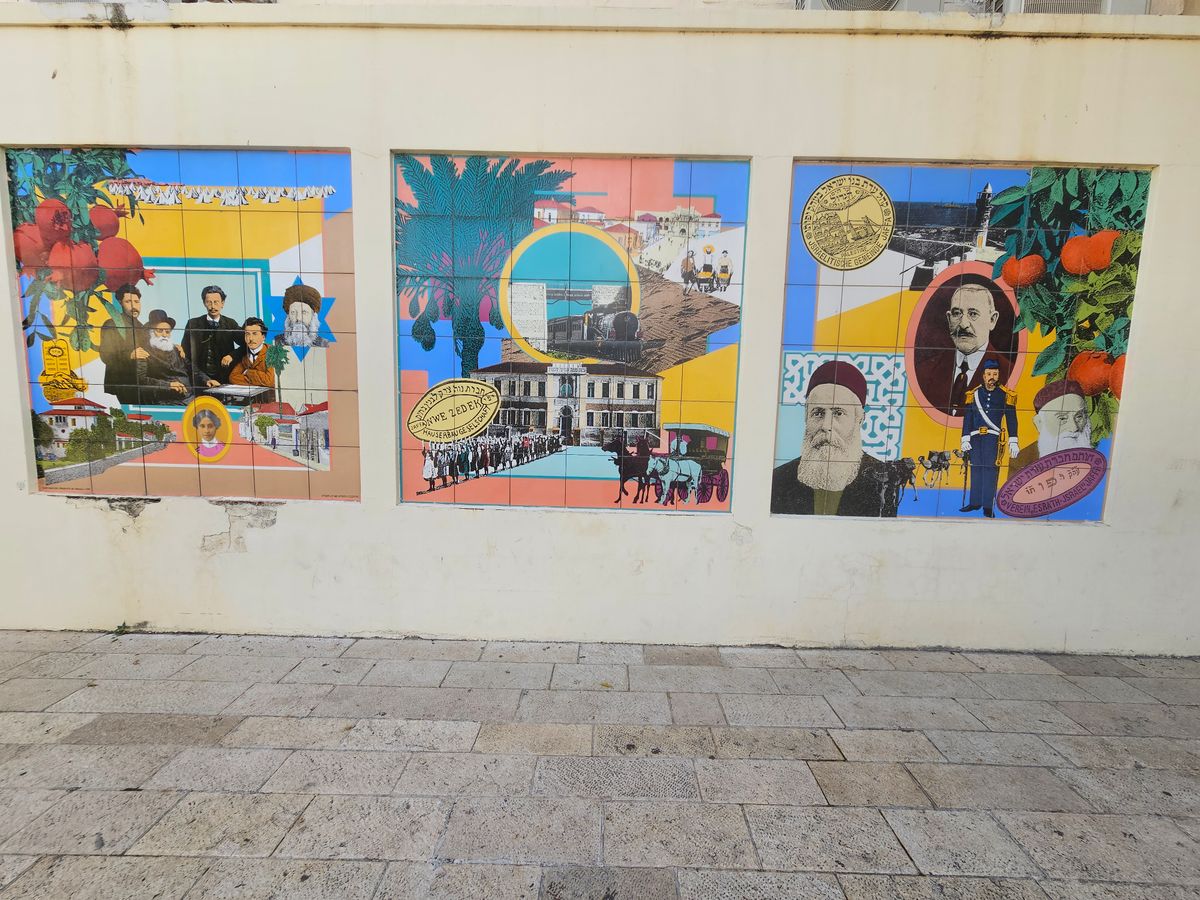 In the first decades of the 20th century, Neve Tzedek became an incubator of modern Hebrew culture. The writer S.Y. Agnon arrived from Galicia in 1908 at the age of 20 and settled in the neighborhood. It was here that he first published under the pen name “Agnon,” derived from his story “Agunot.” The characters of Neve Tzedek, Sephardic old-timers, idealistic immigrants, struggling workers, provided material for the fiction that would eventually earn him the Nobel Prize in Literature in 1966.
The painter Nahum Gutman grew up in these streets after his family arrived in 1905. His watercolors, donkeys on sand dunes, children playing among cactus hedges, the first houses rising from the empty landscape, became the visual memory of early Tel Aviv. His illustrated book “A Small City with Few People” is one of the most beloved works of Israeli nostalgia. The Nahum Gutman Museum on Shimon Rokach Street preserves his art and the world he painted.
The Hebrew writer Yosef Haim Brenner, one of the most influential intellectuals of the Second Aliyah, lived in the Jaffa-Neve Tzedek area during the same period. His raw, unflinching prose about the lives of Jewish laborers and immigrants was shaped by what he witnessed here. Brenner was murdered in the 1921 Jaffa riots, one of the violent upheavals that punctuated the neighborhood’s early history. Dvora Baron, one of the first modern Hebrew women writers, also lived in the area after arriving in 1910.
Ottoman Stone and Iron Balconies
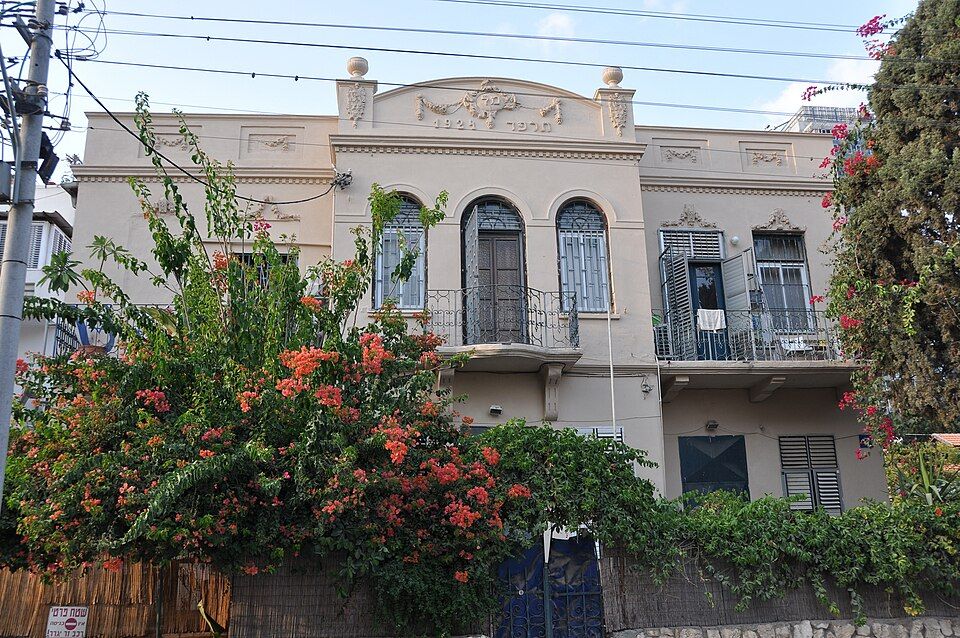
Neve Tzedek’s architecture belongs to a period that predates Tel Aviv’s famous Bauhaus White City by half a century. The buildings are Ottoman-era and early British Mandate construction: kurkar sandstone walls, high ceilings, red Marseille-tile roofs, arched doorways, wrought-iron balconies influenced by European styles, and inner courtyards designed for ventilation and family life. Some later buildings incorporated Art Nouveau and Art Deco elements, creating an eclectic mix that architectural historians call the “Eclectic Style” of pre-Bauhaus Palestine.
The neighborhood’s most notable structures include the Chelouche House (1887), the Rokach House (1887, now a museum), and the Eden Cinema (c. 1914), one of the first purpose-built cinemas in the region. The modest, human scale of the buildings, mostly one to two stories, gives Neve Tzedek a village-like intimacy that no other Tel Aviv neighborhood can match.
Rabbi Kook in Jaffa
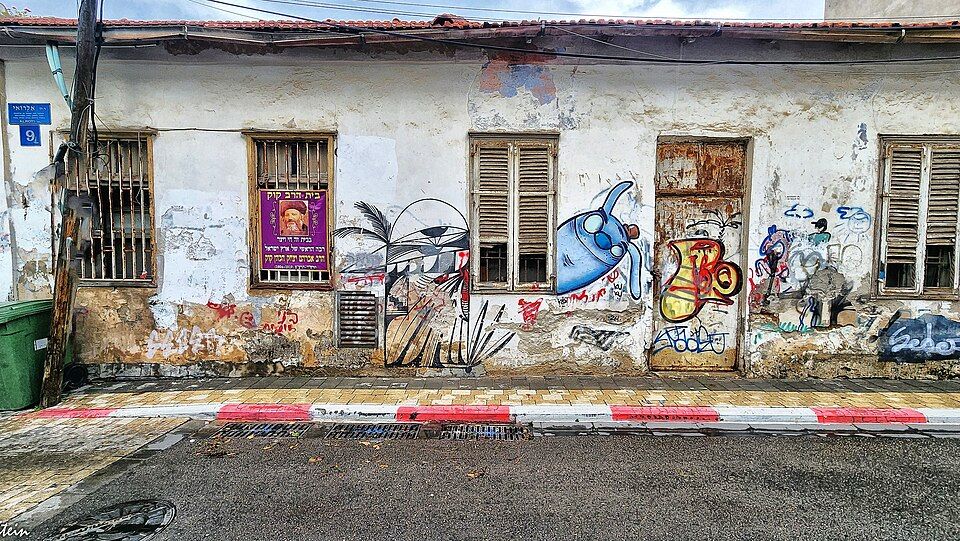 In 1904, Rabbi Abraham Isaac HaCohen Kook arrived to serve as Rabbi of Jaffa and the surrounding new settlements. Neve Tzedek, by then a 17-year-old established neighborhood and the center of Jewish life outside Jaffa’s walls, fell squarely within his jurisdiction. Kook served here until 1914, and it was during these years, living among secular Zionist pioneers, religious Jews, laborers, and intellectuals, that he developed his revolutionary philosophy: that even the work of non-observant settlers had inherent holiness, because they were building the land. This openness toward the secular Zionist project, forged in the diverse streets of Jaffa and its Jewish neighborhoods, would later define his legacy as the spiritual father of Religious Zionism.
The Decline
When Tel Aviv was founded in 1909 and began expanding northward, the center of gravity of Jewish urban life shifted with it. By the 1920s, the action was on Rothschild Boulevard, Allenby Street, and Dizengoff. Neve Tzedek, once the pioneering frontier, became a backwater at the southern edge of the city.
After 1948, mass immigration transformed the neighborhood. Thousands of new immigrants, predominantly from Yemen, Iraq, and North Africa, were housed in Neve Tzedek’s aging buildings, which were subdivided into cramped apartments. By the 1960s, the neighborhood had become a slum: overcrowded, neglected by the municipality, its Ottoman-era buildings crumbling, its residents among the poorest in Tel Aviv. The city drew up plans to demolish the entire neighborhood and replace it with modern housing blocks. It was, by any measure, a place people left, not a place they came to.
Suzanne Dellal and Rebirth
The demolition plans were never carried out. Instead, beginning in the late 1970s, artists and young professionals began discovering Neve Tzedek. The attractions were irresistible: rock-bottom rents, beautiful old buildings with high ceilings and thick stone walls, and an authentic atmosphere that modern Tel Aviv could not offer. Studios and galleries appeared in abandoned houses. The neighborhood’s image began to shift from “slum” to “bohemian.”
The transformation became irreversible with the opening of the Suzanne Dellal Centre for Dance and Theatre in 1989. Built around two restored buildings of the old Alliance Israelite Universelle school, a French-Jewish educational institution that had operated in Neve Tzedek since the Ottoman period, the center was named in memory of Suzanne Dellal, the daughter of Jack Dellal, a British-Jewish property magnate.
The center became Israel’s premier venue for contemporary dance, anchored by the Batsheva Dance Company. Batsheva was founded in 1964 by Baroness Batsheva de Rothschild, who had studied with the legendary Martha Graham, Graham herself served as the company’s first artistic advisor. But it was under the artistic direction of Ohad Naharin, who took over in 1990, just one year after Suzanne Dellal opened, that Batsheva became one of the most celebrated dance companies in the world. Naharin’s “Gaga” movement language revolutionized contemporary dance, and his works are performed on the world’s greatest stages. The fact that this company is based in a restored Ottoman schoolhouse in a neighborhood that was nearly bulldozed is one of the great cultural redemption stories of Israeli history.
From Slum to Most Expensive
 Once Suzanne Dellal opened, the transformation accelerated. Restaurants, boutiques, and design shops followed the galleries. Property values climbed. By the 2000s, Neve Tzedek had completed one of the most dramatic neighborhood reversals in Israeli history: from the poorest quarter in Tel Aviv to one of the most expensive. Today, property prices reach 80,000–120,000 NIS per square meter, placing the neighborhood in competition with premium districts in London and New York.
The gentrification has not been without cost. The working-class Mizrahi families who had lived here for decades, many since the mass immigration of the 1950s, were gradually priced out. The tight-knit community that had survived poverty and neglect could not survive prosperity. The ethnic and class dimensions of the transformation, predominantly Mizrahi working-class families replaced by predominantly Ashkenazi and international wealthy buyers, mirror broader tensions in Israeli society. It is a success story and a displacement story at the same time, and any honest account of Neve Tzedek must hold both truths together.
Walking Neve Tzedek
Shabazi Street, named after the great Yemenite poet Shalom Shabazi, is the neighborhood’s main artery, a narrow, low-rise street lined with restored buildings housing independent boutiques, design shops, galleries, and restaurants. The architecture rewards slow walking: Art Nouveau tilework, carved lintels, iron balconies draped with bougainvillea, and courtyards glimpsed through half-open gates.
Side streets lead to the Nahum Gutman Museum, the Rokach House Museum, and the Chelouche House. The Suzanne Dellal courtyard, with its rows of orange trees and stone paving, is one of the most pleasant public spaces in the city, a place to sit, watch a rehearsal through an open window, and feel the layers of time beneath the surface. At the southern edge of the neighborhood, HaTachana, the restored Ottoman railway station where the first train from Jerusalem arrived in 1892, completes the picture.
Visit with Hoshen Tours
A visit to Neve Tzedek pairs beautifully with nearby destinations along your route. Consider combining it with a stop at Tel Aviv or HaTachana, both just a short drive away. Many travelers also enjoy exploring Rothschild Boulevard and Carmel Market on the same day, while Jaffa offers another worthwhile addition to your itinerary. Your Hoshen Tours guide will craft a seamless route that brings each destination to life with expert commentary and insider knowledge.
Explore Our Tour Collection
Ready to experience Israel in true colors?
Plan Your TourPrivate tours designed around your interests, schedule, and pace.