



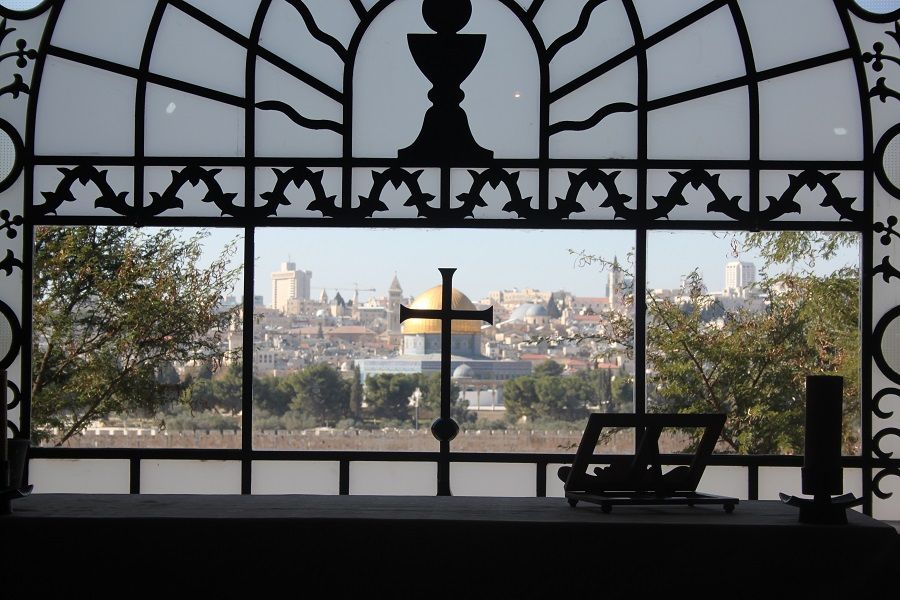
Dominus Flevit (The Lord Wept) is a small Franciscan church on the western slope of the Mount of Olives, marking the place where tradition holds Jesus looked at Jerusalem and wept. The Gospel of Luke records the moment with devastating simplicity: “As he approached Jerusalem and saw the city, he wept over it and said, ‘If you, even you, had only known on this day what would bring you peace, but now it is hidden from your eyes’” (Luke 19:41-42). He was weeping because he foresaw the destruction of the city: “The days will come upon you when your enemies will build an embankment against you and encircle you and hem you in on every side. They will dash you to the ground, you and the children within your walls” (Luke 19:43-44). Forty years later, in 70 CE, the Romans did exactly that.
The Dominus Flevit Church
The church was designed by Antonio Barluzzi and completed in 1955. Like all of Barluzzi’s churches in the Holy Land, the architecture is inseparable from the theology. The building is shaped like a teardrop when viewed from above, echoing the tears of Jesus. The interior is deliberately intimate, a small space designed for a private moment of grief rather than public celebration. The walls are bare, the light is soft, and everything in the building draws the eye toward the window behind the altar.
The Window
The window behind the altar is the most famous feature of the church and one of the most photographed views in Jerusalem. Through the glass, framed by iron arches, you see the Dome of the Rock and the walls of the Old City. A gold mosaic chalice on the window is positioned so that the Dome of the Rock appears to sit inside it, a visual statement about sacrifice, worship, and the relationship between the two faiths that claim this city. The view through this window connects the prophecy of destruction to the city that was destroyed and rebuilt, and rebuilt and destroyed, and rebuilt again.
Photographers struggle with this window because the contrast between the dark interior and the bright view is extreme. But the eye adjusts, and when it does, the image is unforgettable: the ancient city, framed in iron and glass, seen through the tears of the man who loved it and knew what was coming.
The Garden of Dominus Flevit
The church is surrounded by a garden of olive trees, cypress, and Mediterranean plants that offers one of the most peaceful outdoor spaces on the Mount of Olives. The garden terrace provides the same view as the altar window, but from outside, with the Jewish cemetery spreading down the hillside below and the Garden of Gethsemane visible at the foot of the mountain. In the garden, several of the ossuaries (stone bone boxes) found in the excavations beneath the church are displayed in the open air. The ossuaries, dating to the 1st century CE, are carved from local limestone and bear inscriptions in Aramaic and Greek. Some of them are decorated with rosettes and geometric patterns.
These bone boxes represent the Jewish burial practice of the Second Temple period: the body was first laid in a tomb to decompose, and after a year the bones were collected and placed in an ossuary for permanent burial. The practice was common in Jerusalem between approximately 20 BCE and 70 CE, precisely the period of Jesus’s life and the early church. The ossuaries at Dominus Flevit, displayed among the olive trees with the Old City visible beyond, are a quiet but powerful reminder that this hillside has been a place of burial and resurrection faith for two thousand years.
The Tombs
Beneath the church, archaeologists discovered a burial ground with tombs dating from the late Bronze Age through the Byzantine period. Ossuaries (stone boxes for collecting bones after the flesh had decomposed) from the 1st century CE were found with inscriptions in Aramaic, Hebrew, and Greek, some bearing the sign of the cross. These are among the earliest Christian burials ever found in Jerusalem, suggesting that followers of Jesus were buried on the Mount of Olives within decades of the crucifixion. Several of the inscriptions include names found in the New Testament, though no direct connection to specific biblical figures has been established.
Location on the Palm Sunday Road
Dominus Flevit sits directly on the Palm Sunday Road, the route Jesus took when he rode a donkey down the Mount of Olives five days before the crucifixion. It was during this descent, with the crowds waving palm branches and shouting “Hosanna,” that Jesus stopped, looked at the city below, and wept. The church marks the exact point where joy turned to grief, where the triumphal entry collided with the knowledge of what was coming. Five days after the palm branches, the crowd would be shouting something else entirely.
Visit with Hoshen Tours
Dominus Flevit is a highlight of the Mount of Olives descent. Hoshen Tours includes it between the Church of Mary Magdalene above and Gethsemane below, connecting the tears of Jesus to the prayer in the garden and the arrest that followed.
Explore Our Tour Collection
Ready to experience Israel in true colors?
Plan Your TourPrivate tours designed around your interests, schedule, and pace.