



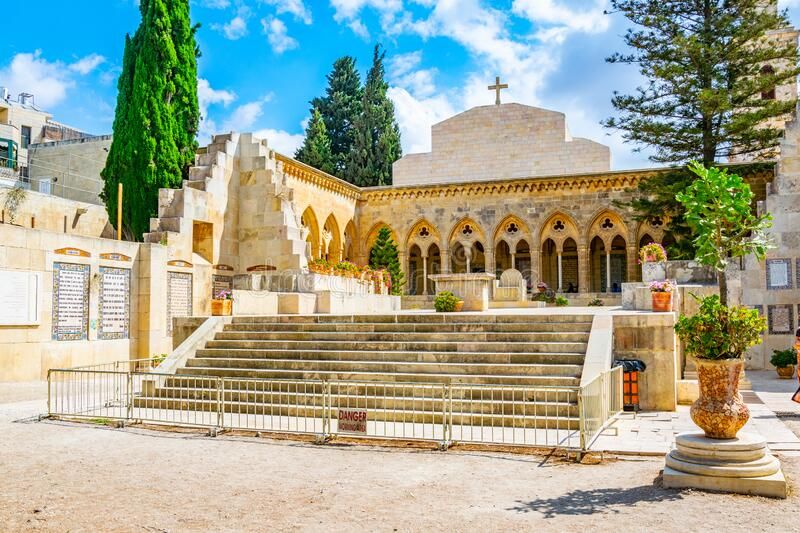
The Church of Pater Noster Jerusalem on the Mount of Olives marks the cave where, according to tradition, Jesus taught his disciples the Lord’s Prayer: “Our Father, who art in heaven, hallowed be thy name. Thy kingdom come, thy will be done, on earth as it is in heaven” (Matthew 6:9-13). The prayer, arguably the most recited text in the history of humanity, was taught in this cave overlooking the city where Jesus would soon be crucified.
The Lord’s Prayer in 140 Languages Jerusalem
The church’s most distinctive feature is the collection of ceramic tiles lining the walls and corridors of the cloister, each displaying the Lord’s Prayer in a different language. Over 140 translations are represented, from major world languages to endangered indigenous tongues, from ancient scripts to modern alphabets. Walking through the corridors, reading the prayer in language after language, is a visual meditation on the global reach of Christianity and a reminder that these words, first spoken in Aramaic in a cave above Jerusalem, are recited daily by over two billion people.
The tiles continue to grow. New translations are added periodically, and the collection now includes languages from every continent. Some of the most moving tiles are in languages that few people still speak, a prayer that has outlived the cultures that once recited it.
The Cave Where tradition holds that Jesus Taught His Disciples
The church is built over a natural cave that Byzantine-era Christians identified as the place where Jesus privately taught his disciples about the end times and the coming of the Kingdom. The Gospel of Luke places this teaching on the Mount of Olives: “Each day Jesus was teaching at the temple, and each evening he went out to spend the night on the hill called the Mount of Olives” (Luke 21:37). The cave is accessible beneath the church and is used for small services and private prayer.
Olivet Discourse
The site of Pater Noster is associated not only with the Lord’s Prayer but also with the Olivet Discourse, Jesus’s longest teaching about the end of days. Sitting on the Mount of Olives, looking at the Temple across the valley, his disciples asked: “Tell us, when will these things happen, and what will be the sign of your coming and of the end of the age?” (Matthew 24:3). Jesus’s answer, spanning two full chapters in Matthew (24-25), describes wars, earthquakes, false prophets, the destruction of the Temple, and the final coming of the Son of Man “on the clouds of heaven, with power and great glory” (Matthew 24:30).
The teaching took place on this hillside, with the Temple in full view across the valley. Less than 40 years later, the Temple was destroyed exactly as Jesus described. Standing at Pater Noster and looking toward the Temple Mount, you see the same view Jesus saw when he spoke these words, minus the Temple itself.
History of the Church
The Empress Helena, mother of Constantine, built the original church here around 330 CE as part of her program of identifying and commemorating the sites of Jesus’s life. She built the Church of the Nativity in Bethlehem, the Church of the Holy Sepulchre in Jerusalem, and this church on the Mount of Olives. The Eleona (from the Greek elaion, olive tree) was one of the three great Constantinian churches in the Holy Land. It was destroyed by the Persians in 614 CE, and only its foundations and caves survive beneath the Crusader and modern structures.
The church and its cloisters are maintained by Carmelite nuns, whose convent occupies the grounds. The Carmelite connection to the Mount Carmel and the prophetic tradition adds another layer to the site. The gardens are peaceful, the cloisters are beautiful, and the atmosphere is contemplative.
Adjacent to the cloister, the partially reconstructed Basilica of the Sacred Heart (Eleona) was built by the Crusaders over an earlier Byzantine church. The basilica was never completed, and the open walls and exposed foundations give the building a quality of beautiful ruin that suits its location on the mountain of prophecy.
Visit with Hoshen Tours
The Church of Pater Noster, with its dozens of ceramic panels displaying the Lord’s Prayer in over 140 languages, sits just below the summit of the Mount of Olives. Hoshen Tours visits the church as part of the descent from the Church of the Ascension nearby, continuing down the Palm Sunday Road toward the Kidron Valley below. The peaceful cloister garden is one of the quietest spots on the mountain.
Explore Our Tour Collection
Ready to experience Israel in true colors?
Plan Your TourPrivate tours designed around your interests, schedule, and pace.