



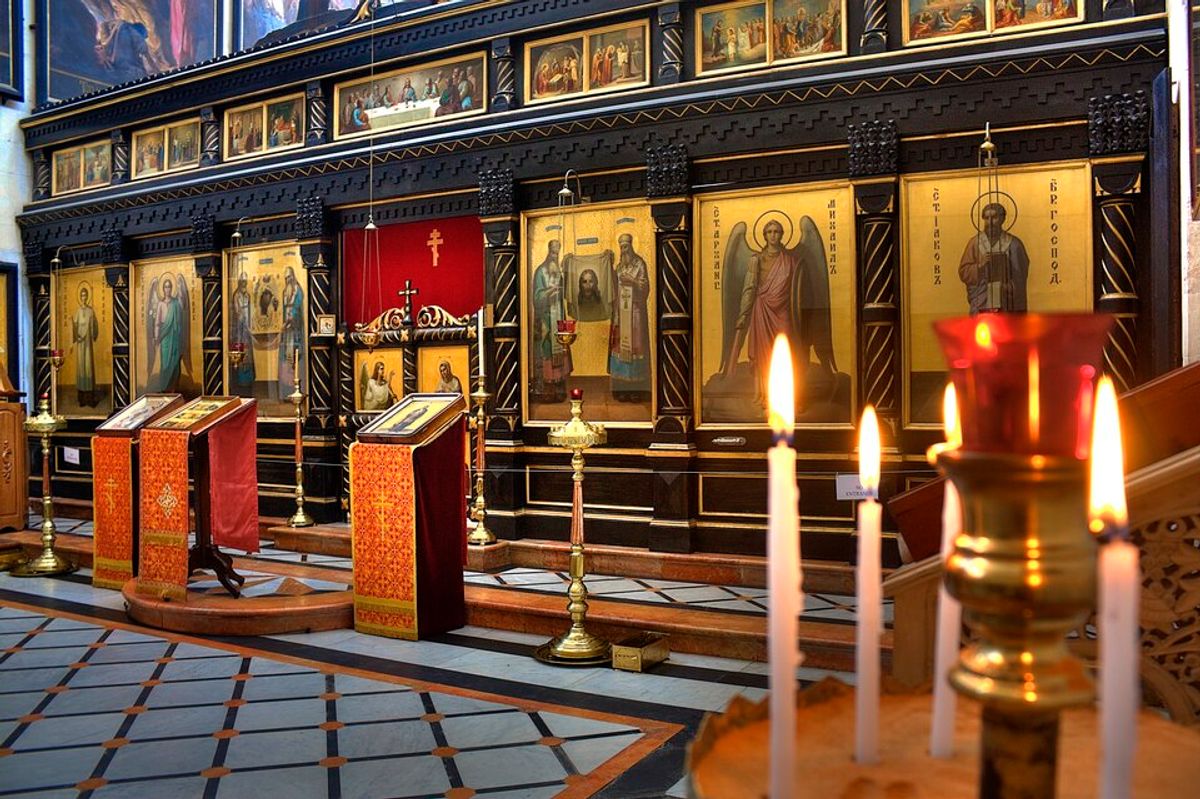
Hidden behind an unmarked door on a side street just meters from the Church of the Holy Sepulchre, the Church of Alexander Nevsky (also known as Alexander’s Hospice or the Russian Excavations) contains one of the most important archaeological discoveries in the Old City: the remains of an ancient gate and wall that may be the very gate through which Jesus passed on his way to crucifixion.
Judgment Gate
In the 1880s, Russian archaeologists excavating beneath the hospice discovered the remains of an ancient city gate and a section of the Second Wall of Jerusalem, the wall that defined the city’s boundary in the 1st century CE. The gate, which the Russians identified as the Judgment Gate (Bab el-Dabbagha), is significant because it confirms that the site of the Church of the Holy Sepulchre was outside the city walls at the time of Jesus, exactly as the Gospels require: “Jesus also suffered outside the city gate” (Hebrews 13:12). The threshold of the gate, worn smooth by thousands of ancient feet, is still visible in the floor of the church. Tradition holds that Jesus stepped over this very threshold on his way to Golgotha.
Archaeological Remains
The excavations revealed several layers of history in a remarkably compact space. The gate and wall date to the Hasmonean or Herodian period (1st century BCE to 1st century CE). Above them, the remains of the triumphal arch built by Emperor Hadrian in the 2nd century CE, when he rebuilt Jerusalem as the pagan city of Aelia Capitolina, are visible. The Roman arch would have stood at the entrance to Hadrian’s Forum, which occupied the area now covered by the Muristan and the Holy Sepulchre. Columns, carved stones, and architectural fragments from both the Herodian and Roman periods are displayed in the excavation space.
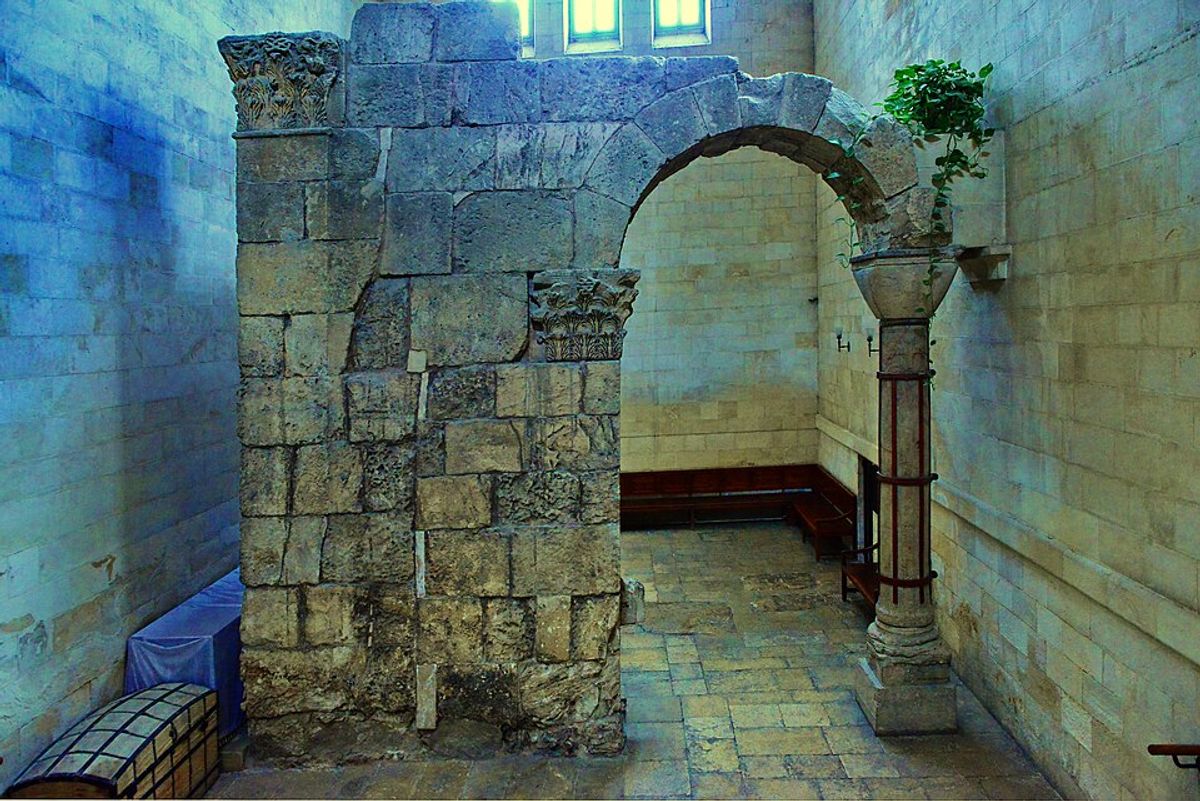
The Church of Alexander Nevsky and the Judgment Gate
The church itself, consecrated in 1891 and named after the medieval Russian hero-saint Alexander Nevsky, is a small, elegant Russian Orthodox chapel built directly over the archaeological remains. The interior features icons, oil lamps, and the distinctive atmosphere of Russian Orthodoxy. The Eye of the Needle, a small opening in the ancient wall, is pointed out by guides as the kind of narrow gate Jesus may have referred to: “It is easier for a camel to go through the eye of a needle than for someone who is rich to enter the kingdom of God” (Matthew 19:24). Whether or not this specific opening inspired the parable, it is a powerful visual.
Russian Connection
The site was purchased by the Imperial Orthodox Palestine Society, the same Russian organization that built the Russian Compound to house thousands of Russian pilgrims. The archaeological excavations were funded by Tsar Alexander III, and the church was named after the patron saint associated with the Russian imperial family. After the Russian Revolution, ownership of the site became contested between the Soviet government and the Russian Orthodox Church Abroad, a dispute that reflected the larger schism within Russian Orthodoxy throughout the 20th century.
Why It Matters
The Judgment Gate is one of the strongest pieces of archaeological evidence supporting the authenticity of the Church of the Holy Sepulchre as the site of the crucifixion and burial. If this gate was in the city wall, then the area immediately beyond it (where the Holy Sepulchre stands) was outside the city, an essential requirement of the Gospel narrative. Combined with the quarry marks found under the Church of the Redeemer next door, the evidence strongly supports the traditional identification of the site.
Visit with Hoshen Tours
The Alexander Nevsky Church sits just steps from the Church of the Holy Sepulchre in the Christian Quarter, housing remarkable archaeological finds including an ancient threshold that may date to the time of Christ. Your Hoshen Tours guide will explain the significance of these discoveries and connect them to the broader story of the Muristan district and the Via Dolorosa route nearby. This is one of Jerusalem’s best-kept secrets for visitors interested in both archaeology and faith. Hoshen Tours often combines this site with Sephardic Synagogues, Deir es-Sultan, and Sisters of Zion for a memorable day exploring the region.
Ready to experience Israel in true colors?
Plan Your TourPrivate tours designed around your interests, schedule, and pace.