



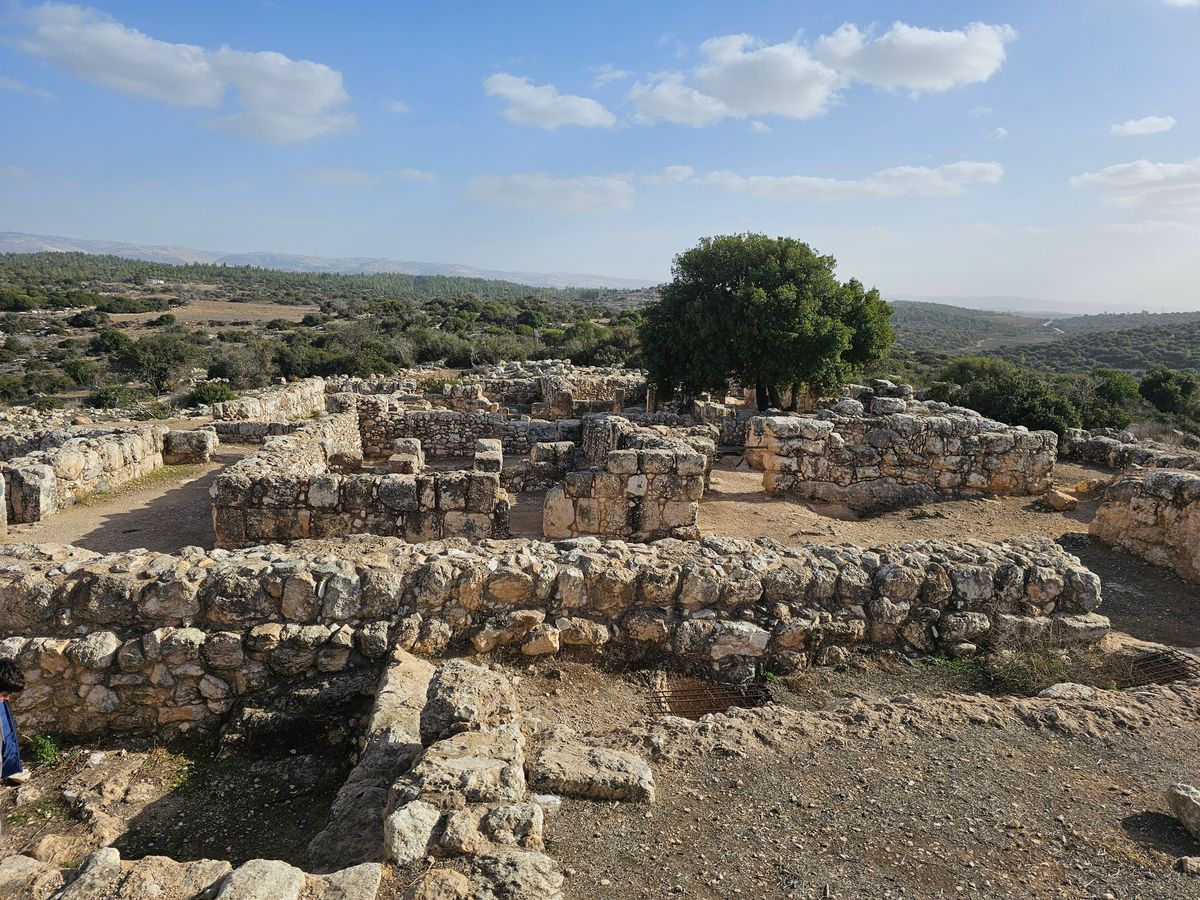
Horvat ‘Ethri (Khirbet Itri) is the ruin of a Jewish village in the Judean foothills, southeast of Beit Shemesh, within the Adulam Grove Nature Reserve. The village was founded in the 4th century BCE and violently destroyed during the Bar Kokhba revolt in 135 CE. What remains is one of the most complete archaeological records of a small Jewish community swept up in the great revolts against Rome.
The Village of Horvat Ethri
Horvat ‘Ethri sits at 406 meters above sea level, overlooking the western Judean foothills about 35 kilometers southwest of Jerusalem and 5 kilometers south of the Ella Valley. The village was founded during the Persian period, when Jews returning from the Babylonian exile established farming settlements across the Shephelah under the self-governing province of Yehud Medinata. Coins from this period, including Yehud coins and imitation Athenian drachmas, confirm the early settlement. At its peak, on the eve of the Great Revolt against Rome (66 CE), the village covered approximately 10 dunams (2.5 acres), with two central plazas, residential lanes, and an economy based on wine production, olive oil, dove-breeding, and textiles.
Caphethra: The Village Josephus Named
Based on a clay ostracon bearing the name “Ethri” in Hebrew script, excavators Boaz Zissu and Amir Ganor have proposed that Horvat ‘Ethri should be identified with Caphethra (Κάφεθρα), a village in the Judean foothills mentioned by the historian Josephus as destroyed during a Roman military campaign by units of the Legio V Macedonica in 69 CE, during the Great Revolt. If this identification is correct, Josephus’s account gives us the name of the army that first devastated the village and its inhabitants.
The Horvat ‘Ethri Synagogue
The most prominent structure at Horvat ‘Ethri is a public building that may be an early synagogue, constructed between the two revolts against Rome, sometime after 70 CE and before 132 CE. The rectangular hall measures 13 by 7 meters, with walls nearly a meter thick and three stone pedestals that supported roof columns with Doric-style capitals. The entrance faces northeast, toward Jerusalem. A large vestibule, a courtyard, and a ritual bath adjoin the main hall. Beneath the vestibule floor, a hidden passage leads down into the underground hiding complex, a feature that reveals how the building was adapted for survival as the second revolt approached.
Ritual Baths
Four mikvehs (ritual immersion baths) have been identified at the site, carved into the bedrock. The baths confirm the religious character of the community: Horvat ‘Ethri was a village of observant Jews who maintained the laws of ritual purity even in a small agricultural settlement. The earliest mikveh dates to the Hasmonean period. One of these baths, Mikveh XI, would later serve a very different purpose.
Hiding Complexes
As the Bar Kokhba revolt (132–135 CE) loomed, the villagers carved an extensive network of underground tunnels and chambers beneath their homes. These hiding complexes, a phenomenon found across the Shephelah and Judean hills, were designed as last-resort refuges against the Roman army. The tunnels connected houses to the synagogue and to concealed exits, allowing movement underground across the entire village. The construction is careful and deliberate: narrow crawl passages designed to slow attackers, ventilation shafts, storage niches for food and water, and secret entrances hidden beneath floors and inside ritual baths.
The Destruction
The end came violently. A destruction layer of ash, charred wood, and collapsed stone was found across the center of the village. In Mikveh XI, excavators discovered the remains of approximately 15 individuals, men, women, and children, buried together in what appears to be a mass grave. Mixed with the bones were ashes, broken tools, bent glass fragments, and coins from the reigns of Trajan and Vespasian. One skeleton bore cut marks on the cervical vertebrae, indicating that the individual had been beheaded by a sword. These were not soldiers on a battlefield. They were families: parents, children, neighbors who had shared meals and worked the same presses and fields for generations. The archaeological evidence tells the story of a community that retreated underground and refused to surrender, and of a last stand that ended in a ritual bath repurposed as a mass grave.
The evidence points to a massacre during the final Roman suppression of the Bar Kokhba revolt. The massive defensive walls of the village, built with unusually large stones, led excavator Boaz Zissu to suggest that Horvat ‘Ethri may have been one of the fifty fortified strongholds in Judea that the Roman historian Cassius Dio recorded as destroyed by Emperor Hadrian during the revolt.
After approximately 200 CE, new residents occupied parts of the ruined village, possibly pagan settlers or Roman military veterans, a pattern seen across the Shephelah after the Bar Kokhba revolt. This late Roman settlement lasted about 150 years before the site was abandoned in the second half of the 4th century. The village was never rebuilt.
Visit with Hoshen Tours
Horvat ‘Ethri lies within the Adulam Grove Nature Reserve, accessible via a short trail from Highway 38 near Moshav Tsafririm. Hoshen Tours visits the synagogue, the ritual baths, the hiding complexes, and the mass grave, telling the story of a village that lived and died in the great upheavals of Jewish history. The site combines well with nearby Adulam Park, the Ella Valley, and Horvat Burgin. Hoshen Tours often combines this site with Tel Miqne Ekron, Tzorah and Eshtaol, and Burma Road for a memorable day exploring the region.
Explore Our Tour Collection
Ready to experience Israel in true colors?
Plan Your TourPrivate tours designed around your interests, schedule, and pace.