



Bethlehem sits on a ridge in the Judean Hills, about ten kilometers south of Jerusalem, at an elevation of roughly 775 meters above sea level. The name in Hebrew, Beit Lehem, means “House of Bread.” For Christians, this is the birthplace of Jesus. For Jews, it is the hometown of King David and the setting of the Book of Ruth. For over 1,700 years, the Church of the Nativity has stood over the cave where tradition holds the birth took place, making Bethlehem one of the most important pilgrimage destinations in the world and one of the oldest continuously operating churches in Christianity.
Bethlehem in the Bible
Bethlehem appears early in the biblical narrative. Rachel, Jacob’s beloved wife, died and was buried “on the way to Ephrath, that is, Bethlehem” (Genesis 35:19). The entire story of Ruth and Boaz unfolds in Bethlehem’s fields, where Ruth the Moabite gleaned grain and won the heart of her kinsman-redeemer. Their great-grandson was David. It was in Bethlehem that the prophet Samuel came to the house of Jesse and anointed the youngest son, the shepherd boy who would become Israel’s greatest king: “the Lord does not see as man sees; for man looks at the outward appearance, but the Lord looks at the heart” (1 Samuel 16:1-13). And it was the prophet Micah who gave Bethlehem its messianic destiny: “But you, Bethlehem Ephrathah, though you are small among the clans of Judah, out of you will come for me one who will be ruler over Israel, whose origins are from of old, from ancient times” (Micah 5:2).
The Nativity
The Gospel of Luke tells the story that has shaped Christmas for two thousand years. Caesar Augustus issued a decree for a census of the Roman world, and Joseph, being of the house and lineage of David, traveled from Nazareth to Bethlehem to register. Mary, who was expecting a child, accompanied him. While they were there, she gave birth to her firstborn son, wrapped him in swaddling cloths, and placed him in a manger, “because there was no room for them in the inn” (Luke 2:7). In nearby fields, shepherds watching their flocks by night were visited by an angel: “Do not be afraid. I bring you good news that will cause great joy for all the people. Today in the town of David a Savior has been born to you; he is the Messiah, the Lord” (Luke 2:10-11). The shepherds went to Bethlehem and found the baby lying in the manger.
The Gospel of Matthew tells a different part of the story. Magi from the East came to Jerusalem following a star, asking “Where is the one who has been born king of the Jews?” (Matthew 2:2). King Herod, troubled by the question, consulted the chief priests, who cited Micah’s prophecy pointing to Bethlehem. The Magi followed the star to the child, presented gifts of gold, frankincense, and myrrh, and departed by another route after being warned in a dream. Herod, furious at being outwitted, ordered the killing of all male children in Bethlehem two years old and under (Matthew 2:16). Joseph, warned by an angel, fled with Mary and the child to Egypt.
Bethlehem at the time of Jesus was a small village in the hills of Judah, significant for its Davidic associations but modest in size. The Gospel narrative places the birth in the context of a census that brought crowds to the town, and the detail that there was no room for them speaks to a village overwhelmed by visitors. The Massacre of the Innocents, recorded only in Matthew, echoes the pharaoh’s order to kill Hebrew boys in Exodus and establishes Herod as a tyrant whose violence extended even to infants. Whether the event is historical or theological in its intent, it became one of the most powerful and disturbing images in Christian art and worship, and the Holy Innocents are commemorated as the first martyrs of Christianity.
The Church of the Nativity
The cave beneath the church was identified as the birthplace of Jesus as early as the 2nd century CE. The Church Father Justin Martyr mentioned it around 150 CE, and Origen of Alexandria referenced it a century later. Emperor Hadrian, who rebuilt Jerusalem as Aelia Capitolina after 135 CE, is believed to have planted a grove sacred to the god Adonis over the site, which may have inadvertently preserved its memory by marking it. Around 326-339 CE, Emperor Constantine and his mother Helena built the first basilica over the cave, a five-aisled basilica with a polygonal apse at the eastern end, featuring an opening in the floor that allowed pilgrims to look down into the grotto below. The original floor was decorated with geometric mosaics, portions of which survive today and are visible through trapdoors in the current nave floor.
The Constantinian church was destroyed during the Samaritan Revolt of 529 CE. Emperor Justinian rebuilt it in the 530s-560s CE, and the current building is essentially his: the nave with its rows of Corinthian columns, the three-apsed transept, and the arrangement around the grotto are approximately 1,500 years old. When the Persians invaded in 614 CE and destroyed churches across the Holy Land, the Church of the Nativity was spared. According to tradition, the Persian soldiers saw a mosaic on the facade depicting the Magi wearing Persian-style clothing and, recognizing what appeared to be their own countrymen, chose not to destroy the building. Whether or not the story is historically accurate, the result is undeniable: the Church of the Nativity is one of the only major Byzantine churches in the Holy Land that survived the Persian invasion intact, making it one of the oldest church buildings in the world still standing in something close to its original form.
By the 21st century, the church was in serious disrepair. The roof had been leaking for decades, causing severe damage to the walls, mosaics, and wooden roof beams. In 2013, a major restoration project began, led by the Palestinian Authority with the Italian restoration firm Piacenti. The work involved repairing the roof structure, cleaning and conserving the 12th-century wall mosaics, restoring the Crusader-era column paintings, and stabilizing the exterior stonework. The restoration uncovered previously hidden mosaic fragments, including a seventh angel that had been concealed under centuries of plaster. The angel, revealed in 2016 and dubbed the “Guardian Angel of Bethlehem,” became a symbol of the project. The work has transformed the interior, allowing visitors to see the mosaics and columns in a condition closer to their original splendor than at any time in centuries.
The Door of Humility and the Interior
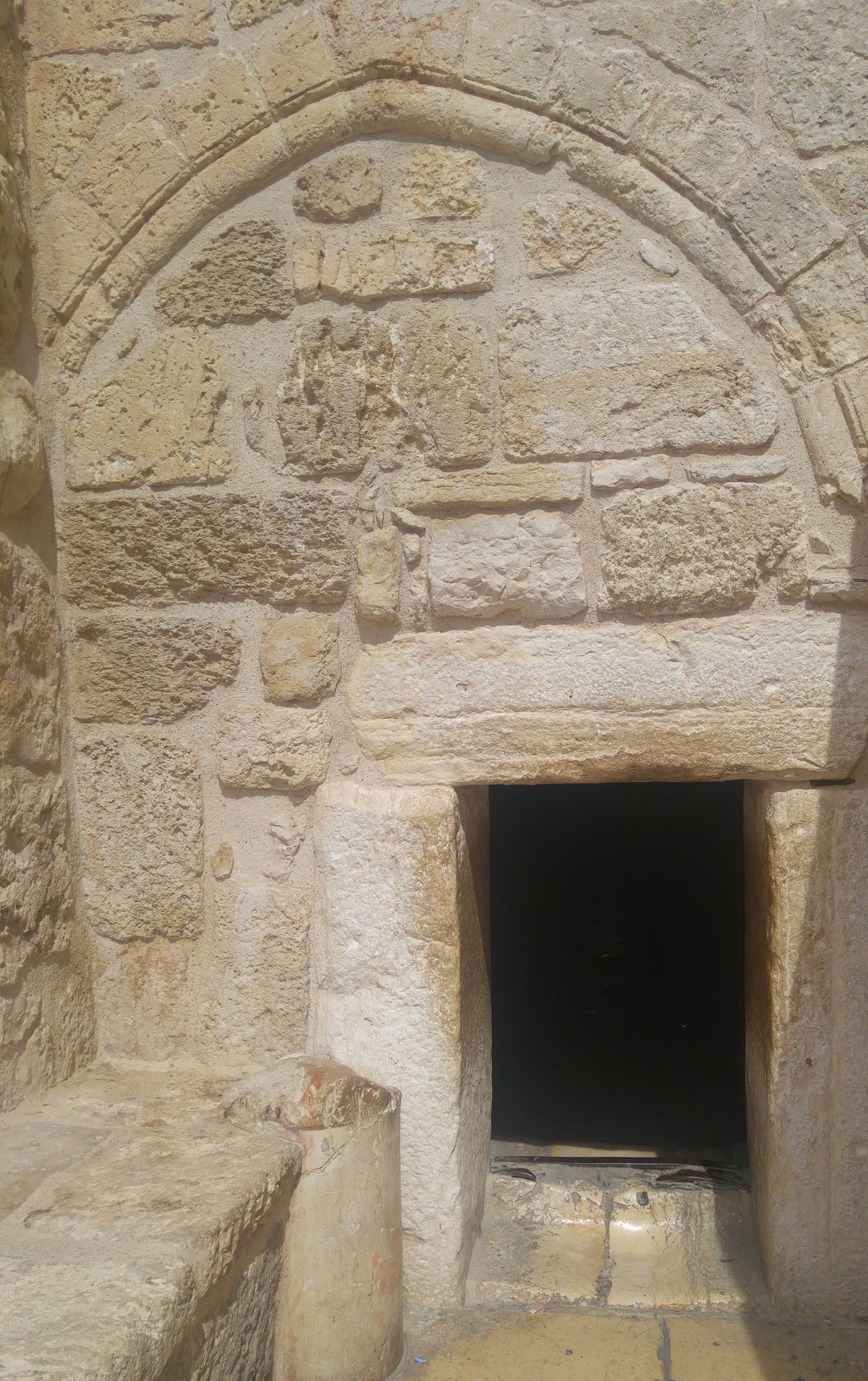
The main entrance is a very low doorway, only about 1.2 meters high, known as the Door of Humility. It forces everyone who enters to bow. The original Justinian-era entrance was much larger; looking at the doorway, you can see the outline of the original arch, a smaller Crusader-era arch within it, and finally the current rectangular opening, reduced in size during the medieval period to prevent horses and carts from being driven into the church. Inside, 44 Corinthian columns line the nave. Many bear paintings of saints added during the Crusader period in the 12th century, in both Western and Byzantine styles. Above the columns, fragments of gold-ground mosaics completed in 1169 by Crusader King Amalric I in collaboration with Byzantine Emperor Manuel I Comnenus survive on the walls, depicting Gospel scenes and ancestors of Jesus. A major Italian-Palestinian restoration project begun in 2013 uncovered previously hidden fragments, including a mosaic angel that has been called the “Guardian Angel of Bethlehem.”
The Grotto
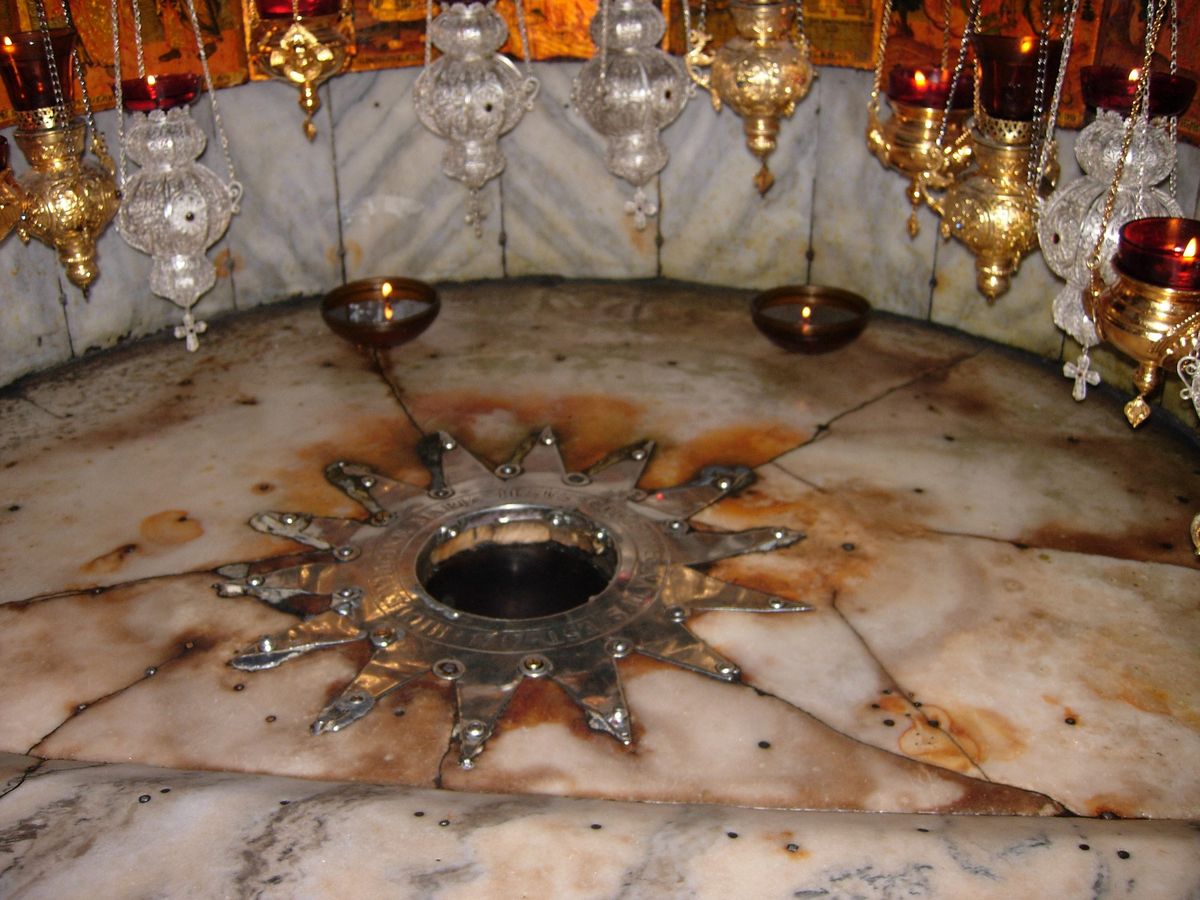
Steps on either side of the high altar lead down to the Grotto of the Nativity, a roughly rectangular underground chamber approximately 12 meters long and 3 meters wide. The exact spot believed by tradition to mark the birthplace is indicated by a 14-pointed silver star set into the marble floor, bearing the Latin inscription: “Hic de Virgine Maria Jesus Christus natus est” (“Here Jesus Christ was born of the Virgin Mary”). The 14 points are traditionally said to represent the 14 generations in Matthew’s genealogy of Jesus. A few steps away, in a separate alcove, the Chapel of the Manger marks the spot where tradition holds the infant was laid. The grotto is shared under the Status Quo arrangement: the Greek Orthodox hold primary rights over the Silver Star area, the Armenians have rights to portions of the grotto, and the Franciscans (Catholic) maintain the Chapel of the Manger. The history of the silver star itself is a story of imperial rivalry: the current star was placed by the Catholics in 1717, stolen in 1847 in an act that contributed to the tensions between France and Russia that helped ignite the Crimean War (1853-1856), and replaced in 1853 by the Ottoman government. The grotto is small, dimly lit, and often crowded with pilgrims waiting in line to kneel and touch the star. The experience of descending into the cave beneath the basilica, reaching the spot where tradition holds that the incarnation entered the world, is for many Christians the most profound moment of their pilgrimage to the Holy Land.
St. Catherine’s Church
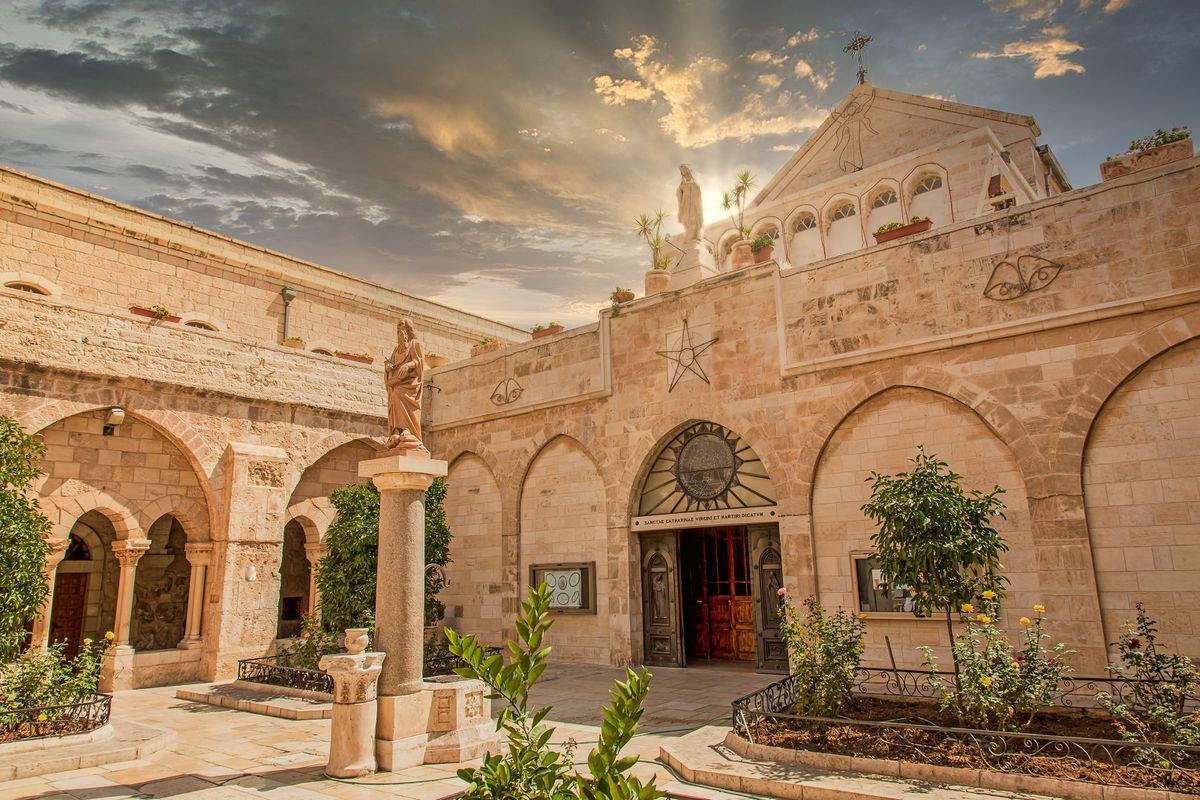
Attached to the northern side of the Church of the Nativity, St. Catherine’s is the Roman Catholic parish church of Bethlehem, administered by the Franciscan Custody of the Holy Land. The current building dates from 1882, replacing a Crusader-era monastery church. On Christmas Eve, the Midnight Mass at St. Catherine’s is broadcast worldwide and is one of the most watched Christian services on earth. The Latin Patriarch of Jerusalem presides, arriving in a formal procession through Manger Square. Beneath the church, caves connected via passages to the Grotto of the Nativity are associated with St. Jerome (c. 347-420 CE), who lived in Bethlehem for roughly 34 years and produced the Vulgate, his landmark translation of the Bible into Latin that became the standard text of the Western Church for over a millennium. Jerome chose Bethlehem deliberately, wanting to live and work in the place where Jesus was born, close to the original languages and landscapes of the Bible. He was known for his fierce intellect, his biting wit, and his ascetic lifestyle. In the caves beneath St. Catherine’s, visitors can see the small chambers associated with his work, and chapels dedicated to the Holy Innocents and to his disciple Eusebius of Cremona. The caves connect via underground passages to the Grotto of the Nativity, so that Jerome’s translation work and the birth narrative exist literally side by side beneath the earth.
The Christmas Eve Midnight Mass at St. Catherine’s is one of the most watched religious services in the world. Broadcast live by television networks across the globe, it begins with the arrival procession of the Latin Patriarch of Jerusalem through Manger Square, accompanied by scouts, clergy, and dignitaries. For the millions who watch from home, this service, held meters from the cave where tradition places the manger, is the closest they will come to the birthplace on the night that commemorates the birth.
Manger Square and Bethlehem Today
Manger Square, the public plaza in front of the Church of the Nativity, is the heart of Bethlehem. Facing the church, the Mosque of Omar (built 1860) stands as a symbol of Muslim-Christian coexistence, named after Caliph Omar, who tradition holds prayed outside the church rather than inside upon the Muslim conquest in 637 CE, so that future Muslims would not claim it as a mosque. Christmas is celebrated here three times: December 25 by Catholics and Protestants, January 7 by the Greek Orthodox, and January 18-19 by the Armenian Church. The city, located in Area A of the West Bank under Palestinian Authority control, has a population of approximately 30,000. Christians, once a majority, now represent roughly 10-12% of the population, many having emigrated to Chile, the United States, and elsewhere. The Israeli separation barrier runs along the northern edge of the city. Tourism remains the primary economic driver, with approximately 1.5 to 2 million visitors in normal years. The Church of the Nativity was inscribed as a UNESCO World Heritage Site in 2012, the first site listed under the name of the State of Palestine.
Visit with Hoshen Tours
Bethlehem is one of the most important stops on any Christian pilgrimage to the Holy Land. Hoshen Tours visits the Church of the Nativity, the Grotto, St. Catherine’s Church, and Manger Square, telling the story from Micah’s prophecy through Constantine’s basilica to the living city that carries the weight of that story today. The visit is often combined with the Shepherds’ Fields at nearby Beit Sahour and with Herodium, the palace-fortress of the king who tried to destroy the child born in the manger below.
Bethlehem is a cornerstone of our Christian tours of Israel, where your guide will help you experience the Nativity story in the very place tradition holds it began.
Ready to experience Israel in true colors?
Plan Your TourPrivate tours designed around your interests, schedule, and pace.