



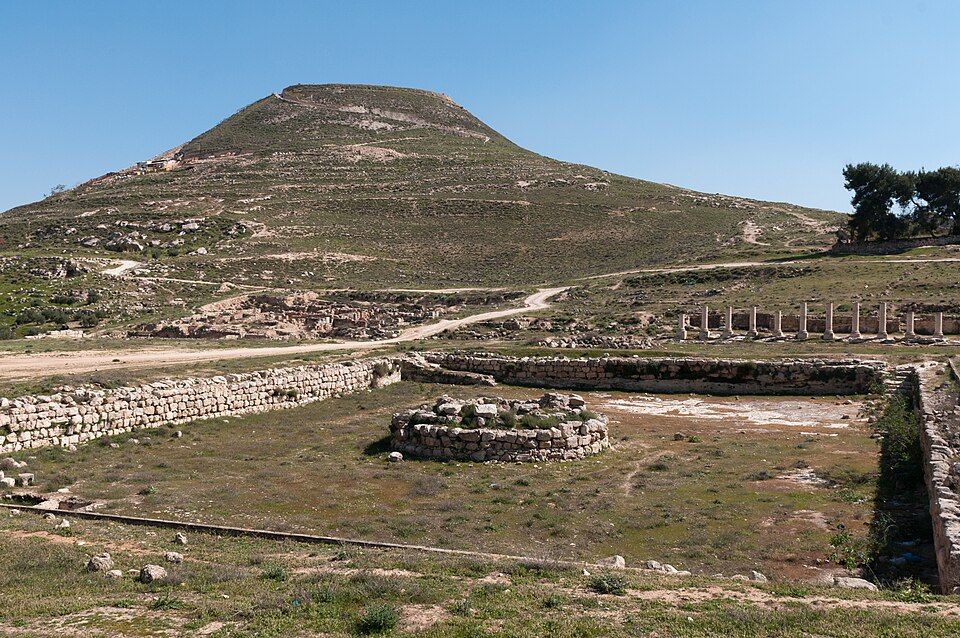
Herodium is one of the most distinctive silhouettes in the Judean landscape: a truncated cone (a flat-topped, volcano-shaped hill) rising from the desert hills southeast of Bethlehem, visible from Jerusalem and from the Dead Sea. Herod the Great built it as a combined palace-fortress and eventual burial site, the only monument in his vast building program that he named after himself. And it is here, after decades of searching, that archaeologists finally found his tomb.
Building a Mountain
Around 23-15 BCE, Herod chose a natural hill about 12 kilometers south-southeast of Jerusalem and did something no one had done before: he built a mountain. He took earth and rubble from a neighboring hill (which was leveled in the process) and piled it onto the existing hilltop, filling the space between two concentric circular walls to create the volcano-shaped cone visible today. Josephus described the shape as resembling a breast. The summit stands approximately 758 meters above sea level, rising roughly 60 meters above the surrounding terrain. The outer diameter of the circular fortress at the top measures about 63 meters, with four towers built into the walls: three semicircular and one massive round tower approximately 18 meters in diameter, which likely served as Herod’s private quarters and watchtower.
The Upper Palace
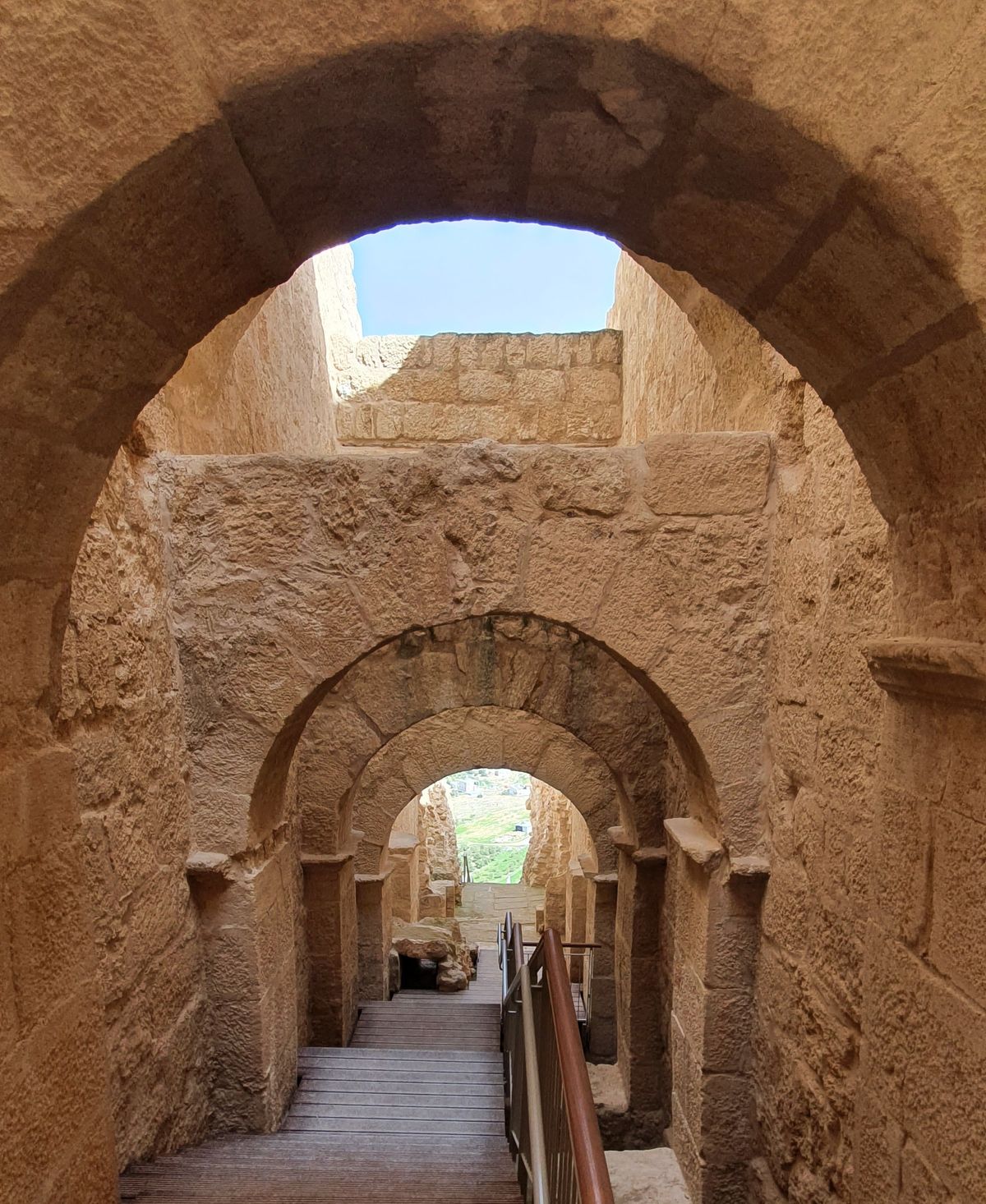
The upper palace inside the cone was a miniature Roman city in the middle of nowhere. Visitors entering through the monumental eastern tower would have passed through corridors and guard rooms before emerging into a space that defied the desert outside. The interior was divided roughly in half. The eastern side was a formal peristyle garden, a Roman-style courtyard enclosed by a colonnade of columns, open to the sky, with greenery, walkways, and possibly fountains. On a hilltop in the Judean Desert, Herod created a garden that belonged in a Roman villa on the Italian coast.
The western half was the palace proper. The triclinium (Roman dining hall) was the largest room, where Herod hosted guests and conducted business. Reception rooms, private living quarters, and service corridors surrounded it. The walls were decorated with frescoes and molded stucco work in the Roman style, fragments of which have been found during excavations. The floors were paved with mosaics, some geometric, some more elaborate. Everything was built to impress visitors with the message that even in the wilderness, Herod lived like a Roman aristocrat.
The bathhouse was perhaps the most remarkable achievement. The caldarium (hot room) had a domed ceiling, its walls painted with frescoes, and a raised floor supported by small pillars (pilae) that allowed hot air from a furnace to circulate beneath, heating the room from below. This hypocaust system was standard in Roman baths across the empire, but building one on a desert hilltop required extraordinary engineering. The tepidarium (warm room) provided a transition space, and the frigidarium (cold room) offered a cold plunge. The water for the entire complex was brought up from cisterns fed by the aqueduct from Solomon’s Pools, kilometers away. For Herod’s guests, the experience of bathing in a fully equipped Roman bathhouse on top of an artificial mountain in the middle of the desert must have been unforgettable.
The Lower
At the base of the mountain, Herod built a second palace complex that was in many ways even more impressive. Its centerpiece was a monumental pool measuring roughly 70 by 46 meters, one of the largest pleasure pools in the ancient world. A round pavilion stood on an island in the center of the pool, accessible by boat or a small bridge, where Herod could entertain guests surrounded by water in the middle of the desert. Around the pool stretched formal gardens, a massive palace building approximately 130 by 55 meters with a grand reception hall, storerooms, stables, and service buildings. An aqueduct brought water from Solomon’s Pools near Bethlehem, about 6 kilometers away, feeding the pool, the gardens, and the cisterns carved into the hill. The lower Herodium was where Herod lived and entertained; the upper fortress was where he retreated when he needed walls around him.
The Funeral Procession
Herod is believed to have died in Jericho in the spring of 4 BCE, after years of deteriorating health. Josephus describes his final days in grim detail: fevers, unbearable itching, swollen feet, breathing difficulties, and convulsions. He had spent his last months at the winter palaces in Jericho, seeking relief in the warm baths of Callirrhoe across the Jordan, but nothing helped. Even in death, Herod remained dangerous: according to Josephus, he ordered the leading men of every Jewish village locked in the hippodrome at Jericho, with instructions that they be executed upon his death, so that the country would mourn whether it wanted to or not. The order, if it was ever given, was never carried out.
The funeral procession that followed was among the grandest the ancient world had seen. Josephus describes it in detail: the body was placed on a golden bier studded with precious stones, covered in purple cloth, with a diadem on his head, a golden crown above it, and a scepter in his right hand. Around the bier marched Herod’s family. Behind them came the entire army in formation: the royal guard, Thracian mercenaries, Germanic bodyguards, and Galatian troops, all in full battle gear, followed by 500 servants carrying spices and incense. The procession traveled approximately 200 stadia (about 37 kilometers) from Jericho to Herodium. The pace was deliberately slow, a distance of roughly 8 stadia according to one ancient source, a ceremonial crawl that turned the journey into a multi-day spectacle visible to every village and hilltop along the route. The message was unmistakable: even in death, Herod commanded the landscape. The procession wound through the Judean Desert, climbing from Jericho (the lowest city on earth) toward the artificial mountain Herod had built to receive him. It was a final act of theater by a king who understood the power of spectacle better than anyone in the ancient world.
The Search for the Tomb
For 35 years, Hebrew University archaeologist Ehud Netzer searched for Herod’s tomb at Herodium. He excavated the summit, the base, the tunnels, and the lower palace. Josephus clearly stated Herod was buried here, but the tomb remained maddeningly elusive. The breakthrough came when Netzer found fragments of a decorative stone urn (urna) of exceptional quality on the northeastern slope of the hill, halfway up the cone. The urn fragments, made of finely carved stone with elaborate ornamentation, were too grand for anything other than a royal burial. They led Netzer to the tomb site, integrated into a monumental staircase that once climbed the mountainside.
In 2007, Netzer announced the discovery. The tomb included a mausoleum estimated to have risen some 25 meters high, with a conical or pyramidal roof similar to the Tomb of Absalom in the Kidron Valley. The sarcophagus, made of local reddish Jerusalemite limestone known as mizzi ahmar (“red stone” in Arabic), a warm-toned prestige stone used in fine construction across Jerusalem, was finely decorated with rosettes, but it had been deliberately and violently smashed into hundreds of pieces, believed to have been smashed by Jewish rebels during the Great Revolt who despised Herod’s memory. No bones could be definitively identified as Herod’s. Two simpler sarcophagi found nearby may have belonged to family members.
The Theater and the VIP Box
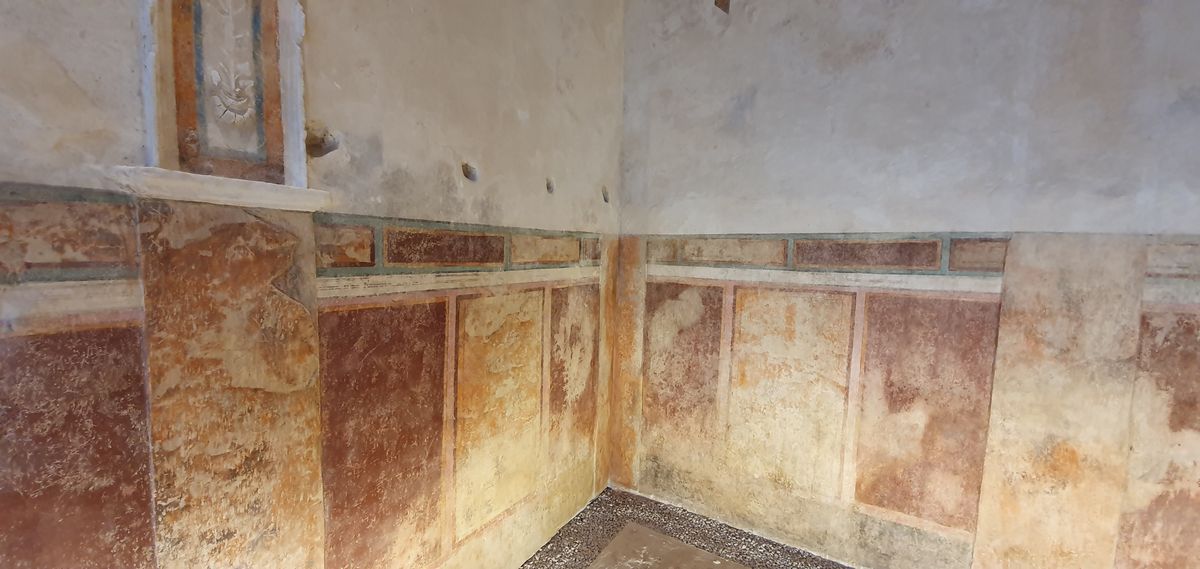
Near the tomb, Netzer’s team uncovered one of the most remarkable finds at Herodium: a small theater (closer to an odeon than a full-scale theater) seating approximately 300-400 people, built into the hillside. At the top of the theater sat a royal VIP box (loggia) that was a sensation when it was excavated. The walls were covered with elaborate painted frescoes depicting landscapes, windows, and architectural scenes in the early Third Pompeian Style, nearly identical to wall paintings found in the villas of Pompeii and Rome. These are among the finest examples of Herodian-era wall painting ever discovered in Israel. The original frescoes have been removed for conservation, but reproductions and photographs at the site convey their extraordinary quality.
The theater appears to have been built for a single event, perhaps Herod’s own funeral or a visit by Marcus Agrippa, Augustus’s son-in-law. After that event, the entire theater was deliberately buried under tons of fill as part of the project to enlarge the artificial mountain. Netzer himself died in October 2010 after a fall from a railing at the site during ongoing excavations. He was 76 years old, and the mountain he had spent his life studying claimed him in the end.
Rebels in the Palace
During the Great Revolt against Rome (66-73 CE), Jewish rebels seized Herodium and made it their own. They converted the triclinium into a synagogue by adding tiered stone benches along the walls, creating one of the oldest known synagogues in the world. They built a mikveh (a Jewish ritual immersion bath) for ritual purification and began digging tunnels for defense. The fortress held out until early 72 CE, when Roman forces under Lucilius Bassus swept through the remaining rebel strongholds after the fall of Jerusalem.
Sixty years later, during the Bar Kokhba Revolt (132-135 CE), Jewish fighters returned to Herodium and transformed it into a rebel stronghold and administrative center. They vastly expanded the tunnel system, carving an elaborate underground network of narrow passages, chambers, and shafts through the Herodian fill and bedrock. The tunnels connected to cisterns for water supply during sieges and had concealed openings designed to give defenders every advantage. Coins minted by Bar Kokhba’s administration, bearing inscriptions like “Year One of the Redemption of Israel” and “Shimon,” have been found at the site. In the Byzantine period, at least three churches and a monastery were built at Herodion, transforming the palace of a hated king into a place of Christian worship.
Visit with Hoshen Tours
Herodium is Herod’s palace-fortress and the site of his tomb. Hoshen Tours pairs it with the Shepherds’ Fields in Beit Sahour, the Cave of Machpelah in Hebron, the story of the Judean Desert Monasteries, and the Tomb of Lazarus in nearby Bethany.
Explore Our Tour Collection
Ready to experience Israel in true colors?
Plan Your TourPrivate tours designed around your interests, schedule, and pace.