



Capernaum is the town Jesus chose as his home. When he left Nazareth at the start of his public ministry, he did not go to Jerusalem. He went to this fishing village on the northwest shore of the Sea of Galilee, and Matthew’s Gospel calls it simply “his own town” (Matthew 9:1). No place outside Jerusalem is mentioned more often in the Gospels. More miracles were performed here, more disciples were called here, and more teaching was delivered here than anywhere else in the life of Jesus. For the Christian pilgrim in the Galilee, Capernaum is not one stop among many, it is the center of everything.
Jesus Moves to Capernaum
The decision to leave Nazareth was not casual. Matthew’s Gospel frames it as a deliberate fulfillment of prophecy: Jesus “left Nazareth and went to live in Capernaum, which was by the lake in the area of Zebulun and Naphtali” (Matthew 4:13). He did not return to live in his hometown. Capernaum became his base of operations, the place he returned to between journeys, the place his disciples gathered, and the place where the most intense period of his recorded ministry unfolded. Matthew calls the town “his own city” (Matthew 9:1), a phrase that carries a sense of belonging and permanent address. When the Gospels say Jesus “came home,” it is Capernaum they mean. The concentration of miracles, teachings, and confrontations recorded here exceeds any other location in the Gospel narrative outside Jerusalem, and no other Galilean town comes close.
Why Capernaum
Nazareth was a tiny, isolated hill village of perhaps 400 people, with no major road access. Capernaum sat on the Via Maris, the great international trade route connecting Egypt to Damascus and Mesopotamia. It was a customs station, which is where the tax collector Matthew was sitting when Jesus called him (Matthew 9:9). It had a fishing industry, a Roman military garrison, and a synagogue built by the local centurion (Luke 7:5). It was a crossroads where Jesus could reach crowds of travelers, merchants, and fishermen. And it was the hometown of Peter, Andrew, James, and John, the fishermen who became the first disciples.
The Ancient Fishing Village
In Jesus’ time, Capernaum was a modest village of roughly 1,000 to 1,500 inhabitants living in tightly clustered basalt stone houses. The dark volcanic rock that covers the site was the only building material available locally, black, rough, and heavy. Walls were constructed from unworked basalt blocks stacked without mortar, and roofs were made of wooden beams laid across the walls, covered with branches, reeds, and packed mud. This detail matters: when four men brought a paralyzed friend to Jesus and could not get through the crowd, they “dug through the roof” and lowered him on a mat (Mark 2:4). A roof of branches and mud could literally be excavated with bare hands. The houses were arranged around shared courtyards where extended families cooked, stored grain, and kept animals, exactly the communal domestic world described in the Gospel accounts. Archaeologists have also found olive presses among the ruins, indicating that in addition to fishing, Capernaum’s residents produced olive oil. Fishing weights, hooks, and net anchors have been recovered from the site, confirming the town’s primary identity as a lakeside fishing community whose rhythms were shaped by the lake and its seasons.
The Synagogue: Two Buildings, One Sacred Spot
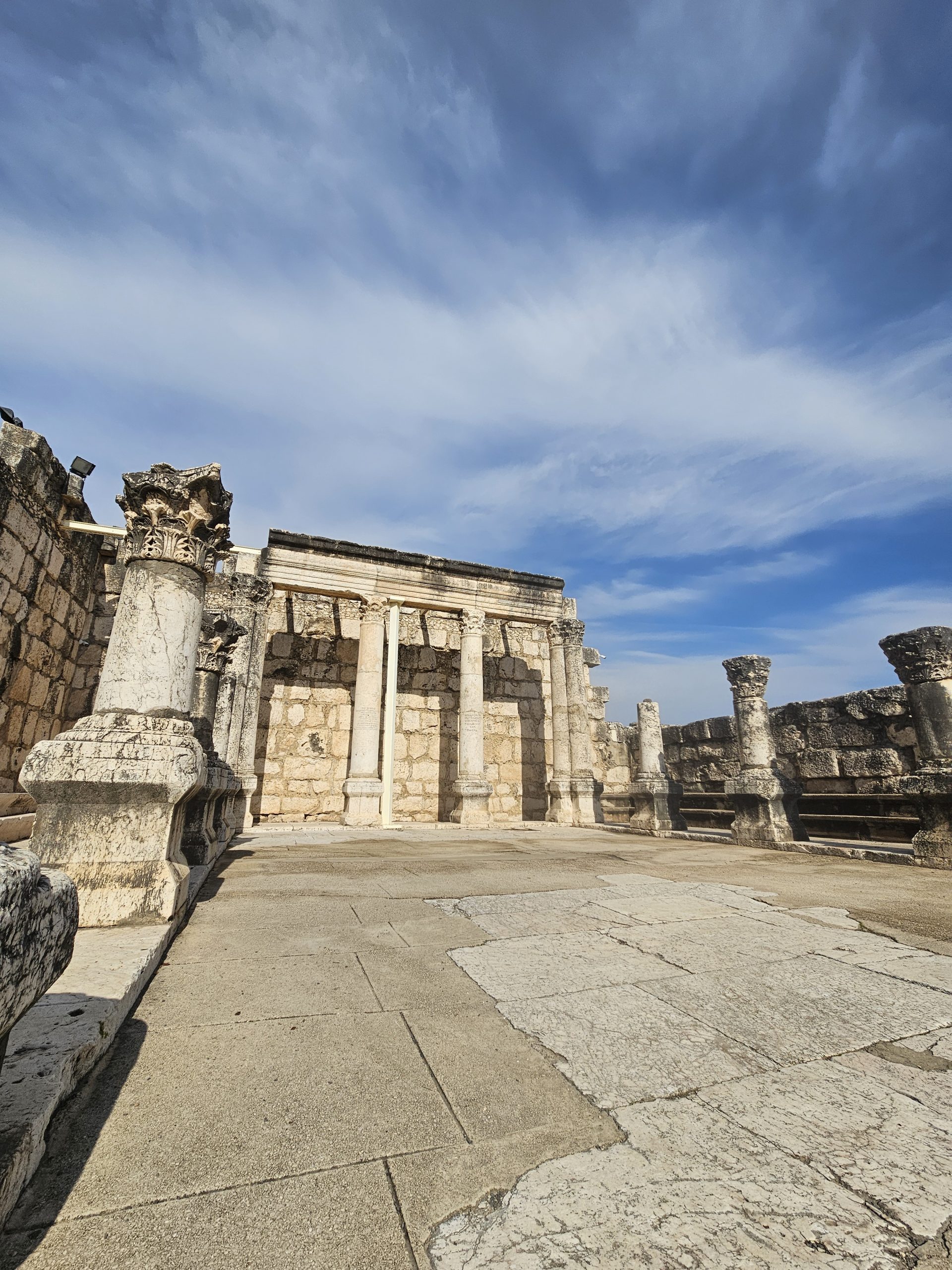
The most visually striking ruin at Capernaum is the partially reconstructed “White Synagogue”, built of imported white limestone that stands in dramatic contrast against the black basalt of every other structure in town. This synagogue dates to the late 4th or 5th century CE, not to Jesus’ time. It is a grand building with carved decorations: the Ark of the Covenant on wheels, Stars of David, menorahs, palm fronds, a shofar, pomegranates, and even Roman eagles, a surprising presence in a Jewish house of worship that reveals how deeply Greco-Roman culture had penetrated Jewish life in the Galilee by the Byzantine period. The quality of the stone carving and the cost of importing white limestone to a town built entirely of black basalt suggest a community of considerable wealth and ambition. But beneath its limestone foundations, excavators found basalt wall remains and a cobblestone floor from an earlier period, consistent with the 1st century. The Franciscan archaeologists identify this lower layer as the remains of the original synagogue, possibly the very building that Luke’s Gospel describes as constructed by the Roman centurion: “He loves our nation and has built our synagogue” (Luke 7:5). This is the synagogue where tradition holds that Jesus taught with an authority that astonished the congregation (Mark 1:21-22), cast out an unclean spirit on the Sabbath (Mark 1:23-26), and delivered the Bread of Life discourse: “I am the bread of life. Whoever comes to me will never go hungry” (John 6:35). The dating of the basalt layer remains debated among scholars, but the tradition is ancient and the location is specific: the white synagogue was built on the same sacred spot where something foundational had stood before.
The Centurion and the Servant
Among the miracles associated with Capernaum, the healing of the centurion’s servant stands apart for what it drew from Jesus. A Roman officer, a man of real military authority commanding a local garrison, came to Jesus and begged him to heal his servant who was paralyzed and suffering at home. When Jesus offered to come and heal him, the centurion replied with words that stopped Jesus in his tracks: “Lord, I do not deserve to have you come under my roof. But just say the word, and my servant will be healed. For I myself am a man under authority, with soldiers under me. I tell this one, ‘Go,’ and he goes; and that one, ‘Come,’ and he comes” (Matthew 8:8-9). The centurion understood command authority, and he recognized that Jesus exercised a similar authority over illness and the natural world. Jesus marveled and said: “Truly I tell you, I have not found anyone in Israel with such great faith” (Matthew 8:10). The servant was healed at that very moment, from a distance, without Jesus setting foot in the house. According to Luke, this same centurion had built the synagogue where Jesus regularly taught (Luke 7:5), making him one of the more fully drawn figures in the Capernaum Gospel narrative.
The Miracles of Capernaum
The concentration of recorded miracles in Capernaum is without parallel in the Galilean ministry. Here Jesus healed Peter’s mother-in-law of a fever, she rose immediately and began serving the household (Mark 1:29-31). That same evening, the Gospels record, the entire town gathered at the door, bringing all who were sick or tormented, and he healed them all. Here four friends carried a paralytic on a mat to a house where Jesus was teaching, and finding the crowd too thick to enter through the door, they climbed to the roof and lowered the man through the opening, and Jesus, seeing their faith, both forgave the man’s sins and restored his ability to walk (Mark 2:1-12). Here the synagogue ruler Jairus fell at Jesus’ feet and begged him to come to his dying daughter; on the way, a woman with a hemorrhage that had lasted twelve years touched the hem of his garment and was healed; and when they arrived at Jairus’s house and were told the girl had already died, Jesus entered, took her hand, and said “Talitha koum”, “Little girl, get up”, and she rose (Mark 5:21-43). The sheer number and variety of healings recorded in and around Capernaum, physical illness, paralysis, demonic affliction, death, gave this small fishing town a reputation that drew crowds from throughout the region.
Peter’s House
Just south of the synagogue, Franciscan archaeologists uncovered what they identified as the house of the apostle Peter. The evidence is circumstantial but compelling. The structure is a typical 1st-century basalt dwelling, but one room was singled out for veneration within the first generation after Jesus: its walls were plastered (highly unusual in Capernaum, where basalt walls were left bare), domestic pottery disappeared from it entirely while continuing in all surrounding rooms, and over 130 inscriptions were scratched into the plaster by early visitors, in Greek, Syriac, Aramaic, and Latin, including references to “Lord Jesus Christ” and the name “Peter.” Early Christian pilgrims were already leaving their marks on the walls of this room within what appears to be decades of Jesus’ death. In the 4th century, the pilgrim Egeria visited and wrote that “the house of the prince of the apostles has been made into a church, with its original walls still standing.” In the 5th century, an octagonal church, a shape reserved in the Byzantine period for sites of special sacred significance, used also at the birthplace of John the Baptist, was built directly over the room. Today, a modern Franciscan church (completed 1990) stands on concrete pillars elevated above the excavations, so that visitors look down through a glass floor at the remains of Peter’s 1st-century home and the Byzantine octagon beneath it. Three layers of faith, stacked on a single square of ancient basalt.
The Franciscan Compound and the Greek Orthodox Section
Capernaum today is divided into two distinct areas maintained by different Christian communities. The larger Franciscan compound, established after the Franciscans purchased the central section of the site in the 19th century, contains the white synagogue, Peter’s House, the modern elevated church, the bronze statue of Peter, and the extensive excavated ruins of the ancient village. Entrance requires a modest ticket and is managed by the Franciscan Custody of the Holy Land. Immediately to the east lies a separate area belonging to the Greek Orthodox Patriarchate of Jerusalem, marked by a distinctive pink-domed church constructed in the late 20th century. The Orthodox section also preserves ancient basalt ruins and sits directly on the lakeshore, offering a quieter and less visited perspective on the same site. The two communities have maintained separate access to Capernaum for more than a century, a quiet reflection of the broader pattern of divided Christian administration that characterizes the major holy sites of the region.
The Condemnation of Capernaum
Perhaps the most haunting moment connected to Capernaum is not a miracle but a judgment. Despite the extraordinary concentration of signs performed within its boundaries, the town did not repent. Jesus pronounced a stark condemnation: “And you, Capernaum, will you be lifted up to the skies? No, you will go down to Hades. For if the miracles that were performed in you had been performed in Sodom, it would have remained to this day. But I tell you that it will be more bearable for Sodom on the day of judgment than for you” (Matthew 11:23-24). The words proved prophetic. Capernaum was gradually abandoned following the Arab conquest of the 7th century and was so completely forgotten that 19th-century explorers could not locate it. When Edward Robinson and others began systematically identifying Gospel sites in the 1800s, Capernaum had vanished from living memory, the most miraculous village in the Galilee buried under centuries of rubble and silence, exactly as Jesus had foretold.
Statue of Peter
At the entrance to the Franciscan compound, a bronze statue of the apostle Peter stands facing the lake, holding the keys to the kingdom of heaven (Matthew 16:19). Peter was a fisherman from this town, he lived here, worked here, and was called from here to become the rock on which the church was built. The statue, set against the backdrop of the lake where Peter cast his nets, is a quiet reminder that the story of Christianity began not in a cathedral but in a fishing village on the northern shore of the Sea of Galilee.
Visit with Hoshen Tours
Capernaum is the center of gravity of the Gospel narrative in the Galilee. Hoshen Tours visits the synagogue, Peter’s House, and the excavated village, connecting the stones to the stories, the tax booth where Matthew sat, the roof that was dug through, the shore where the nets were cast, and the house where Peter’s mother-in-law got up from her sickbed and served dinner. The site combines naturally with Tabgha, the Mount of Beatitudes, and Magdala for a full day on the Gospel shore of the Sea of Galilee.
Capernaum is one of the most requested stops on our church group tours of Israel. Pastors and congregations return year after year to walk these ancient streets together.
Ready to experience Israel in true colors?
Plan Your TourPrivate tours designed around your interests, schedule, and pace.