



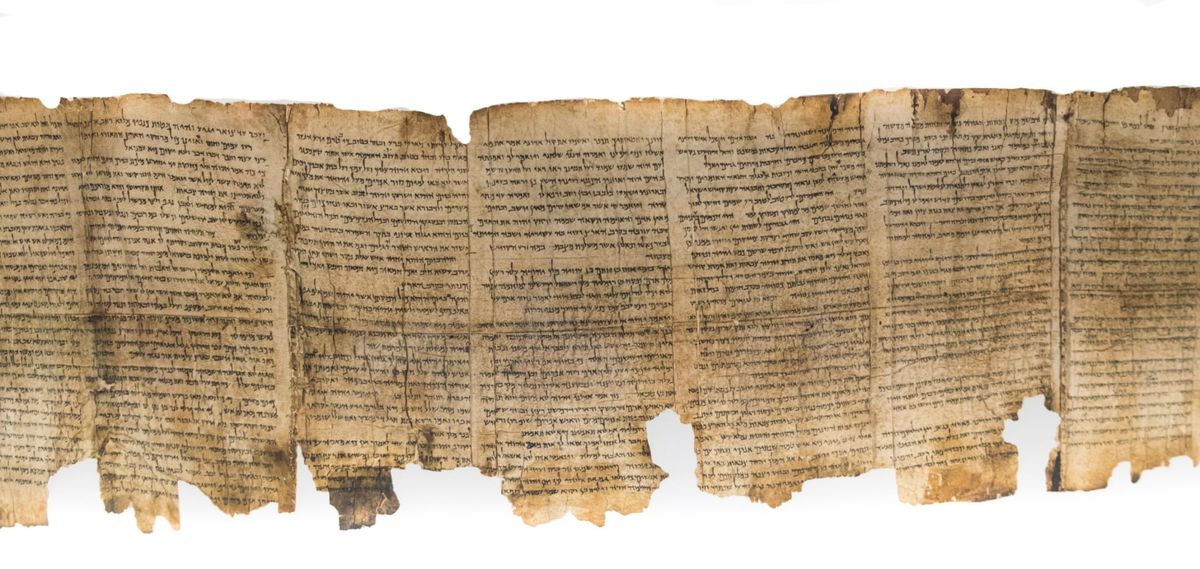
In the winter of 1947, a Bedouin shepherd named Muhammad edh-Dhib was searching for a lost goat among the cliffs above the northwestern shore of the Dead Sea. He threw a stone into a cave and heard the sound of breaking pottery. Inside, he found clay jars containing ancient scrolls wrapped in linen. The discovery turned out to be the most important archaeological find of the 20th century: the oldest known copies of the Hebrew Bible, dating back over 2,000 years.
The Discovery
Muhammad edh-Dhib brought his scrolls to a Bethlehem antiquities dealer named Kando. Four scrolls ended up with Mar Athanasius Samuel, the Syrian Orthodox Archbishop of Jerusalem, and three were purchased by Professor Eleazar Sukenik of the Hebrew University. Sukenik recognized their significance immediately. He bought his scrolls in November 1947, on the very day the United Nations voted on the partition of Palestine.
The Archbishop’s four scrolls were smuggled to the United States, where they were offered for sale. On June 1, 1954, an advertisement appeared in the classified section of the Wall Street Journal: “Biblical Manuscripts dating back to at least 200 BC are for sale.” Yigael Yadin, Sukenik’s son and by then a famous archaeologist and former Chief of Staff of the IDF, purchased them for $250,000 through an intermediary, reuniting all seven original scrolls in Israel.
The Caves
Between 1947 and 1956, eleven caves in the cliffs and marl terrace near Qumran yielded scrolls and fragments. Cave 1, where the initial discovery was made, produced the Great Isaiah Scroll, the Community Rule, and the War Scroll. Cave 4, a man-made chamber just meters from the settlement, contained fragments of over 500 manuscripts, the largest cache. Cave 11, discovered in 1956, produced the Temple Scroll, the longest of the Dead Sea Scrolls. In total, approximately 970 manuscripts were found, written in three languages: Hebrew (the vast majority), Aramaic, and Greek. They include biblical texts, sectarian writings, and documents from everyday life.
Key Scrolls
The Great Isaiah Scroll is the only complete copy of a biblical book among the scrolls. Over 7 meters long, it contains all 66 chapters of Isaiah. When compared to the Masoretic text copied over a thousand years later, the text is remarkably similar, confirming the extraordinary accuracy of the Jewish scribal tradition.
The Community Rule (Serekh HaYahad) describes the laws, hierarchy, and beliefs of the community that produced the scrolls. Members swore to “return to the Torah of Moses” and to separate themselves from the “men of injustice.”
The War Scroll describes an apocalyptic war between the “Sons of Light” and the “Sons of Darkness,” a final battle at the end of days, with military details that reflect actual Roman-era organization.
The Temple Scroll, the longest scroll at over 8 meters, describes an ideal Temple and its festivals in extraordinary detail, including measurements, sacrifices, and purity laws.
The Copper Scroll, found in Cave 3, is unique. Written on copper rather than parchment, it lists 64 hiding places of gold and silver treasure. Whether the treasure was real (perhaps the Temple treasury hidden before the Roman destruction) or legendary remains one of the great unsolved mysteries of archaeology.
The Psalms Scroll from Cave 11 contains 41 canonical psalms plus several non-canonical compositions, including Psalm 151 (known from the Greek Bible but not the Hebrew canon) and a prose passage about David composing 4,050 songs.
The Damascus Document describes the history and laws of a community that made a “new covenant in the land of Damascus.” Fragments were found in Caves 4 and 6, but remarkably, medieval copies of the same text had already been discovered in the Cairo Genizah in 1896, decades before the Qumran caves were found. The Cairo discovery only became fully significant after the Dead Sea Scrolls confirmed that the document originated in the Qumran community.
Essenes
Most scholars believe the scrolls were produced or collected by the Essenes, one of three major Jewish movements in the Second Temple period alongside the Pharisees and Sadducees. The Essenes, described by Josephus, Philo, and Pliny, lived in communities that emphasized strict ritual purity, communal property, and intensive study of scripture. Pliny placed them “on the west side of the Dead Sea,” above Ein Gedi, matching the location of Qumran.
What the Scrolls Changed
Before the discovery, the oldest known manuscripts of the Hebrew Bible dated to about the 10th century CE (the Aleppo Codex and the Leningrad Codex). The scrolls pushed this back by over a thousand years, to the 2nd-3rd century BCE. For biblical scholars, this was revolutionary: they could now compare texts separated by a millennium. The result was a remarkable confirmation of scribal accuracy, though the scrolls also revealed minor textual variations and alternative readings that enriched understanding of how the biblical text was transmitted.
For Christian scholars, the scrolls provided the closest surviving window into the Jewish world from which Christianity emerged. Apocalyptic beliefs, messianic expectations, communal meals, and ritual immersion, all features of early Christianity, were already present in the Essene community a century before Jesus.
Why the Scrolls Survived
The scrolls survived for two thousand years because of a combination of factors that exists almost nowhere else on earth. The caves in the cliffs above the Dead Sea are completely dark, blocking the ultraviolet light that degrades organic material. The Judean Desert has one of the lowest humidity levels in the world, and the Dead Sea region is the lowest point on earth, creating conditions so dry that the parchment and papyrus were essentially freeze-dried in place. The clay jars in which many of the scrolls were stored provided an additional layer of protection against moisture and insects. It was this unique microclimate that preserved 2,000-year-old manuscripts in a condition that scholars could still read.
How the Scrolls Came to Israel
The story of how the scrolls reached Israel is inseparable from the political history of the region. After the initial discovery in 1947, the caves were under Jordanian control. The Jordanian Department of Antiquities, working with the Dominican-run Ecole Biblique in East Jerusalem, brought the fragments to the Rockefeller Museum in East Jerusalem, where an international team of scholars was assembled to study and publish them. The fragments were stored and handled in conditions that caused significant damage: scholars used adhesive tape to join fragments, placed them between glass plates, and worked in rooms without climate control. Many fragments darkened, cracked, or deteriorated during these years.
In June 1967, during the Six-Day War, Israel captured East Jerusalem, including the Rockefeller Museum and its entire collection of scroll fragments. The scrolls came under Israeli control and were transferred to the care of the Israel Antiquities Authority. For Jordan and the Palestinian Authority, the seizure of the scrolls remains a point of contention; for Israel, the scrolls are part of the Jewish people’s heritage, now properly housed and preserved in Jerusalem.
Today, the seven major scrolls from Cave 1 are displayed at the Shrine of the Book at the Israel Museum, whose iconic white dome is shaped like the lid of the clay jars in which the scrolls were found. The remaining tens of thousands of fragments are held by the Israel Antiquities Authority in climate-controlled storage, under conditions incomparably better than those in the Rockefeller Museum decades earlier.
The Jordan Museum in Amman holds a small collection of fragments, including pieces of the Copper Scroll, that remained in Jordan after 1967. Over the decades, some fragments entered the private market. The Museum of the Bible in Washington, D.C. purchased several fragments that were later exposed as modern forgeries, a scandal that highlighted the problem of unprovenanced scroll fragments in the antiquities trade.
Ongoing Research
Scholarship on the scrolls continues. In 2021, new fragments of a Greek translation of the Minor Prophets were discovered in the Cave of Horror in the Judean Desert, the first new scroll discovery in decades. Advanced imaging techniques, including multispectral photography and DNA analysis of the parchment, are revealing previously illegible text and helping scholars piece together which fragments belong to the same manuscripts. The Leon Levy Dead Sea Scrolls Digital Library has made high-resolution images of virtually every fragment available online, opening the scrolls to researchers and the public worldwide.
Visit with Hoshen Tours
The Dead Sea Scrolls story begins at Qumran, where the caves and the settlement can be explored, and is completed at the Israel Museum’s Shrine of the Book in Jerusalem, where the original scrolls are displayed. Hoshen Tours connects both sites, telling the story of the shepherd, the scrolls, and the Wall Street Journal ad that brought them home.