



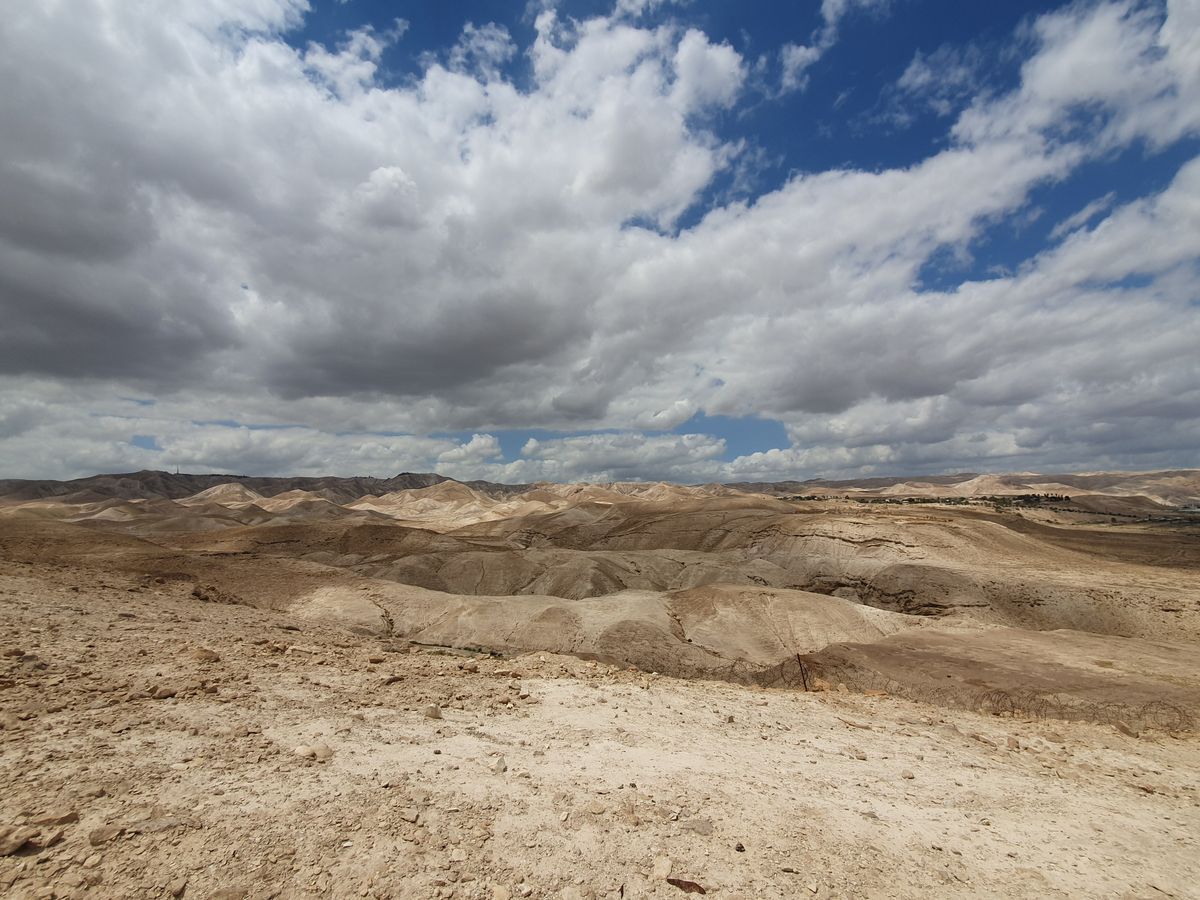
 In 1947, a young Bedouin shepherd named Muhammad edh-Dhib was searching for a lost goat in the cliffs above Qumran, near the northwestern shore of the Dead Sea. He threw a stone into a dark opening in the rock to see if the goat had taken shelter there, and heard something unexpected: the sharp crack of breaking pottery. Curious, he climbed up and looked inside. There were clay jars, sealed and ancient. Inside the jars were scrolls wrapped in linen.
What Muhammad edh-Dhib had stumbled into was Cave 1 at Qumran, and what he had found would become the most important archaeological discovery of the 20th century: the Dead Sea Scrolls.
The Discovery of the Dead Sea Scrolls at Qumran
The scrolls from Cave 1 made their way to a Bethlehem antiquities dealer, and from there into two sets of hands. Three scrolls were purchased by Professor Eleazar Sukenik of the Hebrew University, who recognized immediately what they were. He made his purchase on November 29, 1947, the very day the United Nations voted to partition Palestine and pave the way for the State of Israel. While the vote was being announced, Sukenik was sitting with ancient scrolls on his lap, reading words written two thousand years before. He later wrote in his diary that it was the happiest day of his life.
The remaining four scrolls took a longer road home. They reached the Syrian Orthodox Archbishop of Jerusalem, Mar Athanasius Samuel, who eventually brought them to the United States. For years they sat in relative obscurity. Then, on June 1, 1954, a small classified advertisement appeared in the Wall Street Journal: “Biblical manuscripts dating back to at least 200 B.C. are for sale.” Sukenik’s son, Yigael Yadin, by then a celebrated archaeologist and former Chief of Staff of the IDF, saw the ad and purchased all four scrolls through an intermediary for $250,000. All seven original scrolls were reunited in Israel and are displayed today at the Shrine of the Book at the Israel Museum in Jerusalem. It is one of the most improbable stories in the history of scholarship.
The Isaiah Scroll
Among all the scrolls, one stands above the rest for visitors: the Great Isaiah Scroll. It is a complete copy of the Book of Isaiah, all 66 chapters, written on 17 sheets of parchment stitched end to end, stretching over 7 meters. It dates to around 125 BCE, making it roughly 1,000 years older than any previously known Hebrew manuscript of Isaiah. When scholars compared it to the text Jews and Christians read today, they found it essentially identical. That single fact is the headline: a thousand years of hand-copying, and the text was preserved with extraordinary faithfulness.
What Was Found
Between 1947 and 1956, eleven caves in the cliffs and marl terrace around Qumran were excavated. Together they yielded approximately 900 manuscripts, most in fragmentary condition. The collection includes nearly every book of the Hebrew Bible, with multiple copies of some books (Psalms, Isaiah, and Deuteronomy appear most frequently). Alongside the biblical texts are documents unique to the Qumran community: the Community Rule, which governed daily life; the War Scroll, which describes an apocalyptic final battle between good and evil; the Temple Scroll, which lays out an idealized vision of the Temple and its rituals.
And then there is the Copper Scroll. Most of the Dead Sea Scrolls were written on parchment or papyrus. This one was etched onto sheets of copper. It reads like a treasure map, listing 64 locations where enormous quantities of gold and silver were supposedly buried. Scholars have been arguing about it ever since it was unrolled in 1956. Was the treasure real? Was it the Temple treasury hidden before the Roman destruction? Is it symbolic? No one knows, because no one has ever found a single item from the list. The Copper Scroll remains one of the great unsolved mysteries of the ancient world, and it sits quietly in a museum in Jordan while people argue about it.
The Essenes: The Community Behind the Scrolls
Who left these scrolls in the caves? Most scholars believe it was the Essenes, a Jewish sect that withdrew from Jerusalem and mainstream Temple worship sometime in the 2nd century BCE. The Roman writer Pliny the Elder described an Essene community living “on the west side of the Dead Sea,” above Ein Gedi, a description that fits Qumran exactly.
If the Qumran community was indeed Essene, its members lived simply and strictly. They owned everything communally, including food, tools, and clothing. Every morning before sunrise they rose for prayer. Every day they immersed themselves in ritual baths for purification, sometimes multiple times. They ate communal meals together in a long dining hall, sitting in order of rank, in silence. New members were admitted only after two or three years of probation, during which they were tested and observed.
At the heart of their daily life was the scriptorium, a long narrow room where scribes sat at plastered benches and copied texts by hand. Inkwells found during excavation are still stained with two-thousand-year-old ink. According to ancient sources, the Essenes believed they were the faithful remnant chosen by God, living in the final days before a cosmic battle between good and evil. They were preparing. Copying the scriptures was part of that preparation.
In 68 CE, as Roman legions swept through Judea during the First Jewish Revolt, the community appears to have packed their most precious scrolls into clay jars, sealed them, and hidden them in the surrounding caves. Then they left, and never came back. The scrolls waited in the dark for nearly nineteen centuries.
Why the Scrolls Survived
Two thousand years is a long time for parchment to last. In almost any other climate on earth, those scrolls would have crumbled to dust within a few generations. What saved them was the combination of two things: the desert air around the Dead Sea, which is exceptionally dry, and the sealed clay jars, which kept moisture out entirely. The Dead Sea sits at the lowest point on earth, and the surrounding desert is one of the most arid environments in the world. Temperature swings are extreme but humidity is almost nothing. Inside those sealed jars, conditions barely changed for two millennia. When the scrolls were opened, scholars could read text written before the birth of Jesus as clearly as if it had been written a century ago. The cave itself became a perfect time capsule.
Qumran Today
Visitors to Qumran today walk through the remains of the settlement that housed this community for roughly two centuries. The site is compact but striking, set on a marl plateau above the Dead Sea with the Judean cliffs rising behind it and the shimmering blue of the sea below.
Before heading into the ruins, stop at the visitor center and watch the short film. It runs about fifteen minutes and tells the whole story, from Muhammad edh-Dhib’s accidental discovery to Sukenik’s purchase on partition day to the reuniting of the scrolls in Israel. Watching it first means you will walk the site knowing what you are looking at, and the ruins will make a lot more sense.
The most visible features on the site are the water system and the ritual baths. The community built an elaborate network of channels and cisterns to capture winter rainwater, essential for survival in this desert setting and for the constant ritual purification their way of life required. Several large stepped cisterns, used as mikvaot (ritual immersion pools), are well preserved and clearly visible. The scriptorium, a long narrow room where tradition holds the scribes copied their manuscripts, yielded inkwells and plastered benches when excavated. The communal dining hall, the kitchen, and a pottery workshop are also identifiable. The caves in the cliffs are visible from the site, some of them accessible by short walks along marked paths.
Where Are the Scrolls Now?
The seven original scrolls from Cave 1, including the Great Isaiah Scroll, are displayed at the Shrine of the Book at the Israel Museum in Jerusalem. The building’s distinctive white dome is designed to echo the shape of the lids of the clay jars in which the scrolls were found. The display is one of the finest in the world: the Isaiah Scroll is presented in a circular case at the center of the room, dramatically lit. A visit to Qumran pairs naturally with an afternoon at the Shrine of the Book.
The remaining fragments, tens of thousands of pieces from the approximately 900 manuscripts, are held by the Israel Antiquities Authority in Jerusalem.
Visit with Hoshen Tours
Hoshen Tours combines Qumran with the Shrine of the Book in a single day that tells the complete story of the Dead Sea Scrolls. Pair it with a float at the Dead Sea, a hike through Ein Gedi, or a deeper exploration of the Judean Desert and the canyon of Wadi Qelt. Every itinerary is private and tailored to your pace.
Explore Our Tour Collection
Ready to experience Israel in true colors?
Plan Your TourPrivate tours designed around your interests, schedule, and pace.