



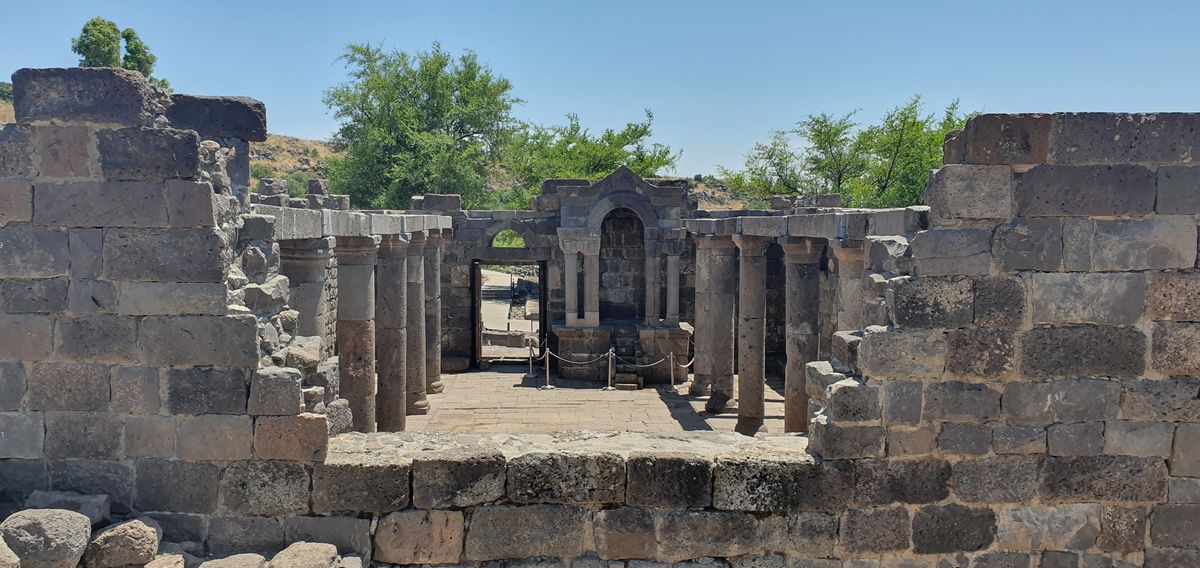
Umm el Israel-Kanatir (“Mother of the Arches”) is an ancient Jewish village on the southern Golan Heights where a magnificent synagogue, toppled by the earthquake of 749 CE, has been reassembled stone by stone using technology that no other archaeological site in the world has attempted. The result is one of the most remarkable reconstruction projects in Israeli archaeology. A Byzantine-era synagogue rising again from its own ruins after 1,250 years on the ground.
The Ancient Village
The village sits on the edge of Nahal Samekh (Wadi Samekh), a deep ravine on the southern Golan, overlooking the eastern shore of the Sea of Galilee. It was a Jewish agricultural community that flourished from the 5th through the 8th century CE. The inhabitants farmed the volcanic soil, produced olive oil, and channeled spring water to the village through an aqueduct built on stone arches, the arches that gave the site its Arabic name. The village was entirely Jewish, as confirmed by the grand synagogue at its center.
The Umm el-Kanatir Synagogue
The synagogue at Umm el-Kanatir was one of the grandest on the Golan Heights. Built from local black basalt, it measured approximately 18 by 13 meters and followed the basilica plan common to Golan synagogues. The stone carving was exceptional: an eagle and a lion, geometric patterns, wreaths, and an elaborate Torah ark facade. The building faced west toward Jerusalem.
The Earthquake
On January 18, 749 CE, a massive earthquake struck the Jordan Rift Valley, destroying cities and villages from Beit She’an to Tiberias. The synagogue at Umm el-Kanatir collapsed. But because the village was never rebuilt or resettled, and because the site was remote enough to escape looting, the thousands of basalt stones remained exactly where they fell. Every block, every carved lintel, every column drum lay in the rubble for over 1,250 years. A collapsed building with all its pieces still on site.
The Reconstruction
This is what made the impossible possible. Beginning in the early 2000s, architect and engineer Yehoshua Dray launched a pioneering project to reassemble the synagogue. Every one of the thousands of fallen stones was individually documented using 3D scanning and computerized mapping. Dray’s team calculated the original position of each stone based on its shape, fracture patterns, carved decorations, and relationship to neighboring stones. The process has been compared to assembling a three-dimensional jigsaw puzzle of enormous complexity, except that the puzzle had been scattered by an earthquake and left in the dirt for a millennium and a quarter.
The result is extraordinary. The synagogue walls have risen again, courses of basalt stacked in their original positions. Carved lintels have returned to their doorframes. The reconstruction is not a replica or a guess. It is the actual building, the original stones, put back where they were. No other ancient structure in the world has been reassembled using this method.
The arches that give the site its name are the remains of the ancient aqueduct that carried spring water across the ravine to the village. Built from basalt, the arched structure demonstrates the engineering skill of the ancient community and was essential for sustaining agriculture and daily life on this dry plateau.
Visit with Hoshen Tours
Umm el-Kanatir is where ancient archaeology meets cutting-edge technology. Hoshen Tours visits the reconstructed synagogue and tells the story of the earthquake that destroyed it, the 1,250 years it lay in ruins, and the architect who put it back together stone by stone. Hoshen Tours often combines this site with Mitzpe Gadot, Mitzad Ateret, and Yehudiya for a memorable day exploring the region.
Ready to experience Israel in true colors?
Plan Your TourPrivate tours designed around your interests, schedule, and pace.