



Moshava Kinneret is a small agricultural village on the southern shore of the Sea of Galilee, founded in 1908 on land acquired through the Jewish Colonization Association (ICA), founded by Baron Maurice de Hirsch, which had taken over management of Rothschild’s colonies in 1899. It was not just another farming colony. Kinneret became the laboratory where an entire generation of pioneers experimented with new forms of Jewish life, and the ideas born here, collective labor, communal ownership, Hebrew as a daily language, changed the course of Zionist history.
The Founding
In 1908, the Jewish Colonisation Association (ICA), to which Baron Edmond de Rothschild had transferred his colonies in 1899, purchased land on the southern shore of the Sea of Galilee, near the spot where the Jordan River flows out of the lake. The area was swampy, malaria-ridden, and almost uninhabited. The agronomist Aharon Eisenberg was sent to establish a training farm where young Jewish immigrants from Eastern Europe could learn modern agriculture. The farm, known as Havat Kinneret (the Kinneret Farm), and the small moshava that grew around it became the center of the Second Aliyah’s agricultural revolution.
The location was chosen carefully. The Jordan Valley soil was rich, the water supply was reliable, and the climate allowed year-round farming. But the conditions were brutal. The heat in summer was unbearable, malaria killed several of the early settlers, and the work of draining swamps and clearing stones was backbreaking. The pioneers who stayed were the ones who believed most fiercely in the idea of Jewish self-labor.
Pioneers Who Built a Nation
The men and women who came to Kinneret were idealists from Eastern Europe who wanted to transform themselves from urban Jews into farmers and workers. They came from the shtetls and cities of Russia, Poland, and Ukraine, most of them young, most of them educated, and most of them with no farming experience whatsoever. They drained swamps, fought malaria, learned to plow and plant, and debated endlessly about the right way to build a new society.
Among them were figures who would become legends of the Zionist movement. A.D. Gordon, the philosopher of labor, came to Kinneret at the age of 48, having left a comfortable life in Russia to work the land with his own hands. His philosophy of “the religion of labor” argued that Jews could redeem themselves only through physical work on their own soil. He became the spiritual father of the kibbutz movement, though he never joined a kibbutz himself.
Rachel the Poet
The poet Rachel (Rachel Bluwstein, 1890-1931) arrived at Kinneret in 1909 from Russia. She worked at the farm, studied agriculture, and fell in love with the landscape of the Sea of Galilee. Her Hebrew poems, written in a simple, musical style that broke with the ornate tradition of earlier Hebrew poetry, became the anthem of the pioneering generation. “Perhaps it never happened,” she wrote. “Perhaps I never rose at dawn / To work the garden with the sweat of my brow.”
Rachel contracted tuberculosis and was eventually forced to leave the farm. She spent her final years in Tel Aviv, poor and ill, writing poems of longing for Kinneret. She died at 40 and was buried at the Kinneret Cemetery, overlooking the lake she loved. Her grave, under a simple stone inscribed with her name “Rachel,” is the most visited grave in Israel.
Great Debate: Moshava or Commune?
The Kinneret Farm became the arena for a fierce ideological argument that would shape the future of Jewish settlement. The workers were divided: should they work as hired laborers on privately owned farms (the moshava model), or should they form collective communities where everything was shared (the commune model)? The argument was not academic. It was about the kind of society the Jewish people would build in their homeland.
In 1910, a group of workers from Kinneret asked the JNF for land to farm collectively. They were given a plot across the Jordan, on the land that became Degania, the first kibbutz. The idea that was debated at Kinneret became a movement. Within a generation, hundreds of kibbutzim had been founded across the country, and the kibbutz became the most iconic institution of the Zionist project.
Kinneret Farm (Havat Kinneret)
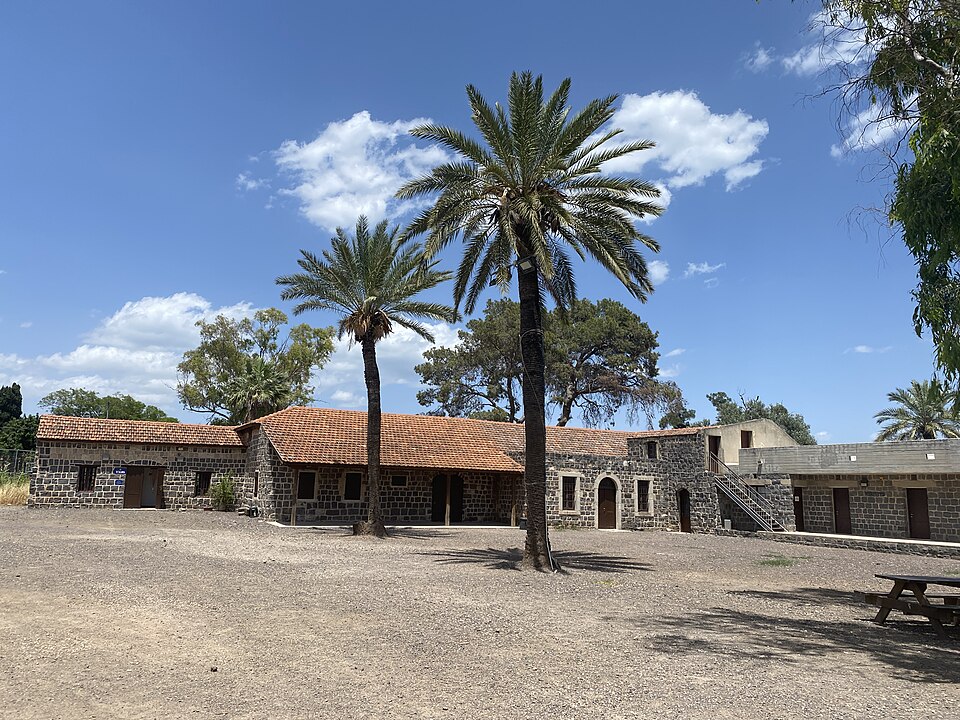
The farm itself, known today as Hatzer Kinneret (the Kinneret Courtyard), was the physical center of the pioneering world. It was here that workers trained in agriculture, that debates about collective life took place over meals, and that the social experiments that led to the kibbutz were first attempted. The old stone buildings of the farm, including the workers’ dining hall and dormitories, have been preserved as a historical site.
The farm also served as a hub for the Labor Zionist movement’s cultural life. Meetings, festivals, and political discussions took place here. The tradition of communal singing, Hebrew folk dancing, and open-air assemblies that became a hallmark of Israeli culture was born in this courtyard.
The restored farm buildings, with their stone walls, courtyards, and agricultural installations, now house a museum documenting the early years of the Labor Zionist movement. The exhibits include photographs, tools, personal items, and documents from the founding generation, bringing the pioneering period to life.
Malaria and Sacrifice
The cost of building Kinneret was measured in lives. Malaria was the constant enemy. The swamps along the Jordan and the southern shore of the lake were breeding grounds for mosquitoes, and the disease killed settlers regularly. The cemetery at Kinneret holds the graves of young pioneers who died of malaria, some within months of arriving. It was only in the 1920s and 1930s, when systematic drainage projects eliminated the swamps, that the threat was brought under control.
Moshava Kinneret today is a quiet village of a few hundred residents, surrounded by date palms and banana plantations. Most visitors pass through on their way to the more famous sites nearby. But this small settlement, and the farm beside it, is where the kibbutz idea was born, where the ethos of Hebrew labor was lived out in practice, where Rachel wrote her poems, and where Gordon walked into the fields at dawn to prove that a middle-aged intellectual could become a farmer. The story of modern Israel, in many ways, begins here.
Visit with Hoshen Tours
Moshava Kinneret is where early Zionist settlement began in the Jordan Valley. Hoshen Tours pairs it with the Aliyah story at the Aliyah Return Center, the power station at Naharayim, the fortress at Belvoir Castle, and the springs of Gan HaShlosha.
Explore Our Tour Collection
Ready to experience Israel in true colors?
Plan Your TourPrivate tours designed around your interests, schedule, and pace.