



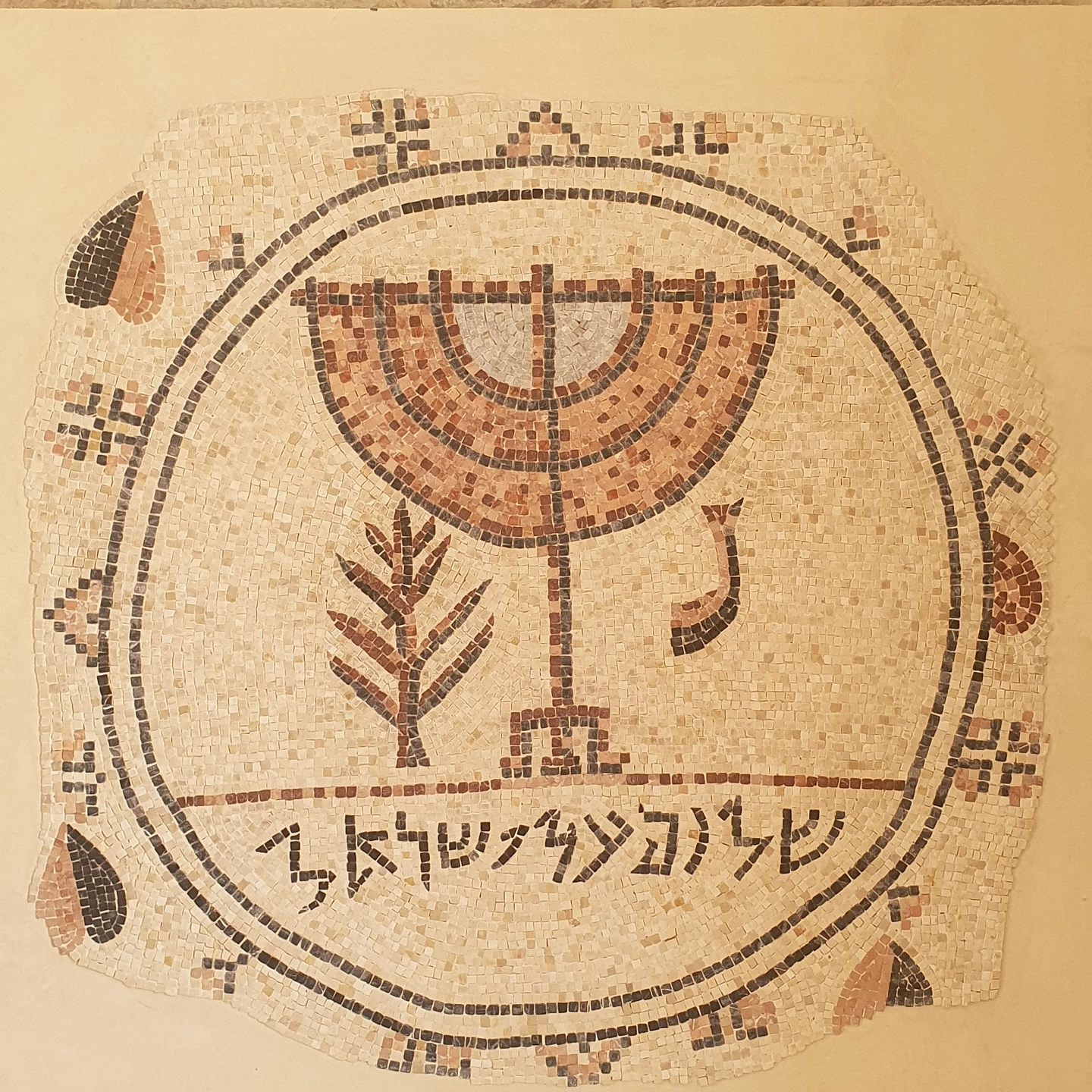
The Shalom Al Yisrael synagogue is a 6th-century Byzantine-period synagogue in Jericho one of the most important archaeological testimonies to Jewish life in the Jordan Valley after the destruction of the Second Temple. Discovered in 1936, the synagogue takes its name from the Hebrew inscription “שלום על ישראל” (“Peace Upon Israel”) that runs beneath its centerpiece: a beautifully preserved mosaic floor featuring a large seven-branched menorah flanked by a lulav (palm branch), a shofar (ram’s horn), and an incense shovel, the classic symbols of Jewish worship in the late antique period.
The quality of the mosaic workmanship points to a prosperous and established Jewish community that maintained its religious institutions in Jericho through centuries of Roman and Byzantine rule. After the destruction of the Temple in 70 CE, many Jewish families relocated to communities in the Jordan Valley, the Galilee, and the coastal plain. Jericho’s warm climate, abundant spring water, and fertile soil made it a natural destination, and the Shalom Al Yisrael synagogue is tangible evidence that Jewish communal life continued to flourish here well into the 6th century, with enough resources to commission high-quality mosaic art and maintain a dedicated house of worship.
The synagogue is located within Palestinian-controlled Jericho (Area A) and access requires advance coordination, sometimes including military escort for Israeli and international visitors. Despite the logistical complexity, the site rewards those who make the effort, the menorah mosaic, with its bold lines and warm earth tones, is one of the most iconic images of ancient Jewish presence in the Land of Israel.
The synagogue belongs to a broader pattern of Jewish religious architecture in the Jordan Valley and the Galilee during the Byzantine period. Like the synagogues at Beit Alpha Hamat Tiberias, and Huqoq the Shalom Al Yisrael synagogue used mosaic art to express religious identity and communal pride. The menorah, the seven-branched candelabrum that once stood in the Temple in Jerusalem, had by this period become the most recognizable symbol of Jewish identity, appearing on synagogue floors, lintels, and burial sites across the Land of Israel. At Shalom Al Yisrael, it is rendered with bold, confident lines in warm earth tones, flanked by the lulav, shofar, and incense shovel that evoke the Temple service and the festivals of the Jewish calendar.
Jericho’s Jewish community had deep roots. During the Second Temple period, the city was home to several of the 24 priestly courses (mishmarot), the rotating groups of priestly families, established by King David (1 Chronicles 24), who took turns serving in the Temple in Jerusalem. These priests lived in Jericho year-round and ascended to Jerusalem for their week of service. The Shalom Al Yisrael synagogue, built centuries after the Temple’s destruction, is evidence that the descendants of these priestly families, and the broader Jewish community that grew around them, continued to worship and identify as Jews in Jericho well into the Byzantine era.
The inscription itself, שלום על ישראל, “Peace Upon Israel”, is drawn from Psalm 125:5 and Psalm 128:6. It is a blessing and a statement of hope, and its presence on the synagogue floor suggests that this was a community that, even under Byzantine Christian rule, maintained its faith, its Hebrew language, and its connection to the Temple that had been destroyed five centuries earlier.
The site has a complicated modern history. After Israel captured the West Bank in 1967, the synagogue was excavated more fully and became accessible to Jewish visitors. Following the Oslo Accords and the transfer of Jericho to Palestinian Authority control in 1994, the synagogue fell within Area A. In October 2000, during the Second Intifada, the site was damaged and set on fire by Palestinian rioters. It has since been partially restored, but access remains restricted and intermittent, dependent on security coordination between Israeli and Palestinian authorities.
Visiting Shalom Al Yisrael Synagogue in Jericho
The Shalom Al Yisrael Synagogue preserves a stunning mosaic from the Byzantine period. Hoshen Tours pairs it with the broader story of Jericho, the the Hasmonean Palaces at Jericho, the Mount of Temptation, and the monastery of Deir Hajla Monastery.
Explore Our Tour Collection
Ready to experience Israel in true colors?
Plan Your TourPrivate tours designed around your interests, schedule, and pace.