



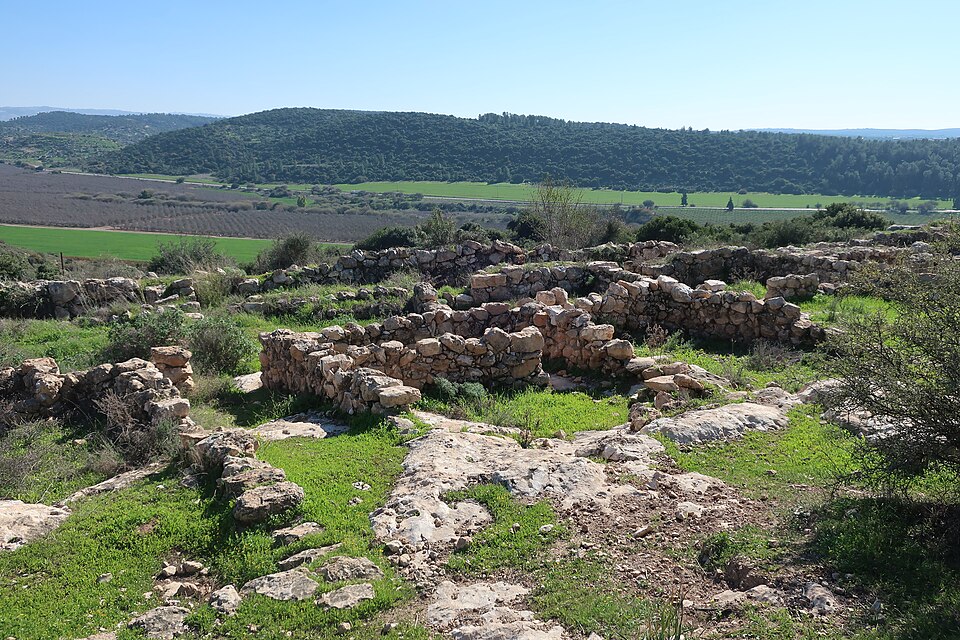
Khirbet Qeiyafa is a fortified city on the northern ridge of the Ella Valley, dating to the time of King David (late 11th-early 10th century BCE), and one of the most debated archaeological sites in Israel. The excavation, led by Yosef Garfinkel of the Hebrew University, uncovered a heavily fortified city with two gates, casemate walls, and finds that suggest a central authority, providing what the excavators argue is the first archaeological evidence for an organized Israelite kingdom in the time of David.
The Discovery of a Fortified City from David’s Time
The site was identified in 2007 and excavated between 2007 and 2013. Radiocarbon dating of olive pits found in the destruction layer placed the city firmly in the late 11th to early 10th century BCE, the period traditionally associated with the reigns of Saul and David. The city was occupied for only a short period (perhaps 20-40 years) before being destroyed, which makes it a chronological snapshot of a single generation.
The Archaeological Finds
Khirbet Qeiyafa is unique among Iron Age cities in having two gates, one facing the Ella Valley and one facing the route toward Jerusalem. This feature led Garfinkel to identify the site with the biblical Sha’arayim (“Two Gates”), a city mentioned in the account of David and Goliath: “The dead Philistines were strewn along the Shaaraim road to Gath and Ekron” (1 Samuel 17:52). The identification is debated but geographically plausible.
A pottery shard found at the site bears what may be the oldest known Hebrew inscription, five lines of text written in proto-Canaanite script. The inscription, still being deciphered, appears to contain words related to justice, slaves, and widows, possibly an early legal or ethical text. If the reading is correct, it demonstrates that writing and literacy existed in Judah during the time of David, a point that skeptics had denied.
Two portable stone shrines (model temples) were found at the site, each with architectural features that match the biblical description of Solomon’s Temple: recessed doorframes, columns, and a tripartite design. The shrines are the earliest architectural models found in the region and suggest that the builders of Qeiyafa were familiar with temple architecture that would later be realized on a grand scale in Jerusalem.
Archaeological Discoveries and Excavations
The fortifications at Khirbet Qeiyafa are among the most impressive Iron Age defensive works found anywhere in the Shephelah. The casemate wall — a double wall with rooms built into its width — encircles the entire summit of the hill, enclosing an area of roughly 2.3 hectares. The construction required moving thousands of tons of stone, a feat that suggests centralized planning and significant manpower. Inside the walls, excavators found an organized urban layout with houses built against the inner wall in a style consistent across the site, indicating a planned settlement rather than an organic village. Storage rooms contained hundreds of pottery vessels, animal bones, and stone tools that paint a picture of a prosperous agricultural community with connections to the broader region. The absence of pig bones — unusual for Philistine sites but consistent with Israelite dietary practices — has been cited as evidence for the ethnic identity of the inhabitants, though this interpretation remains debated among scholars.
The Debate: Evidence for the Kingdom of David
Khirbet Qeiyafa sits at the center of the debate between “maximalists” (who accept the biblical account of a unified Davidic kingdom) and “minimalists” (who argue that David, if he existed, ruled a small chiefdom). The site’s fortifications, urban planning, and inscriptions suggest a level of organization that goes beyond a tribal society, but whether this proves the existence of a kingdom centered in Jerusalem remains contested.
Visit with Hoshen Tours
Khirbet Qeiyafa is one of the most important discoveries in biblical archaeology. Hoshen Tours pairs it with the the Ella Valley battlefield below, the Philistine camp at Tel Sokho, the panoramic view from Tel Azekah, and Goliath’s hometown at Tel Zafit (Gath).
Explore Our Tour Collection
Ready to experience Israel in true colors?
Plan Your TourPrivate tours designed around your interests, schedule, and pace.