



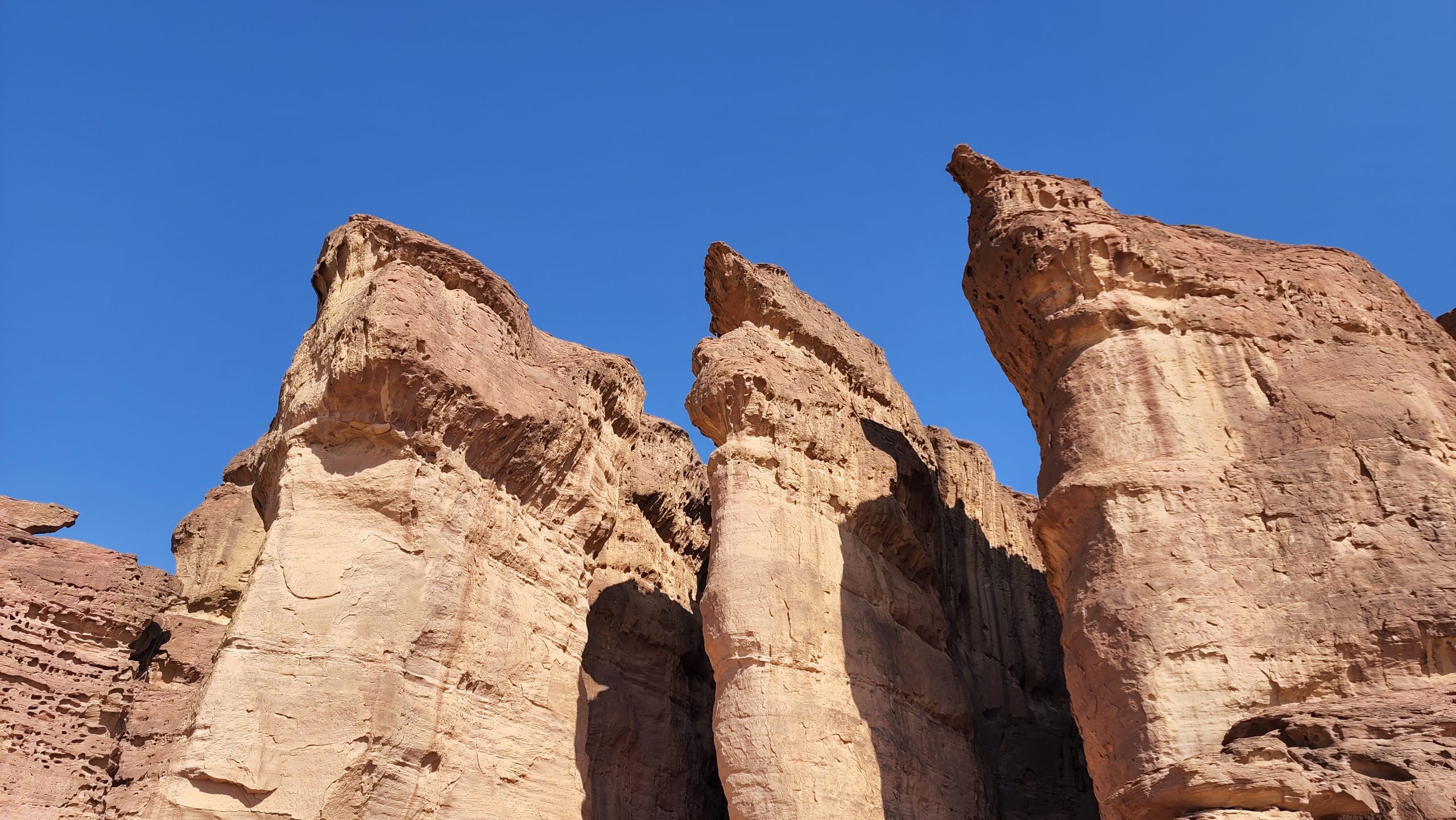
Timna Park lies 25 kilometers north of Eilat in a horseshoe-shaped valley surrounded by towering cliffs of red, brown, and cream-colored sandstone. Covering some 60 square kilometers, the park is one of the most geologically dramatic landscapes in Israel. But Timna is far more than scenery. This valley holds evidence of the oldest copper mining operations in the world, an Egyptian temple to a foreign goddess, a biblical connection to the Tabernacle in the wilderness, and rock formations that have become icons of the Negev. For visitors traveling to or from Eilat, Timna is an essential stop, a place where natural history, human history, and biblical narrative converge in a single desert basin.
Geology: A Story Written in Stone
The Timna Valley sits within the Arava, the southern section of the Great Rift Valley, the Syrian-African Rift that stretches from Lebanon to Mozambique. This massive geological fracture exposed ancient layers of rock that would otherwise remain buried deep underground. The cliffs enclosing the valley are made of Nubian Sandstone, a formation laid down hundreds of millions of years ago when this region lay beneath a shallow sea. Over time, minerals, primarily iron and manganese oxides, stained the rock in vivid layers of red, orange, purple, white, and black. The result is a landscape of extraordinary color, especially in the early morning and late afternoon light when the cliffs seem to glow.
Millions of years of wind and occasional flash floods sculpted the sandstone into arches, pillars, mushroom-shaped hoodoos, and canyon walls. The geological processes visible here are essentially the same ones that shaped the American Southwest, and the resemblance is striking. But unlike most desert parks, Timna adds a deep human layer on top of the geological one, people have been working this valley for at least seven thousand years.
Solomon’s Pillars
The most iconic formation in the park is Solomon’s Pillars, a series of massive sandstone columns rising some 50 meters from the valley floor, carved by natural erosion along vertical joints in the cliff face. The name dates to the early 20th century, when archaeologists believed the copper mines in the valley were operated by King Solomon. That theory was overturned in the 1960s by archaeologist Beno Rothenberg, whose excavations demonstrated that the main period of mining activity predated Solomon by centuries. The pillars themselves, of course, have nothing to do with any king, they are purely geological. But the name stuck, and Solomon’s Pillars remain the most photographed feature in the park.
At the base of the pillars, Rothenberg discovered something far more significant than a royal connection: an Egyptian temple dedicated to the goddess Hathor, dating to the 14th, 12th centuries BCE. This was one of the most remote Egyptian religious sites ever found, and its presence here speaks to the strategic importance Egypt placed on Timna’s copper.
The Copper Mines and the Egyptian Temple
Copper mining at Timna began as early as the 5th millennium BCE, making it one of the earliest known copper production sites in the world. The most intensive period of activity came during Egypt’s New Kingdom (roughly 1400–1150 BCE), when Egyptian expeditions organized large-scale mining and smelting operations in the valley. Thousands of mining shafts, smelting furnaces, and slag heaps have been identified across the site. Together with the copper mines at Faynan (biblical Punon) on the Jordanian side of the Arava, Timna formed part of one of the most important copper-producing regions in the ancient Near East. Today the two sites are separated by roughly 100 kilometers and the deep rift of the Arava between them, but before the tectonic forces of the Rift pulled the land apart millions of years ago, Timna and Faynan were likely part of the same continuous copper-bearing geological formation. Both sites exploit the same type of copper-rich sandstone layers, a shared geological origin now split across two countries.
The Hathor Temple at the base of Solomon’s Pillars served the Egyptian miners and their local workforce. Hathor was the Egyptian goddess of mining, beauty, and foreign lands, a fitting patron for a remote copper operation. Excavations uncovered votive offerings, copper figurines, faience beads, and cartouches bearing the names of pharaohs including Seti I and Ramesses III. The temple was small but richly furnished, reflecting the wealth that copper brought to the Egyptian economy.
After the Egyptians withdrew around 1150 BCE, the temple was taken over by the Midianites, a semi-nomadic people mentioned frequently in the Bible. The Midianites converted the Egyptian shrine into their own place of worship, erecting a tent-like structure over the ruins. Among the finds from this Midianite phase was a small copper serpent with a gilded head, an artifact that immediately recalls the Nehushtan, the bronze serpent Moses raised in the wilderness (Numbers 21:4–9). Whether the connection is direct or coincidental remains debated, but the resonance between the Timna serpent and the biblical narrative is powerful.
The Mushroom Rock and the Arches
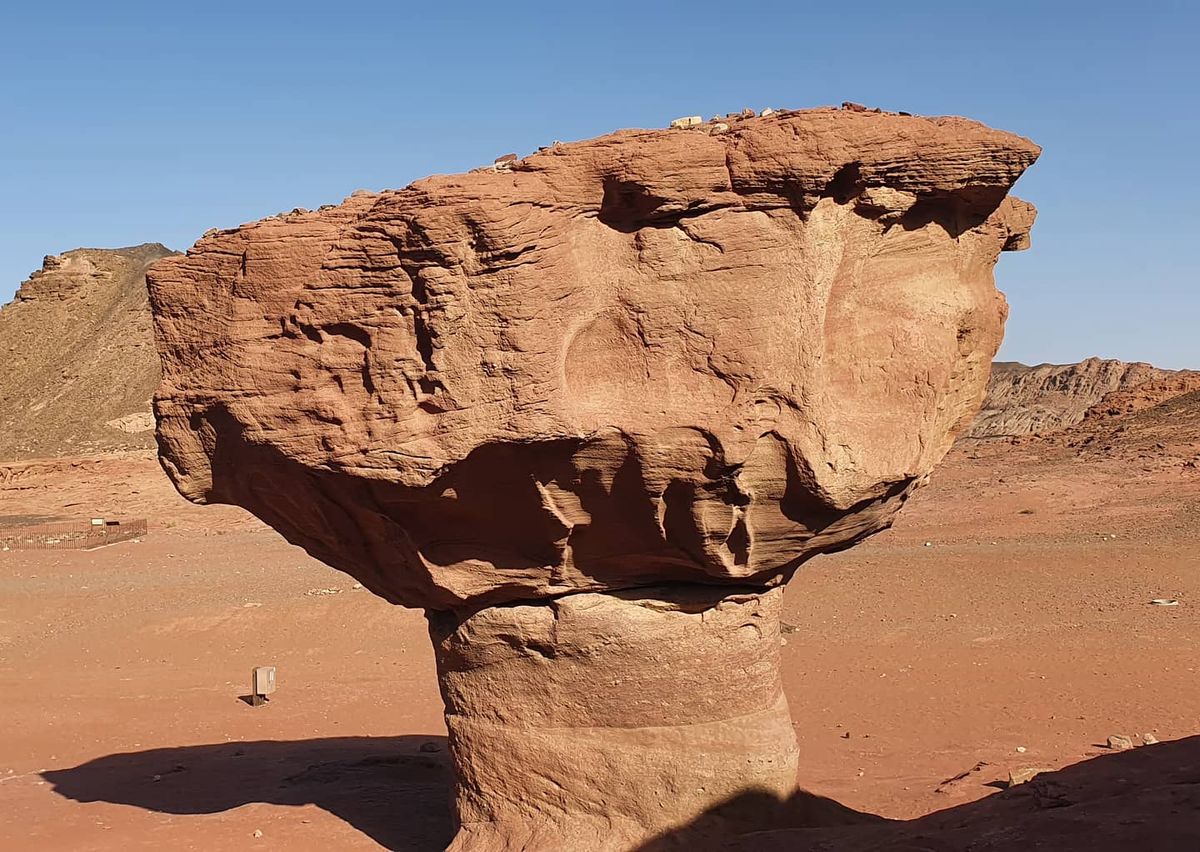
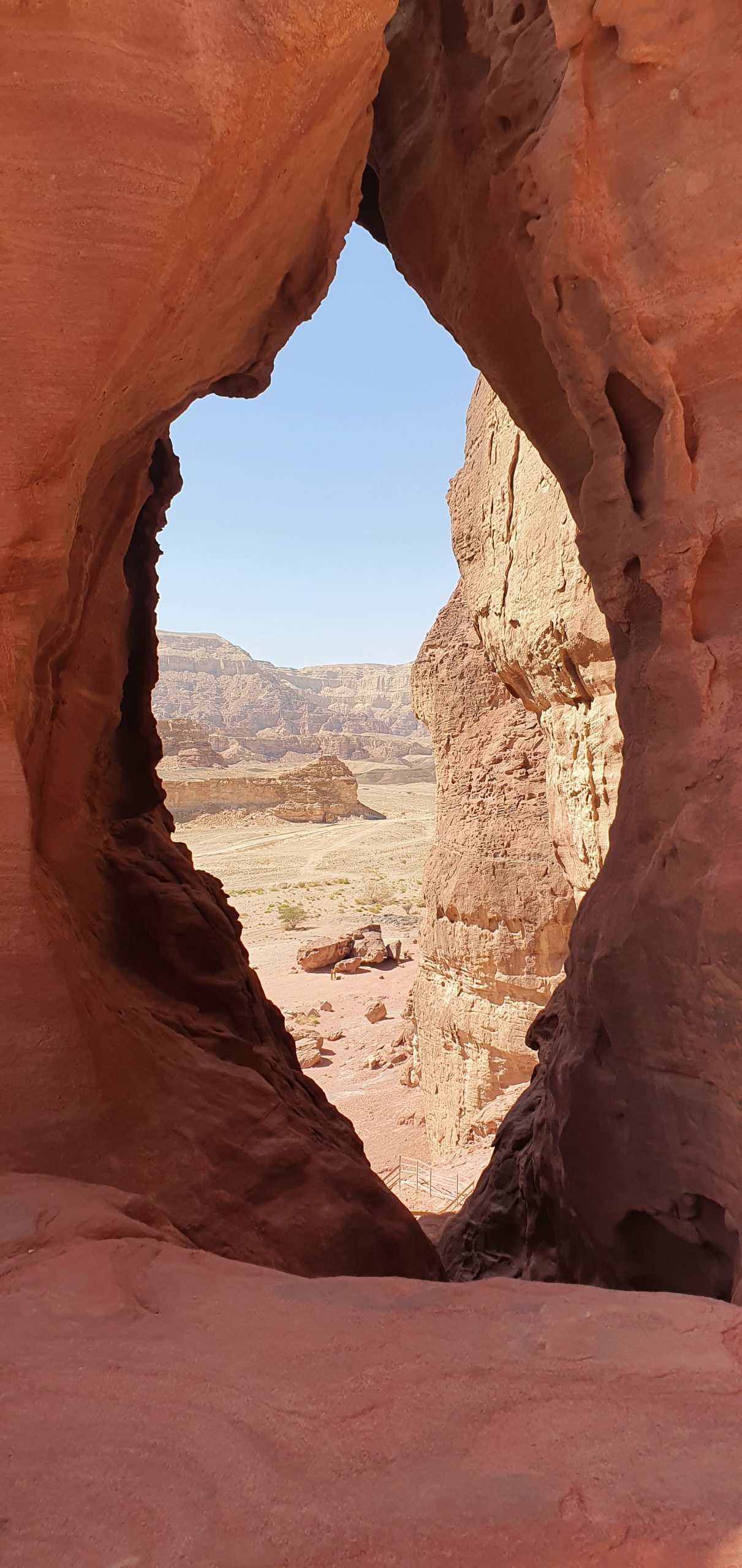
Beyond the mines and the temple, the park is filled with geological curiosities. The Mushroom Rock, a massive sandstone cap balanced on a narrow eroded stem, is one of the most photographed natural features in the Negev. It was formed by differential erosion: the softer lower layers wore away faster than the harder capstone, creating the improbable mushroom shape. Nearby, natural arches span gaps in the cliff walls, formed when erosion hollowed out weaker sections of rock while leaving the harder surrounding stone intact.
A network of marked hiking trails winds through these formations, ranging from short 30-minute walks to half-day routes that climb to viewpoints above the valley. The colors shift throughout the day as the sun moves across the cliffs, and the silence of the deep desert adds to the otherworldly atmosphere.
The Tabernacle Replica
Near the center of the park stands a full-scale replica of the biblical Tabernacle, the portable sanctuary the Israelites are said to have carried through the wilderness during the Exodus. Built according to the specifications described in the Book of Exodus (chapters 25–27), the replica includes the outer courtyard with its linen curtain walls, the bronze altar of burnt offerings, the laver for priestly washing, and the Tabernacle structure itself with its two chambers: the Holy Place and the Holy of Holies.
Inside, visitors can see reproductions of the Menorah, the Table of Showbread, the Altar of Incense, and the Ark of the Covenant behind its curtain. The setting is deliberately chosen, the Tabernacle stood in the wilderness, and the arid landscape of Timna evokes exactly that environment. For Christian pilgrims especially, this is one of the most meaningful stops in the Negev, bringing the Exodus narrative to life in a tangible, three-dimensional way. Guided tours explain the symbolism of each element and its significance in both Jewish and Christian tradition.
The Lake and Evening Activities
At the heart of the park, an artificial lake surrounded by palm trees and sandstone cliffs provides an unexpected oasis. Visitors can rent paddleboats and kayaks, relax on the small beach, or simply enjoy the surreal contrast of water against red desert rock. The lake area also serves as the starting point for the park’s popular night programs.
Timna’s distance from any city means almost zero light pollution, and the park has developed evening activities that take advantage of this. Night hiking with headlamps through the illuminated rock formations, stargazing sessions, and seasonal sound-and-light shows at Solomon’s Pillars are among the offerings. For families, the combination of daytime hiking, the lake, and an evening program makes Timna a full-day destination.
Visit with Hoshen Tours
Timna Park brings together 6,000 years of copper mining history, extraordinary desert geology, and some of the most dramatic rock formations in Israel. Hoshen Tours walks visitors through Solomon’s Pillars, the ancient mining shafts, and the mushroom-shaped rock formations, explaining how Egyptian and later Midianite miners extracted copper here in conditions of extreme heat. The Tabernacle replica in the park adds a biblical dimension to the visit. Combine it with Eilat and the Red Sea, the Makhteshim, the Incense Route, and the civilization of the Nabateans.
Ready to experience Israel in true colors?
Plan Your TourPrivate tours designed around your interests, schedule, and pace.