



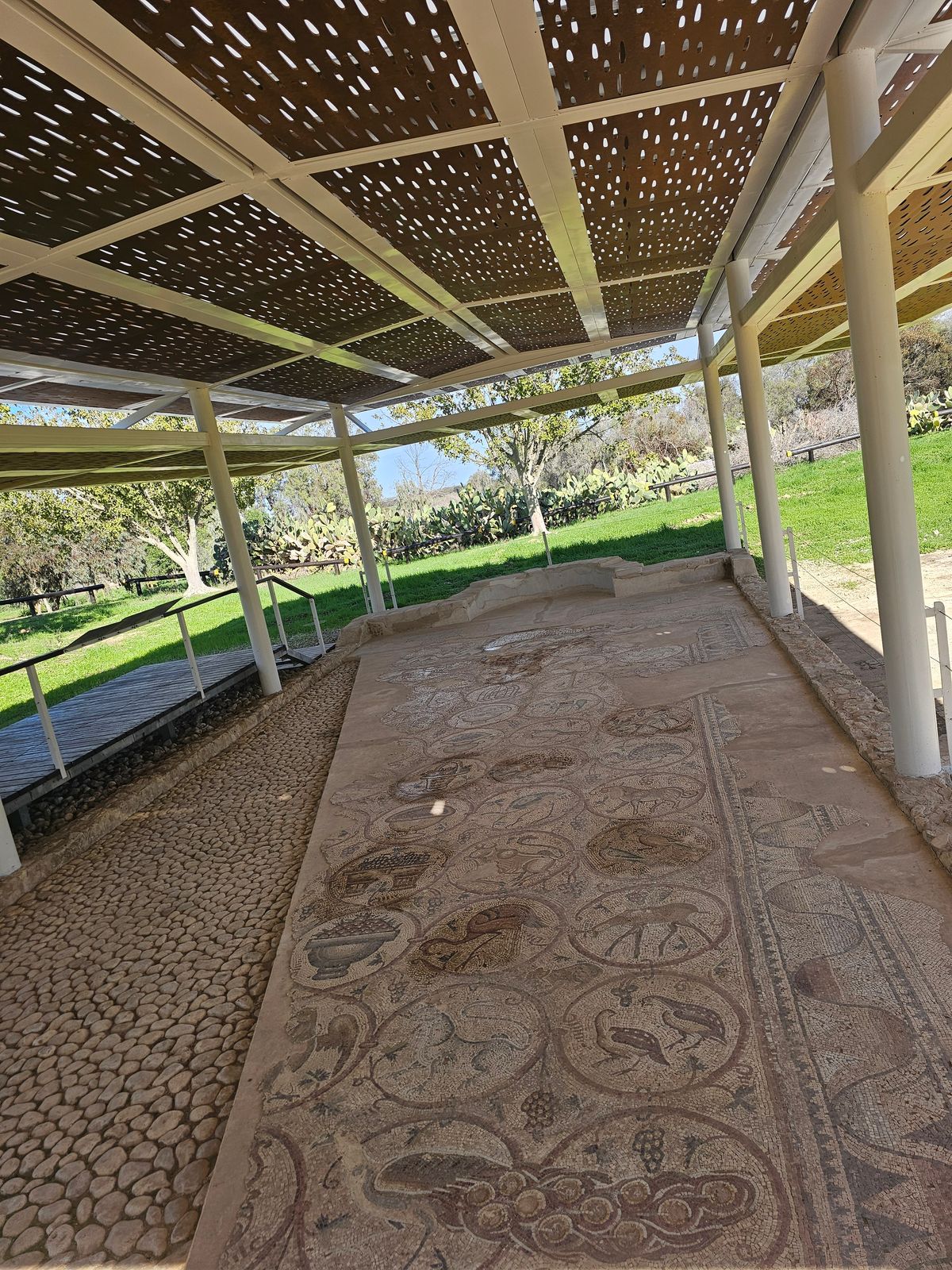
Near Kibbutz Nirim in the western Negev, the remains of a 6th-century synagogue were discovered in 1957, containing one of the finest mosaic floors found in Israel. The Maon synagogue mosaic features a stunning vine scroll pattern inhabited by birds, animals (including a giraffe, a zebra, an elephant, a lion, and a peacock), Jewish symbols including menorot and an amphora, and geometric patterns of exceptional quality.
The Mosaic Floor of Maon Synagogue
The mosaic is similar in style to the famous mosaic at the nearby Gaza synagogue and to church mosaics from the same period, reflecting the shared artistic traditions of Jewish and Christian communities in the Byzantine Negev. The vine scroll, emerging from an amphora and spreading across the floor, contains medallions with individual animals, each rendered with remarkable naturalism. The presence of exotic animals like elephants and giraffes suggests that the artists were working from pattern books that circulated across the Mediterranean world.
The synagogue’s location near the Gaza border places it in the heart of the region affected by the October 7 attack. Kibbutz Nirim itself was attacked on that day, and the ancient synagogue, with its images of peace and beauty created 1,500 years ago, stands in poignant contrast to the violence that the region has endured.
Figurative Art in Ancient Synagogues
The Maon mosaic raises a question that puzzles many visitors: how could a Jewish synagogue contain images of animals and decorative motifs? The answer is that ancient Judaism was far more flexible about visual art than most people assume. By the Byzantine period (4th-7th century CE), the ancient threat of paganism had faded, and Jewish communities across the Land of Israel decorated their synagogues with elaborate figurative mosaics. The synagogue at Beit Alpha has a zodiac wheel with Helios at its center; the synagogue at Zippori has elaborate mosaic decorations; and at Huqoq, images of Samson and elephants fill the floor. The rabbis of the period permitted images as long as they were not objects of worship, and communities reinterpreted pagan motifs through a Jewish lens. This openness did not last forever, but the mosaics that survive in synagogues across Israel, from Maon to Beit Alpha to Huqoq, are evidence of a period when Judaism was comfortable with visual beauty in ways that later generations would find surprising.
The Byzantine Negev
The Maon synagogue belongs to the broader story of the Byzantine Negev, a period (4th-7th century CE) when the region supported a surprising density of settlement, agriculture, and religious life. Nearby sites like Nitzana, Shivta, and Halutza (all UNESCO World Heritage Sites) show how Byzantine engineering, including terraced agriculture, cisterns, and flood-water harvesting, enabled communities to thrive in the desert. The Jewish community at Maon was part of this flourishing. The quality of the mosaic floor suggests a prosperous congregation with the resources to commission skilled artisans, likely the same workshops that produced church mosaics across the Negev. The synagogue’s location at the edge of the settled zone, where agriculture gave way to pastoral desert, reflects a community living at the frontier of the cultivable world.
Visit with Hoshen Tours
The ancient synagogue at Maon (Nirim) preserves a remarkable mosaic floor. Hoshen Tours pairs it with the innovation of the Salad Trail, the trails of Park Eshkol, the Steel Division Memorial, and the Black Arrow Memorial.
Ready to experience Israel in true colors?
Plan Your TourPrivate tours designed around your interests, schedule, and pace.