



On the evening of November 4, 1995, approximately 100,000 Israelis gathered in what was then called Kings of Israel Square (today Rabin Square) for a rally in support of the Oslo peace process. It was a Saturday night, the mood was hopeful, and Prime Minister Yitzhak Rabin, a man not known for public displays of emotion, stood on the stage and joined the crowd in singing “Shir LaShalom” (Song for Peace), the iconic anthem written by Yankele Rotblit and set to music by Yair Rosenblum, first performed by the Lehakat HaNahal (the Nahal Brigade entertainment troupe) in 1969. Minutes later, as Rabin walked toward his car in the parking area behind the stage, a 25-year-old Israeli law student named Yigal Amir stepped forward and shot him. Rabin died shortly afterward at Ichilov Hospital. A blood-stained sheet of paper with the lyrics of “Shir LaShalom” was found in his jacket pocket. The square was renamed Kikar Yitzhak Rabin, and Israel was never quite the same.
Rabin’s Legacy
Yitzhak Rabin was a soldier who became a peacemaker. As IDF Chief of Staff, he led the army to its most decisive victory in the Six-Day War of 1967. He served as Prime Minister from 1974 to 1977, and again from 1992 until his assassination. His second term was defined by the Oslo Accords, a series of agreements between Israel and the Palestine Liberation Organization that, for the first time, established mutual recognition and a framework for Palestinian self-governance. The first Oslo agreement was signed on the White House lawn on September 13, 1993, in a ceremony remembered for the handshake between Rabin and Yasser Arafat, brokered by President Bill Clinton. In 1994, Rabin shared the Nobel Peace Prize with Foreign Minister Shimon Peres and PLO Chairman Arafat for their efforts toward peace. Oslo II, which expanded Palestinian self-rule, was signed in September 1995, just weeks before Rabin’s murder.
The assassination was carried out by a right-wing extremist who opposed the peace process and believed he was acting to prevent the surrender of biblical land. The killing stunned the nation. It was the first assassination of a sitting Israeli prime minister, and it came not at the hands of an external enemy but from within Israeli society itself. The trauma of that night, the gunshots in the parking lot, the bloodied song lyrics, the sense that something irreversible had happened, remains one of the defining moments in Israeli collective memory.
Yet Rabin Square is not only a place of grief. For many Israelis, it also represents the courage of a decorated general who chose negotiation over continued conflict, who shook the hand of his enemy on the White House lawn, and who stood before his own people that night to sing about peace. The square bears his name not because of how he died, but because of what he was trying to build.
The Square and the Memorial
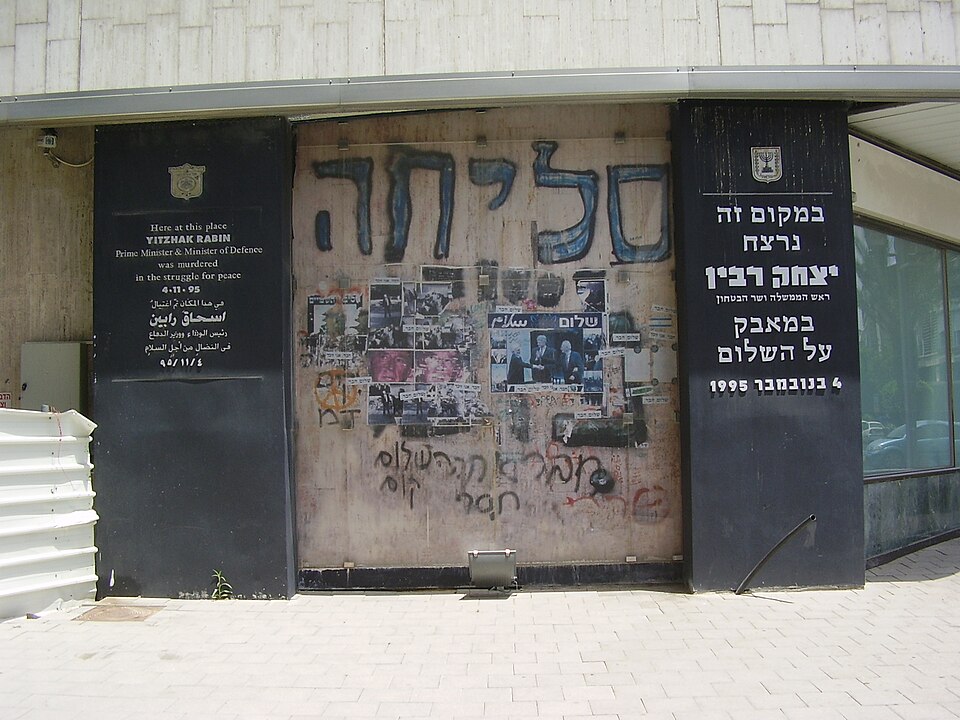
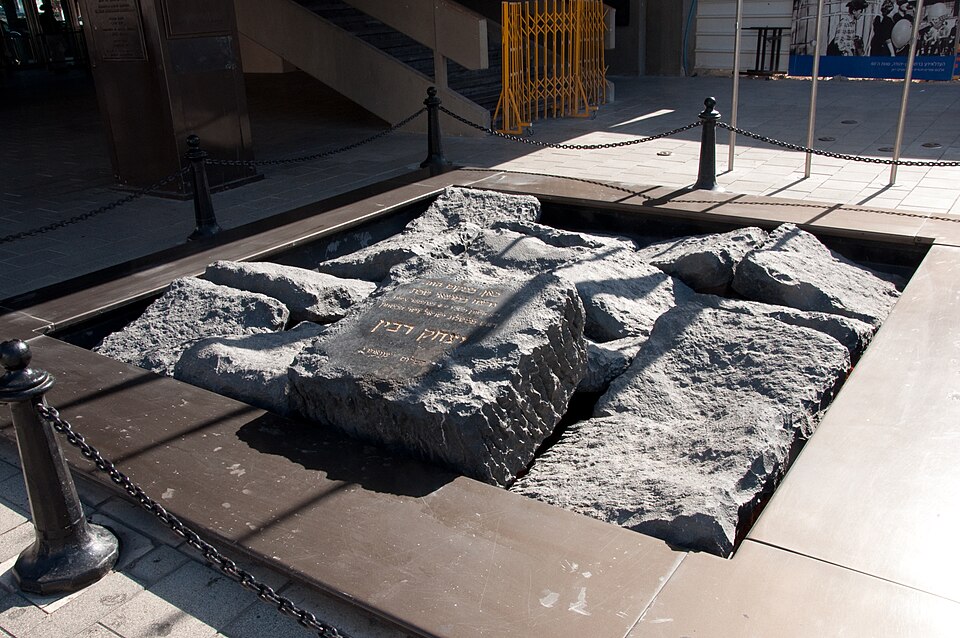
Rabin Square is a large, open public space in central Tel Aviv, adjacent to City Hall. It serves as the city’s main gathering point for rallies, demonstrations, public events, and national commemorations. The memorial to Rabin stands at the exact spot where he was shot, in the parking area below the square near the stairs on the north side of City Hall. Designed by sculptor Yael Artzi, it consists of 16 basalt stones arranged in a geometric pattern, stark, angular, and deliberately unsettling. Every year on the anniversary of the assassination, thousands gather at the square for a memorial ceremony.
The Yitzhak Rabin Center, a museum and educational center dedicated to Rabin’s legacy and to Israeli democracy, opened nearby in 2005 in a building designed by architect Moshe Safdie. It traces Rabin’s life from his childhood in Tel Aviv through his military career, his political leadership, and the peace process, ending with the assassination and its aftermath.
Visit with Hoshen Tours
Rabin Square is a place where Israeli history is not ancient but raw and recent. Hoshen Tours visits the square, the memorial, and tells the story of the rally, the song, the shots, and the blood-stained lyrics, a story that every Israeli knows by heart and that visitors need to understand if they want to grasp where this country has been and where it is still trying to go. Hoshen Tours often combines this site with Migdal Tzedek, Simon the Tanner, and Eretz Israel Museum for a memorable day exploring the region.
Explore Our Tour Collection
Ready to experience Israel in true colors?
Plan Your TourPrivate tours designed around your interests, schedule, and pace.