



The Abuhav Synagogue in Safed is one of the most storied houses of worship in the Galilee, steeped in Kabbalistic tradition and artistic detail. 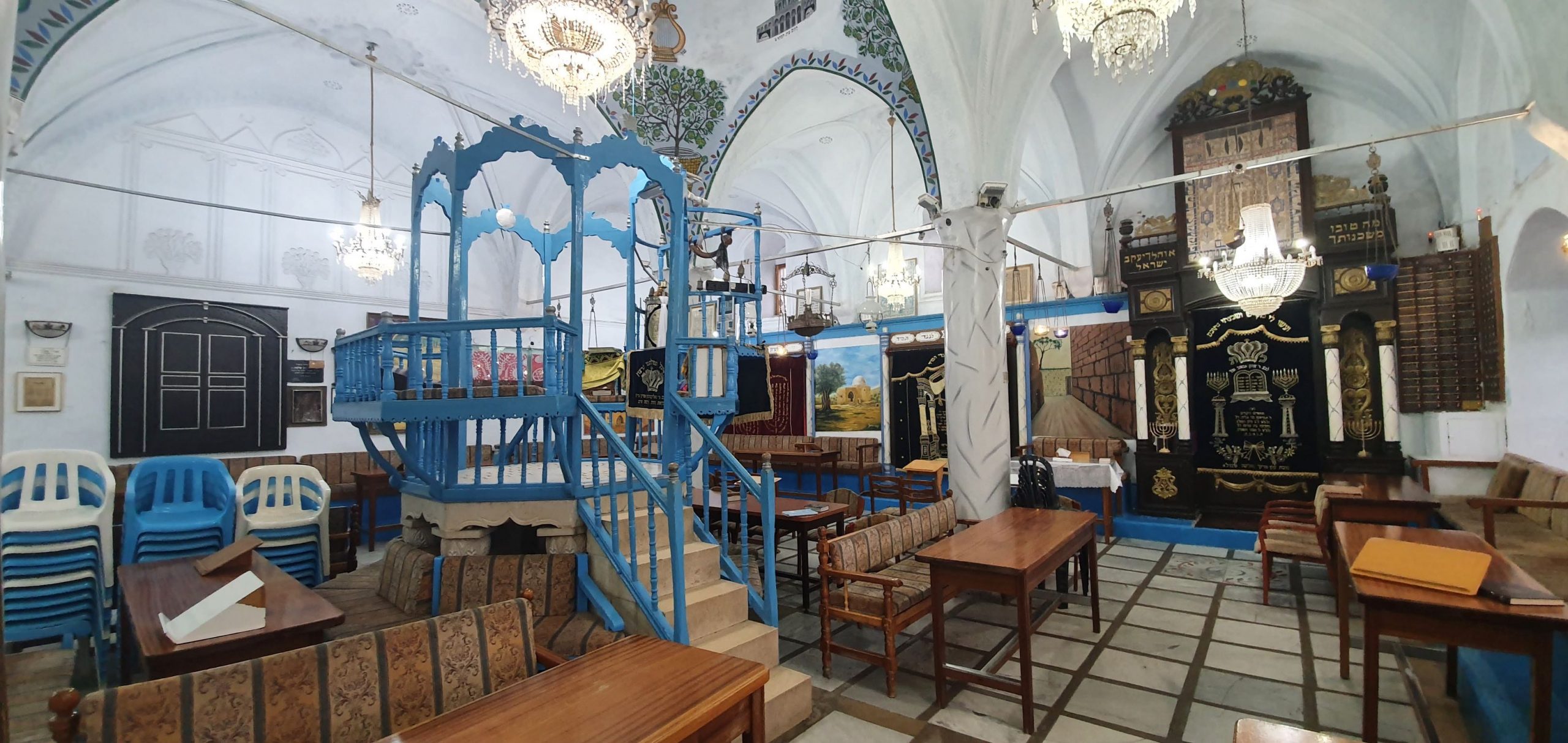
One of the most intriguing details in the synagogue is a painting of the Dome of the Rock on one of the walls. At first glance, it may seem surprising to find an image of an Islamic holy site inside a Jewish house of worship. But the inscription beneath the painting reads “מקום המקדש”, “The Place of the Temple.” For the community, the golden dome is not a symbol of Islam but a visual marker for the location of the ancient Jewish Temple on the Temple Mount. It is a reminder of what once stood there and, in Kabbalistic tradition, of what is yet to be restored.
Of all the synagogues in Safed, the Abuhav Synagogue is perhaps the most enchanting. Named after Rabbi Yitzhak Abuhav, a 15th-century Spanish rabbi, Kabbalist, and author, the synagogue is a place where art, mysticism, and legend come together under a single painted dome.
Rabbi Yitzhak Abuhav
Rabbi Yitzhak Abuhav (c. 1433–1493) lived in Toledo, Spain, during the final decades of Jewish life on the Iberian Peninsula. He was a student of Rabbi Yitzhak Campanton, one of the leading Talmudists of Castile, and became one of the most respected halakhic authorities of his generation. His major work, a major halakhic commentary (“The Candelabrum of Light”), was a comprehensive guide to Jewish ethics and daily conduct, organized around the image of the seven branches of the menorah. The book became widely popular among Sephardic communities and remained in print for centuries.
Abuhav was also deeply immersed in Kabbalah, and tradition holds that his mystical knowledge shaped not only his writings but also the way he prepared sacred objects, most famously, the Torah scroll that bears his name. When the Jews were expelled from Spain in 1492, his students and followers carried his teachings, and, according to tradition, this Torah scroll written in his own hand, to the Land of Israel, eventually reaching Safed, where it found its permanent home in the synagogue named after him.
The Torah Scroll
The synagogue’s most prized possession is a Torah scroll attributed to Rabbi Abuhav himself. According to tradition, when Rabbi Abuhav wrote this scroll, each time he reached the sacred Name of God (the Tetragrammaton), he would go to immerse in the mikveh 26 times before writing it, 26 being the numerical value (gematria) of the Name: Yod (10) + Heh (5) + Vav (6) + Heh (5). This extraordinary level of devotion and spiritual preparation is believed to have imbued the scroll with a unique sanctity.
The scroll is kept in the right Holy Ark and is taken out only three times a year: on Rosh Hashanah, Yom Kippur, and Shavuot. On these occasions, the reading draws worshippers from across Safed. A well-known tradition in Safed holds that whenever the scroll was removed from the Ark outside of these three appointed times, the person who took it out did not survive the year. Whether historically grounded or not, this tradition has reinforced the deep reverence surrounding the scroll and ensured its careful preservation for over five centuries.
The Three Holy Arks
Visitors entering the Abuhav Synagogue often notice an unusual feature: three Holy Arks (aronot kodesh) line the southern wall, facing Jerusalem. The number three is itself part of the synagogue’s Kabbalistic numerical symbolism. The right ark is the most sacred, it houses the Abuhav Torah scroll along with one other ancient scroll, and is opened only on the three appointed occasions each year. The central ark holds the Torah scrolls used for regular Shabbat and weekday readings. The left ark functions as a genizah, a repository for worn sacred texts and old manuscripts that, according to Jewish law, may not be discarded but must be respectfully stored or buried.
The Painted Dome
The interior of the Abuhav Synagogue is dominated by a beautifully painted dome covered in Kabbalistic symbols. The dome features representations of the four elements (earth, water, fire, and air), the twelve tribes of Israel, and the ten sefirot, the divine attributes that form the Tree of Life in Kabbalistic thought. The colors are vivid, the symbolism is layered, and the overall effect is a ceiling that reads like a visual encyclopedia of Jewish mysticism. For visitors who have just learned about Kabbalah in the alleys of Safed, the Abuhav dome brings the abstract concepts to life in paint and gold.
The Earthquake Legend
According to local tradition, the Abuhav Synagogue has survived every earthquake that has struck Safed, including the devastating quakes of 1759 and 1837 that destroyed much of the city and killed thousands of residents. The story goes that while buildings collapsed all around it, the wall of the Abuhav Synagogue that holds the Holy Ark remained standing, protecting the sacred Torah scroll inside. Whether this is historical fact or pious legend, it has only added to the synagogue’s mystique, and generations of worshippers have seen in its survival a sign of divine protection.
The Atmosphere
The Abuhav Synagogue is small and intimate, with carved wooden furnishings, Sephardic-style liturgical arrangements, and an atmosphere of quiet devotion that sets it apart from the larger, more visited synagogues in Safed. It is a working synagogue with a regular congregation, and visitors are welcomed with the warmth that characterizes Safed’s religious community. The combination of the ancient Torah scroll, the painted dome, the earthquake legend, and the living prayer community makes the Abuhav one of the most special synagogues in Israel.
Visit with Hoshen Tours
The Abuhav Synagogue is a highlight of any visit to Safed’s Synagogue Quarter. Hoshen Tours includes it alongside the Ari Synagogue and the Caro Synagogue, giving visitors a complete picture of the spiritual world that made Safed the capital of Jewish mysticism.
Visitors exploring the upper Galilee often combine Abuhav Synagogue with nearby destinations such as Safed, Kabbalah in Safed, and Rabbi Joseph Caro, each offering its own distinctive perspective on the region’s layered history and landscape. A broader itinerary might also include The Ari – Rabbi Isaac Luria and Mount Meron, both within easy reach and rich in their own right.
Every Hoshen Tours itinerary is private and fully customizable. Contact us to begin planning your journey through the upper Galilee.
Explore Our Tour Collection
Ready to experience Israel in true colors?
Plan Your TourPrivate tours designed around your interests, schedule, and pace.