



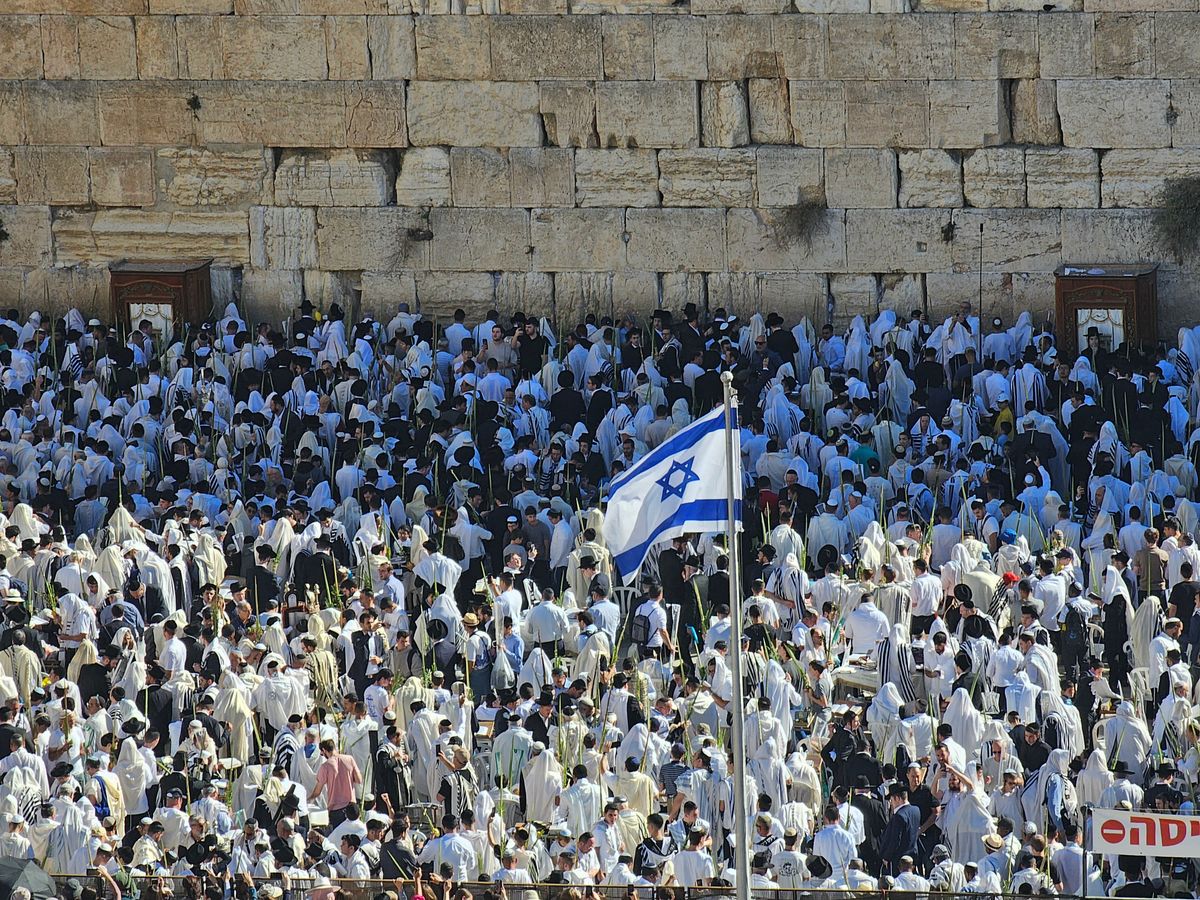
The Western Wall (HaKotel HaMa’aravi in Hebrew) is the holiest site in Judaism, a 57-meter section of the ancient retaining wall that Herod the Great built around the Temple Mount in the 1st century BCE. For nearly 2,000 years, since the destruction of the Second Temple in 70 CE, Jews from every corner of the world have come to pray here, to mourn here, and to simply stand here. The Midrash teaches that “the Divine Presence never departed from the Western Wall” (Midrash Rabba, Shir HaShirim 2:9), and that promise has drawn pilgrims through every century of exile and every decade of modern history.
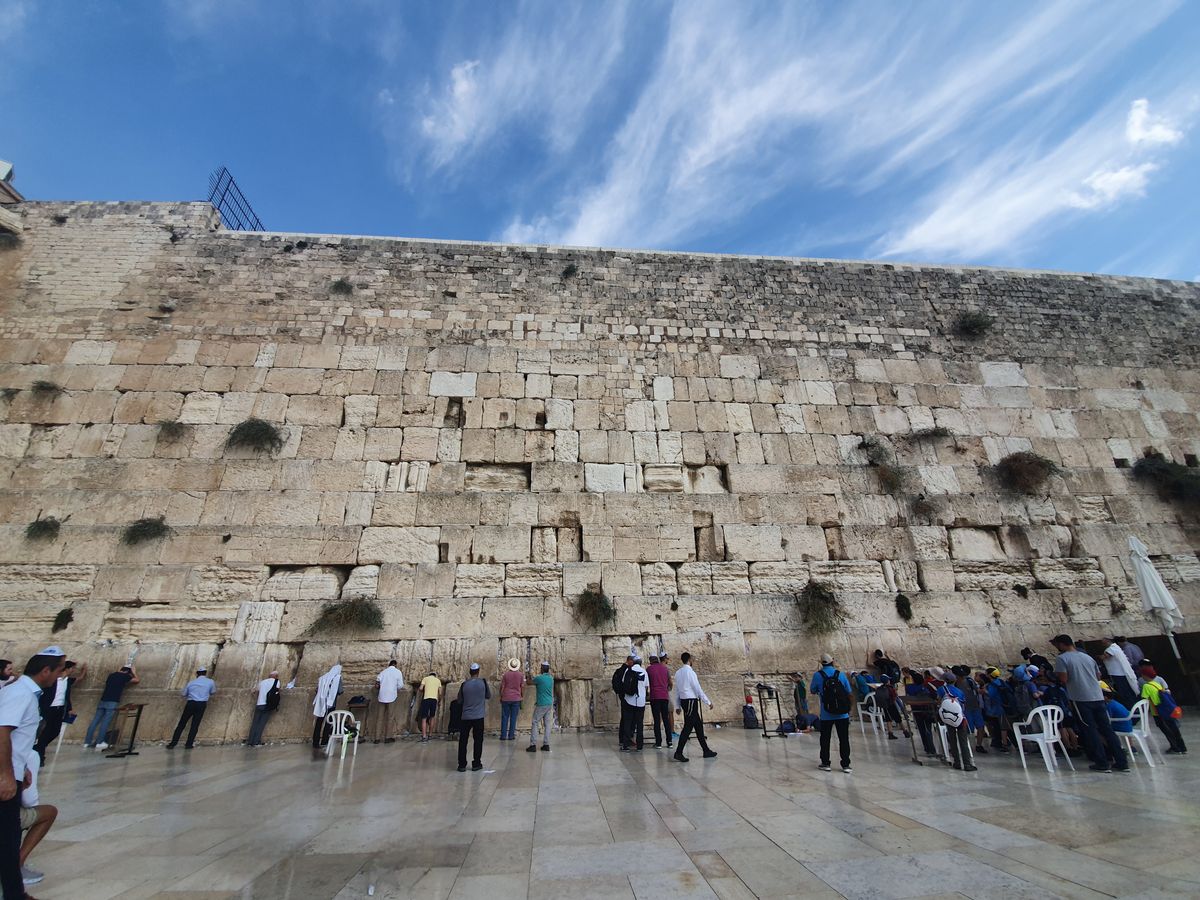
Nothing quite prepares you for your first sight of it. You walk through the Jewish Quarter, pass through a security checkpoint, and then the plaza opens up and the Wall is just there, taller and more golden than you imagined, worn smooth in places from two thousand years of hands and foreheads pressed against it. It stops most people in their tracks.
What the Wall Actually Is
The Western Wall is not, as many visitors assume, a remnant of the Temple itself. The Temple stood on top of the Mount, and it was destroyed completely in 70 CE. What remains is the retaining wall of the enormous platform that Herod the Great constructed to enlarge the Temple Mount between 20 and 10 BCE. Herod was one of the great builders of the ancient world, and his expansion of the Temple Mount was one of his most ambitious projects: he essentially doubled the size of the mountain by building a vast rectangular platform around it, held in place by massive retaining walls on all four sides.
The stones of the lower courses are Herodian: enormous limestone blocks, some weighing over 500 tons, cut with the distinctive flat-dressed face and narrow marginal draft that characterizes Herod’s masonry. They are among the heaviest objects ever moved by human hands in the ancient world. Above the Herodian courses, smaller stones from later periods, Umayyad, Mamluk, and Ottoman, show how the wall continued to be used and repaired across the following centuries. The largest stone in the visible wall measures 13.6 meters long, 3 meters high, and weighs approximately 570 tons. It sits underground in the Western Wall Tunnels, where the full hidden length of the wall becomes visible.
Of the full perimeter wall Herod built, the western section alone stretches approximately 488 meters, most of it hidden behind buildings. The section at the open-air plaza is just one part of a much longer structure. The rest runs under the Muslim Quarter to the north and is accessible through the tunnel system.
June 7, 1967
For 19 years, from 1948 to 1967, the Western Wall was under Jordanian control and Jews had no access to it. The armistice line cut through Jerusalem, leaving the Old City and the Wall on the Jordanian side. Entire generations of Israelis grew up unable to visit the holiest site in Judaism.
On June 7, 1967, the third day of the Six-Day War, Israeli paratroopers fought their way through the streets of the Old City. The fighting was fierce and close-quarters through the narrow alleys of the Muslim Quarter. At approximately 10 a.m., Paratroop Brigade commander Motta Gur broadcast over his radio the words that would become one of the most quoted phrases in modern Israeli history: “The Temple Mount is in our hands.”
Within minutes, the paratroopers reached the Western Wall. Rabbi Shlomo Goren, the chief military rabbi, was among the first to arrive, carrying a Torah scroll and a shofar. He blew the shofar at the Wall, tears streaming down his face. Around him, battle-hardened soldiers, men who had been fighting for three days with little sleep, broke down and wept. Some pressed their faces to the stones. Some simply stood in silence. The photographs from that morning, shot by David Rubinger, are among the most iconic images of the 20th century.
Defense Minister Moshe Dayan arrived that afternoon and placed a note in the Wall, a tradition that continues with every Israeli leader and world figure who visits. The note read: “May peace descend upon the whole House of Israel.”
That moment stands as the emotional climax of modern Jewish history. The Wall had been out of reach for a generation, and suddenly it was back. Understanding this history is essential for understanding why the Wall affects people the way it does today. When you watch a soldier weep at the Wall, or see a family dance during a bar mitzvah, or witness the Friday night crowds singing at the top of their lungs, you are seeing something that connects directly to that morning in 1967 and to 2,000 years before it.
The Plaza
The Western Wall Plaza as it exists today was created in the days immediately after June 7, 1967. Before the Six-Day War, the prayer area in front of the Wall was a narrow alley, barely 3.6 meters wide, squeezed between the Wall and the houses of the Mughrabi Quarter. In the days following the Israeli takeover, those houses were demolished and the open plaza was created, giving Jews a proper gathering place at the Wall for the first time in modern history.
The plaza is divided into two sections separated by a mechitza (partition): the northern, larger section for men, and the southern section for women. Dress codes apply to both areas. Shoulders and knees should be covered, and men are required to wear a head covering when approaching the Wall. Paper kippot are available for visitors who arrive without one.
A third area, south of the main plaza near the remains of Robinson’s Arch, is the egalitarian prayer space known as Ezrat Yisrael. This area is open to mixed-gender prayer groups and is used regularly by Reform, Conservative, and egalitarian congregations. The arrangement remains politically sensitive in Israel, where the Orthodox establishment controls the main plaza.
The Notes
The tradition of placing written prayers in the cracks between the Wall’s stones is centuries old. Today the Wall receives an estimated one million notes per year, tucked into every available gap by pilgrims, tourists, presidents, and popes. World leaders place notes as a matter of protocol when visiting Israel. Pope John Paul II placed a note here in 2000. Pope Benedict XVI did the same in 2009. U.S. presidents have made it a near-standard stop on visits to Israel, each one photographed pressing a folded paper into the ancient stone.
Twice a year, the accumulated notes are carefully collected by the authorities and buried on the Mount of Olives, in keeping with the Jewish tradition that written texts containing God’s name must be buried rather than discarded. The notes are considered sacred regardless of who wrote them or what they said.
Shabbat at the Wall
Friday evening at the Western Wall is one of the most powerful weekly gatherings on earth. As the sun sets over the Judean Hills and turns Jerusalem gold, thousands of people begin streaming into the plaza. Yeshiva students arrive in white shirts, singing and linking arms. Families with small children crowd along the mechitza. Soldiers in olive-green uniforms press close to the stones. Tourists stand at the edges taking in the scene.
The singing is communal and unscripted. Different groups start different songs, and sometimes the whole plaza picks up the same melody at once. The Kabbalat Shabbat prayer service, which welcomes the Sabbath, fills the air. It builds and builds until, at the moment of nightfall, the Sabbath begins and something shifts. The energy becomes quieter, more internal.
Coming to the Wall on a Friday evening is not a tourist activity. It is a chance to witness something that happens every single week and has happened every week for decades, an entire city pausing together to mark time. No visit to Jerusalem is complete without it.
Tisha B’Av
At the opposite end of the emotional spectrum is Tisha B’Av, the ninth day of the Hebrew month of Av (usually falling in July or August), which marks the anniversary of the destruction of both the First and Second Temples. It is the most somber day of the Jewish year.
In the evening, thousands come to the Wall and sit directly on the ground, which is the traditional posture of mourning. They read from the Book of Lamentations, the biblical text written in the aftermath of the Babylonian destruction of Jerusalem in 586 BCE. The text is chanted in a distinctive plaintive melody. The plaza is lit dimly, and the mood is one of collective grief that is thousands of years old but does not feel abstract. Standing at the Wall on Tisha B’Av, surrounded by people reading lamentations about the very Temple whose retaining wall you are touching, collapses the distance between past and present in a way that very few experiences can.
Bar Mitzvahs and Celebrations
The plaza is the most popular location in Israel for bar and bat mitzvah celebrations, especially on Monday and Thursday mornings when the Torah is read publicly. Multiple simultaneous celebrations are the norm. Families arrive with singing, candy-throwing, ululating, and elaborate costumes marking the occasion. The combination of ancient stones and the very Jewish tradition of maximum joy at a milestone moment makes the atmosphere unique in the world.
If you happen to be at the Wall on a Thursday morning, you may find yourself watching five or six bar mitzvahs happening simultaneously in different corners of the plaza, each group in its own celebratory orbit, the sound of one family’s singing mixing with another’s. It is chaotic and joyful and entirely Israeli.
The Western Wall Tunnels
Below and behind the open-air plaza, a network of excavated passages follows the full length of the Western Wall northward under the Muslim Quarter. The Western Wall Tunnels reveal the complete height of the Herodian wall, sections that are buried underground and dwarf what is visible above, and bring visitors face to face with the Western Stone, the single largest building stone in the ancient world. The tunnels require a separate ticket and are one of the most remarkable archaeological experiences in Israel.
Practical Information
The Western Wall Plaza is open 24 hours a day, seven days a week. Entry is free. Dress code is enforced: modest clothing covering shoulders and knees, and a head covering for men approaching the Wall. Paper kippot are provided at the entrance to the men’s section. Photography is permitted in the plaza at most times but is restricted on Shabbat and Jewish holidays. The closest parking to the Wall is at the Mamilla parking garage, a 10-minute walk through the Jewish Quarter.
The best times to visit are early morning for quiet and contemplative access, Friday evening for Shabbat celebrations, or Monday and Thursday mornings if you want to see bar mitzvah ceremonies.
Visit with Hoshen Tours
Hoshen Tours guides visitors to the Western Wall with the historical and spiritual context that transforms a visit from a brief stop into a meaningful encounter. Our guides explain the Herodian stonework, the significance of the prayer plaza, and the traditions that have sustained Jewish connection to this site for two thousand years. The Western Wall visit combines naturally with the Jewish Quarter and the Temple Mount for a day that covers the heart of Jerusalem’s Old City.
The Western Wall is a centerpiece of every Jewish heritage tour of Israel. Contact us to plan a private visit with a licensed guide.
Ready to experience Israel in true colors?
Plan Your TourPrivate tours designed around your interests, schedule, and pace.