



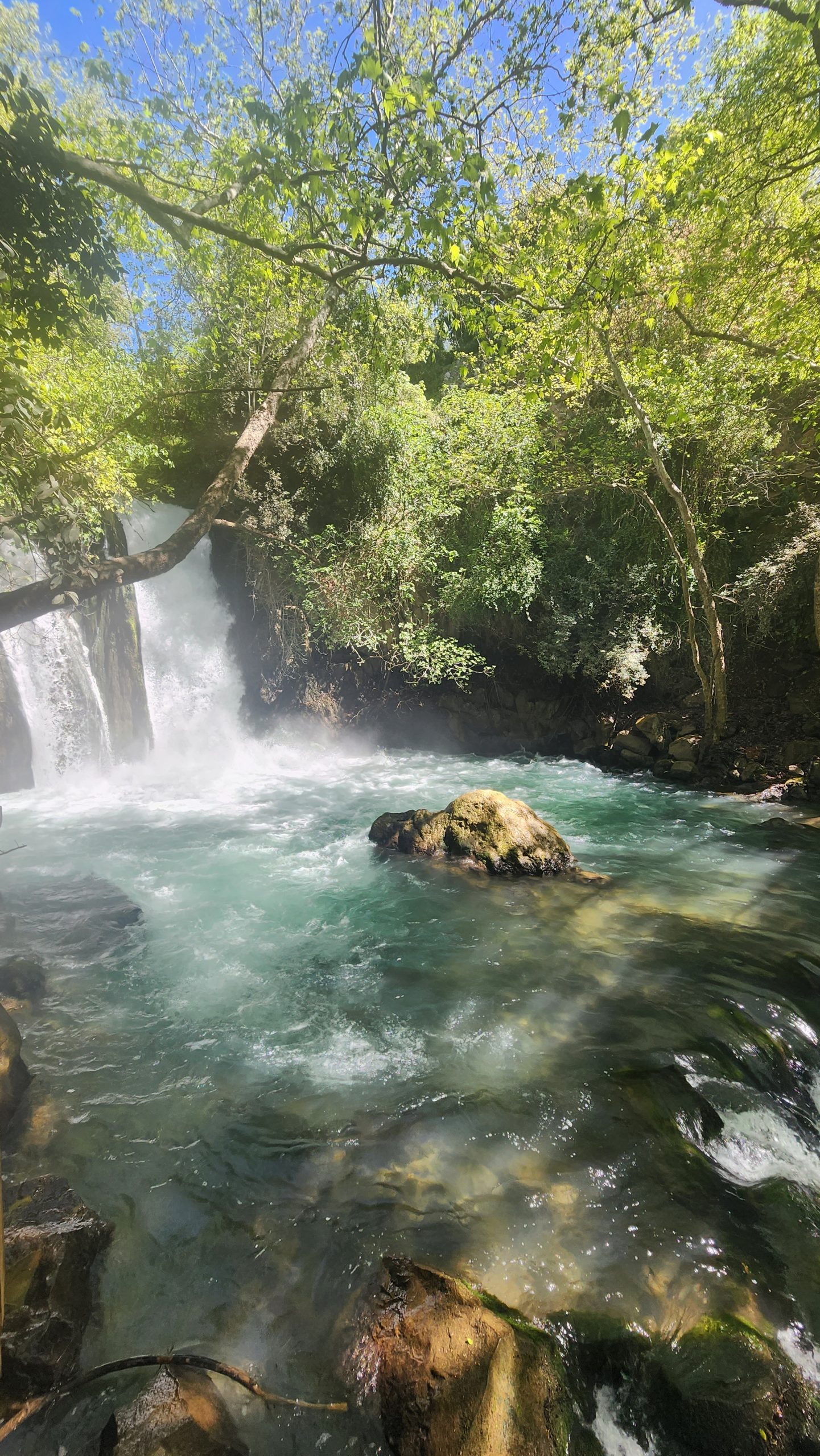
The Banias stream, fed by the springs at the ancient sanctuary, rushes along the Banias Suspended Trail through one of Israel’s most dramatic gorges before plunging over a 10-meter basalt cliff to form the Banias Waterfall, the most powerful waterfall in the country. The Hermon Stream Nature Reserve that surrounds this gorge is a world apart: dense plane trees and willows, ferns clinging to spray-soaked rock, and the constant roar of water in a landscape otherwise dominated by the dry volcanic plateau of the Golan Heights. This is one of the must-visit natural sites in all of Israel, and the Suspended Trail that threads along the cliff face above the gorge makes it one of the most exciting hikes in the country.
The Waterfall: Israel’s Most Powerful
The Banias Waterfall drops a full 10 meters into a churning pool at the base of a basalt cliff, surrounded by ferns, overhanging plane trees, and mist-dampened rock. It is not the tallest waterfall in Israel, that distinction belongs to the falls at Gamla, but it is by a significant measure the most powerful, and the difference is something you feel the moment you step into the gorge. The volume of water crashing through Nahal Hermon (the Banias stream) is remarkable year-round, but in winter and early spring, after snowmelt from Mount Hermon begins feeding the springs above, the falls become something altogether extraordinary. The sound reaches you long before the waterfall comes into view. The spray hangs in the air. The pool at the base foams white. In peak flow, the force of the water is visceral, you feel it in your chest. Even in the dry heat of summer, when much of the Golan bakes under a white sky, the air inside this gorge remains cool and the water never stops.
A Source of the Jordan River
The water in the Banias stream does not simply come from a spring. It descends from the slopes of Mount Hermon, where winter snowpack slowly releases through rock and soil into a complex aquifer system. The Banias spring, which feeds this stream, is one of three principal headwaters of the Jordan River, the others being the Dan spring to the west and the Hasbani (Snir) river rising to the north. These three streams merge on the floor of the Hula Valley to form the Jordan, which then flows south through the Sea of Galilee and on down to the Dead Sea. Standing at the Banias Waterfall, you are standing above water that will eventually reach the lowest point on earth. The Jordan’s journey begins here, in snowmelt and springs, in the cold clear water of Nahal Hermon cutting through basalt.
The headwaters geography explains why this watershed has been strategically significant for generations. Water in this region is not merely scenery. It is survival.
The War Over Water
In the mid-1960s, beginning in 1964, Syria undertook an engineering project intended to divert the Banias and Hasbani headwaters away from Israel, rerouting them before they could reach Israeli territory. The goal was to deny Israel a critical portion of its fresh water supply and to undermine the National Water Carrier then under construction. Israel regarded the diversion as an existential threat and responded by bombing the Syrian engineering works from the air, in 1965 and again in 1967. The project was abandoned. This confrontation over the Jordan headwaters became one of the sustained escalations that contributed to the tensions preceding the June 1967 Six-Day War, what historians have called the “War Over Water.” When Israeli forces captured the Golan Heights during that war, securing the Banias headwaters was among the strategic objectives. The water flowing through this gorge today carries that history with it. It is worth understanding before you visit.
The Suspended Trail (Shvil Talui)
The Suspended Trail, Shvil Talui in Hebrew, is unlike any other hiking experience in Israel. Metal walkways are bolted directly into the basalt cliff face above the Banias stream gorge, carrying you along the rock wall with nothing but air and rushing water between you and the riverbed below. At certain points the trail passes over the gorge on elevated crossings, and you look straight down into the white-green water crashing over boulders. The basalt walls rise on either side, draped with ferns and moss fed by the constant spray. The experience is both exhilarating and beautiful in equal measure, one of those places where the engineering required to get visitors into a landscape only makes the landscape more dramatic.
The trail was closed for an extended period for major renovation and safety upgrades, and the reopened version is significantly improved: the walkways are solid, the railings are secure, and the route is well-signed throughout. Its reputation as one of the most exciting hikes in the country is fully deserved. Visitors with a fear of heights should know in advance that sections of the trail involve looking directly down into the gorge, it is not a hidden challenge. But for those who can embrace it, the Suspended Trail is the defining experience of any Banias visit.
The Hermon Stream Nature Reserve
The waterfall and the trail sit within the Hermon Stream Nature Reserve (Nahal Hermon), one of the lushest protected areas in Israel. The contrast between the interior of the reserve and the plateau above is startling. On the Golan Heights, the landscape is largely open, rolling basalt fields, agricultural land, wide sky. Step down into the gorge and the world closes in. Plane trees with their distinctive mottled bark arch over the stream. Willows trail their branches into the current. Ferns cover every wet surface. The sound of running water is constant. In spring, wildflowers appear in the shade of the canopy. Birds that require riparian habitat, kingfishers, warblers, herons, are regularly spotted along the stream. The reserve is a genuine ecological sanctuary, and the trail through it gives visitors unhurried access to a microhabitat that is invisible from the road above.
Trail Options and What to Expect
There are two main approaches to this site, and they suit different schedules. The short walk from the lower parking area to the waterfall and back takes roughly 30 minutes and is suitable for most visitors, including families with younger children. The path is well-maintained and the waterfall is the clear destination. For those with more time and energy, the longer route incorporates the Suspended Trail, connecting the lower waterfall area to the upper part of the reserve near the Banias sanctuary and archaeological site. This full circuit covers approximately 3 kilometers and takes around two hours at a comfortable pace, with some stairs, uneven terrain, and the elevated walkway sections along the cliff. The trail is well-marked throughout. Wear shoes with grip. In winter and spring, expect spray and wet surfaces near the falls.
Visit with Hoshen Tours
Hoshen Tours pairs the waterfall and Suspended Trail with the Banias sanctuary for a complete experience of this remarkable site, often combining the full Banias visit with Tel Dan and a broader Golan Heights itinerary. The combination of natural drama, ancient history, and the layered story of water in this region makes Banias one of the most rewarding stops on any northern Israel tour.
Visitors exploring the Golan Heights often combine Banias Suspended Trail with nearby destinations such as Banias, Nimrod Fortress, and Mount Hermon, each offering its own distinctive perspective on the region’s layered history and landscape. A broader itinerary might also include Birkat Ram and Nahal Meshushim, both within easy reach and rich in their own right.
Every Hoshen Tours itinerary is private and fully customizable. Contact us to begin planning your journey through the Golan Heights.
Explore Our Tour Collection
Ready to experience Israel in true colors?
Plan Your TourPrivate tours designed around your interests, schedule, and pace.