



Banias: The Spring and Its Geography
At the southwestern foot of Mount Hermon, where Israel’s tallest peak rises to over 2,200 meters, the ancient site of Banias occupies one of the most striking landscapes in the entire country. The spring of Banias is one of the three principal sources of the Jordan River, alongside the springs at Tel Dan and the Hasbani River to the north. For thousands of years, water has emerged here from the porous limestone rock of Hermon’s base, fed by snowmelt and rainfall that percolates through the mountain’s karst geology before resurfacing in powerful, year-round flows.
The contrast at Banias is dramatic. Above, the rocky flanks of Mount Hermon rise steeply, often capped with snow well into spring. Below, the abundant water creates a world of lush, almost subtropical vegetation — towering plane trees, Atlantic pistachios, Syrian ash, and dense undergrowth fed by the constant moisture. Fig trees and wild grapevines cling to the rock faces near the spring’s mouth. The air is noticeably cooler here than in the valleys to the south, and the sound of rushing water fills the gorge. It is easy to understand why ancient peoples considered this place sacred — the sheer force of water bursting from solid rock must have seemed miraculous, a gift from the gods dwelling within the mountain. Even today, the volume of water at Banias is remarkable: the spring contributes roughly a quarter of the Jordan River’s total flow, making it one of the most important freshwater sources in the region.
Pan and the Gates of the Underworld
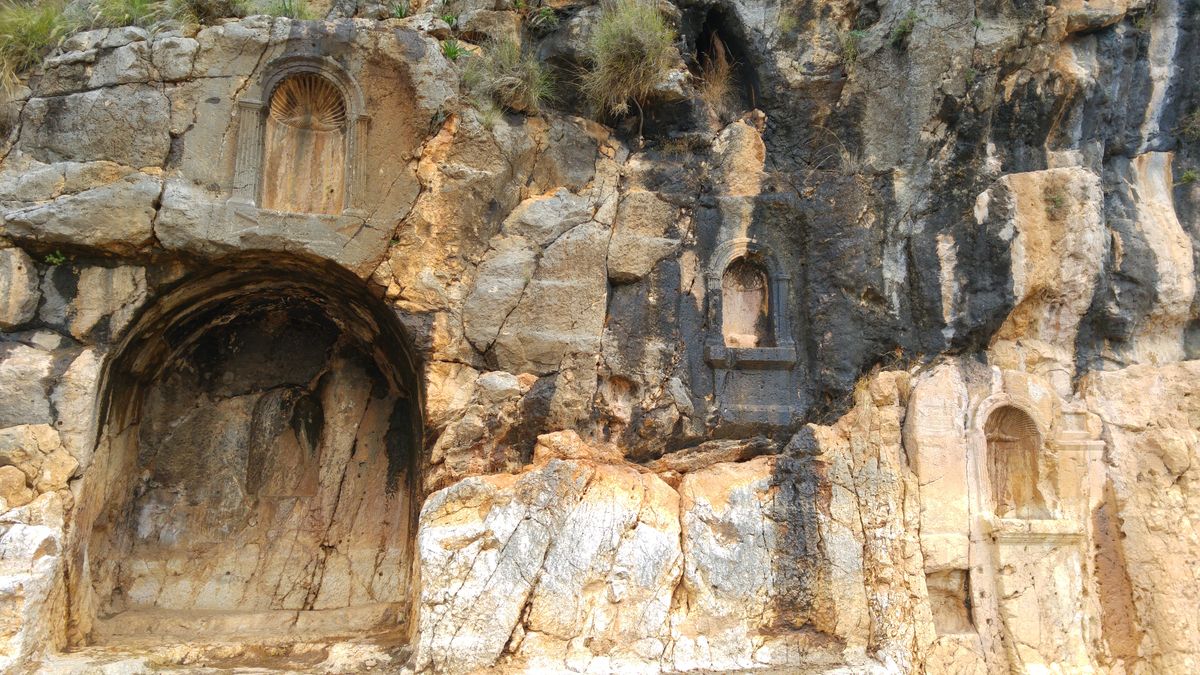
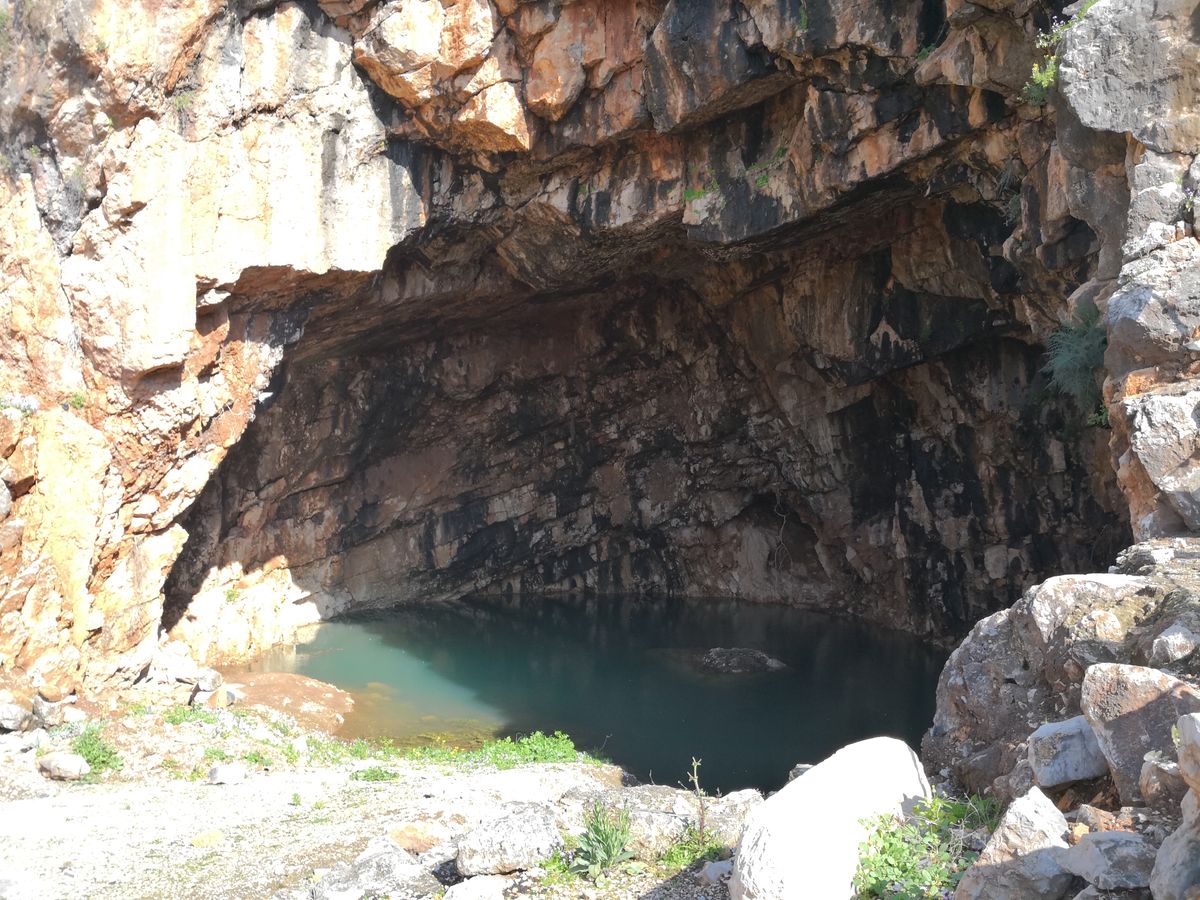
The name Banias is an Arabic adaptation of the Greek name Paneas, itself derived from Pan, the Greek god of shepherds, flocks, and wild nature. When Hellenistic culture spread across the Near East following the conquests of Alexander the Great in the fourth century BCE, Greek settlers and soldiers recognized this dramatic cave and spring as a fitting home for Pan. The large cave at the base of the cliff, from which the spring once flowed before an earthquake shifted its course, became a center of Pan worship. Niches carved into the rock face beside the cave once held statues of Pan and other deities, and their Latin and Greek inscriptions remain visible to this day.
The cave itself held a deeper significance. Ancient writers described a pool of seemingly bottomless water inside the grotto, and the belief arose that the cave was an entrance to the underworld — a passage to the realm of the dead. The phrase “the gates of Hades,” familiar to readers of the New Testament, may well have resonated with anyone standing before this very cave. The rock face, riddled with niches for cultic offerings, the dark mouth of the cavern, and the roar of water from unseen depths — all of this contributed to an atmosphere of awe and mystery that persists even today. Visitors can still walk up to the cave mouth and see the carved niches, some bearing inscriptions dedicated to Pan, Echo, and other figures of Greek mythology.
Caesarea Philippi and the Gospel
In 20 BCE, the Roman emperor Augustus granted this territory to Herod the Great, who built a white marble temple near the cave and dedicated it to his patron. After Herod’s death, his son Philip inherited the region and transformed the settlement into a proper Greco-Roman city, renaming it Caesarea Philippi — “Philip’s Caesarea” — to distinguish it from the coastal city of Caesarea Maritima. The city became the administrative capital of Philip’s tetrarchy and grew into a prosperous urban center with temples, markets, and a palace.
It is in this setting, according to the Gospel of Matthew, that one of the most significant exchanges in the New Testament is believed to have taken place. Matthew 16:13–18 describes Jesus bringing his disciples to the district of Caesarea Philippi, where he asked them, “Who do people say the Son of Man is?” Simon Peter answered, “You are the Messiah, the Son of the living God.” According to the text, Jesus responded: “You are Peter, and on this rock I will build my church, and the gates of Hades will not overcome it.” Many scholars and pilgrims have noted the powerful symbolism of this declaration being set here — before the great rock cliff, beside the cave long considered an entrance to the underworld. Whether Jesus was deliberately drawing on the imagery of the place or the Gospel writer chose the location for its theological resonance, the connection between the physical landscape and the words of the text remains one of the most discussed questions in New Testament geography.
The Palace of Agrippa II
Among the most impressive discoveries at Banias is the palace of Agrippa II, the last king of the Herodian dynasty. Agrippa II inherited the territory from his father, Agrippa I, and ruled from roughly 50 to 100 CE. He expanded and embellished Caesarea Philippi, renaming it Neronias in honor of the Roman emperor Nero. The palace complex uncovered by archaeologists is a massive structure that reflects the wealth and ambition of his reign. Excavations have revealed grand reception halls, elaborate frescoes painted in Roman style, ritual bathing pools, and a sophisticated system of water channels that drew on the abundant spring to supply fountains and pools throughout the building.
Agrippa II is a figure well known to readers of the New Testament. In Acts 25–26, the apostle Paul, held as a prisoner in Caesarea Maritima, is brought before Agrippa II to make his legal defense. The king reportedly told Paul, “Do you think that in such a short time you can persuade me to be a Christian?” For visitors walking through the remains of the palace at Banias, the connection is tangible — this is the seat of power of the very king described in the Book of Acts. The frescoed walls and paved floors offer a rare, physical glimpse into the life of a ruler who straddled the Jewish and Roman worlds during one of the most transformative periods in history.
The Archaeological Site
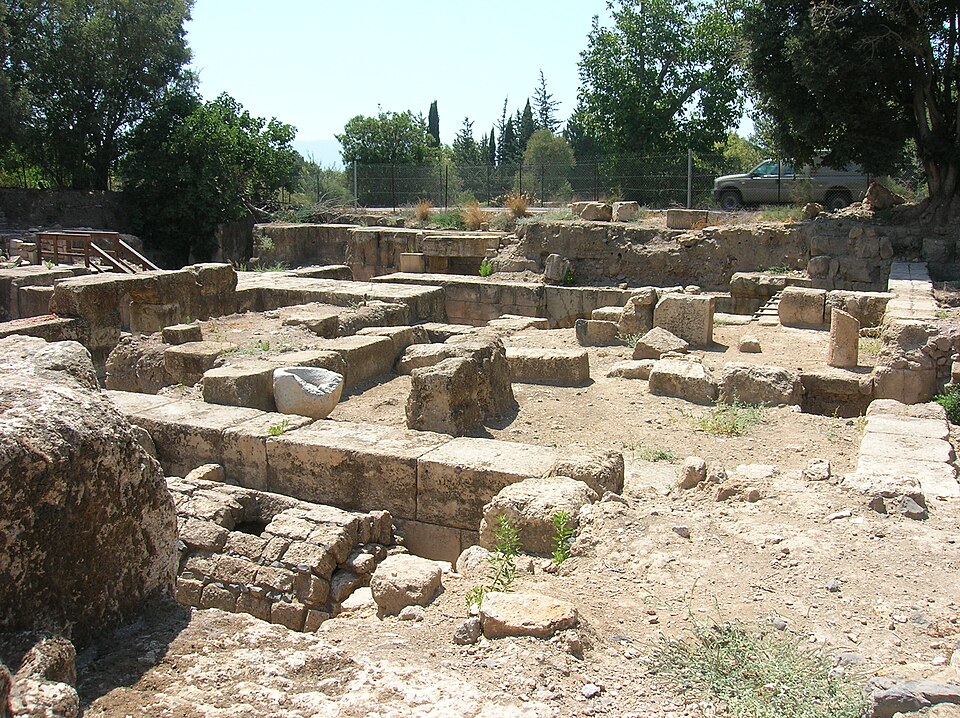
Today, the archaeological park at Banias preserves remains spanning more than two thousand years of continuous habitation and worship. The sacred precinct near the cave includes the carved niches of the Pan cult, the foundations of Herod’s temple to Augustus, and a later Roman-period temple known as the Temple of Zeus. Nearby, a large open-air court of Pan and the Goats, with a raised platform, served as a gathering place for rituals and festivals. Visitors walking through the site can trace the layers of history — from Hellenistic cult worship through Roman urbanism, Byzantine Christianity, and the medieval period.
The city’s layout is still legible in the landscape. A colonnaded street, or cardo, once ran through the center of the Roman city, flanked by shops and public buildings. Sections of the street and its drainage system have been excavated. A Byzantine-era church was built over part of the earlier pagan precinct, reflecting the Christianization of the site in the fourth and fifth centuries. Throughout the park, informative signs guide visitors through the different periods, making Banias one of the best-interpreted archaeological sites in northern Israel. Coins, pottery, oil lamps, and carved stone fragments recovered during excavations are displayed at local museums and help tell the story of daily life in this frontier city across the centuries.
The Crusader Period
During the medieval period, Banias occupied a position of considerable strategic importance. Situated on the road between Damascus and the coastal cities, it served as a border fortress contested by Crusader and Muslim forces for generations. The Crusaders, who knew the site as Belinas, fortified it and recognized its value as a gateway to the upper Jordan Valley and the Galilee. Control of Banias changed hands multiple times during the twelfth century — the Crusaders held it, lost it to the Fatimids, recaptured it with the help of the Assassin sect, and ultimately lost it again to Nur ad-Din in 1164.
The remains of the Crusader-era fortifications are still visible at the site today. Sections of thick defensive walls, built from the local basalt stone, stand among the trees near the spring. A Crusader tower and gate complex can be traced in the ruins, and the massive walls of the hilltop fortress of Nimrod — known as Qal’at al-Subeiba — loom on the ridge above Banias, serving as a reminder of the intense military rivalry that defined this region for nearly two centuries. Visitors who look up from the archaeological park can see the fortress silhouetted against the sky, one of the largest and best-preserved medieval castles in the Middle East. Together, the ruins at Banias and the fortress above paint a vivid picture of the military and political struggles that shaped the Levant during the age of the Crusades.
The Banias waterfall and the Suspended Trail are located nearby along the Hermon Stream. For details, see our page on the Banias Waterfall and the Suspended Trail.
Visit with Hoshen Tours
Banias is one of the most rewarding stops on a tour of northern Israel, combining ancient history, biblical significance, and outstanding natural beauty in a single location. With Hoshen Tours, a visit to Banias is typically part of a full-day Golan Heights itinerary that may also include Tel Dan, the Nimrod Fortress, and the viewpoints overlooking the Hula Valley. The site is suitable for visitors of all ages and interests — families with children enjoy the waterfall trail, while history enthusiasts and pilgrims are drawn to the archaeological park and its connections to the Gospels.
Visitors exploring the Golan Heights often combine Banias with nearby destinations such as Mount Hermon, Nimrod Fortress, and Banias Suspended Trail, each offering its own distinctive perspective on the region’s layered history and landscape. A broader itinerary might also include Birkat Ram and Majrase, both within easy reach and rich in their own right.
The waterfall trail is of moderate difficulty, with some uneven terrain and steps, and is best enjoyed in comfortable walking shoes. The ideal seasons to visit are spring, when snowmelt swells the stream and wildflowers carpet the hillsides, and autumn, when the air is crisp and the foliage begins to turn. Summer visits are also popular, as the shade and water provide welcome relief from the heat. Shuki Cohen, founder of Hoshen Tours and a licensed Israeli tour guide, brings decades of experience in making sites like Banias come alive — connecting the archaeology, the landscape, and the ancient texts into a story that stays with visitors long after they leave. Contact us to plan your private tour of the Golan Heights and northern Israel.
Explore Our Tour Collection
Ready to experience Israel in true colors?
Plan Your TourPrivate tours designed around your interests, schedule, and pace.