



Tel Azekah is a fortress city on the western ridge of the Ella Valley, guarding the entrance to the valley system from the coastal plain. Azekah appears in the Bible in connection with two of the most dramatic military events in Israelite history: Joshua’s conquest and the last days of the Kingdom of Judah.
Joshua’s Battle
During the Israelite conquest, Joshua pursued the Amorite kings after the battle at Gibeon, and God intervened with both hailstones and a cosmic miracle: “The Lord hurled large hailstones down on them, and more of them died from the hail than were killed by the swords of the Israelites.” Then Joshua spoke to the Lord: “Sun, stand still over Gibeon, and you, moon, over the Valley of Aijalon.” And the sun stood still and the moon stopped until the nation avenged itself on its enemies (Joshua 10:11-13). The pursuit continued “to Azekah and Makkedah,” placing this tell at the endpoint of one of the Bible’s most spectacular narratives. The route of the pursuit ran downhill from Gibeon through the Beth Horon pass and then southwest along the valley roads toward the Shephelah. That the fleeing Amorite kings were chased all the way to Azekah shows just how far Joshua’s forces pressed their advantage, covering a distance of roughly 30 kilometers from the highlands down to the foothills. Azekah marked the point where the lowlands began and the pursuit reached its end.
David and Goliath
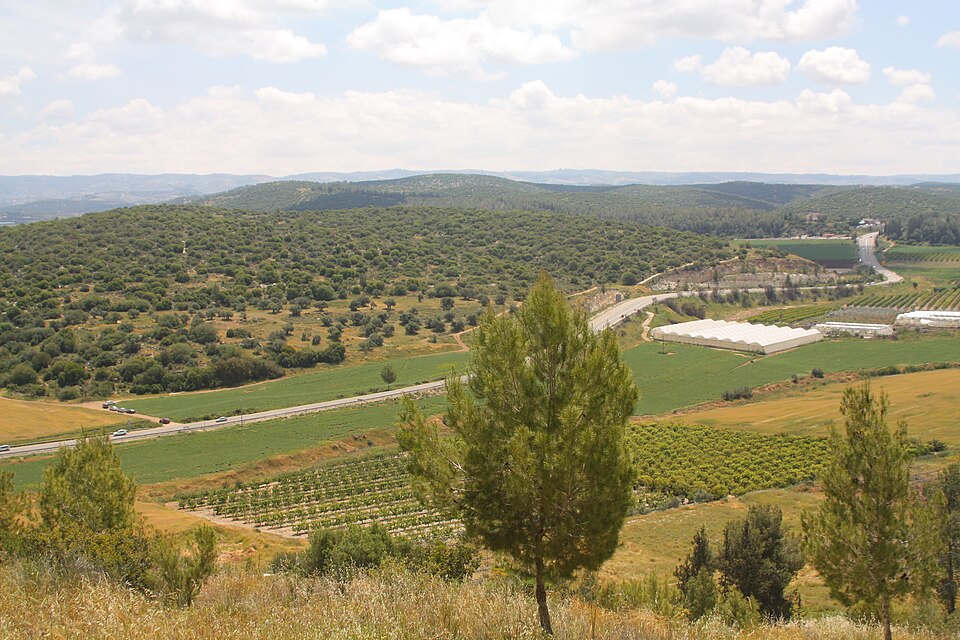
Azekah is one of the two cities named as the Philistine camp position during the David and Goliath encounter: “Now the Philistines gathered their forces for war and assembled at Sokho in Judah. They pitched camp at Ephes Dammim, between Sokho and Azekah” (1 Samuel 17:1). From the top of the tell, the entire Ella Valley is visible, and the positions of both armies can be traced on the landscape. The Philistines, according to the biblical account, camped on the southern ridge between Sokho and Azekah, while the Israelites under King Saul took position on the opposite hill to the north. The valley floor between them — the Nahal Elah streambed — was the no-man’s land where Goliath issued his challenge for forty days.
Standing on Tel Azekah, you can see Tel Sokho directly across the valley, the streambed where David is said to have picked his five smooth stones, and the gentle slope where the two armies would have faced each other. It is one of the rare biblical narratives where the geography fits the text with remarkable precision, and a guide who knows how to read the landscape can bring the story to life in a way that no book ever could. The Ella Valley has become one of the most popular sites in Israel for visitors who want to understand the Bible through the land itself.
Last Days of Judah and the Lachish Letters
Azekah was one of the last cities to fall before the Babylonian destruction of Jerusalem in 586 BCE. The prophet Jeremiah records the final stand: “The army of the king of Babylon was fighting against Jerusalem and against all the cities of Judah that were left, Lachish and Azekah. These were the only fortified cities remaining in Judah” (Jeremiah 34:7). The Lachish Letters confirm this: “We are watching for the fire signals of Lachish… because we cannot see Azekah.” Azekah had already fallen. Its signal fire was dark. The Lachish Letters are a collection of ostraca (ink-on-pottery inscriptions) found at Tel Lachish, written by a military officer at an outpost to his commander during the final Babylonian campaign. Letter IV, which contains the reference to Azekah, is one of the most haunting documents in biblical archaeology. The writer reports what he can and cannot see, and the absence of Azekah’s fire signal tells the reader everything: the chain of Judean fortresses was collapsing one by one, and the end was near.
The View from the Summit
Recent excavations by Tel Aviv University and the Lautenschlager Azekah Expedition have uncovered fortifications, a water system, and artifacts spanning from the Late Bronze Age to the Persian period. The views from the summit are among the finest in the Shephelah, encompassing the Ella Valley, the coastal plain, and on clear days, the Mediterranean Sea. Looking east up the valley, the terrain rises toward the Judean highlands and the road to Bethlehem and Jerusalem. Looking west, the valley opens toward the coastal plain and the territory of the ancient Philistines. The panorama ties together the full sweep of Azekah’s biblical story, from Joshua’s pursuit to the Babylonian siege, in a single view.
Visit with Hoshen Tours
Tel Azekah offers a panoramic view of the Ella Valley, the very landscape where the story of David and Goliath unfolded. Standing at the top of the tell with Hoshen Tours, visitors can see the Philistine camp, the Israelite positions, and the valley floor between them, making the biblical account vivid and geographical. The view from this vantage point is one of the finest in the Judean foothills. Combine it with the Ella Valley, Khirbet Qeiyafa, Tel Sokho, and Tel Zafit (Gath).
Explore Our Tour Collection
Ready to experience Israel in true colors?
Plan Your TourPrivate tours designed around your interests, schedule, and pace.